


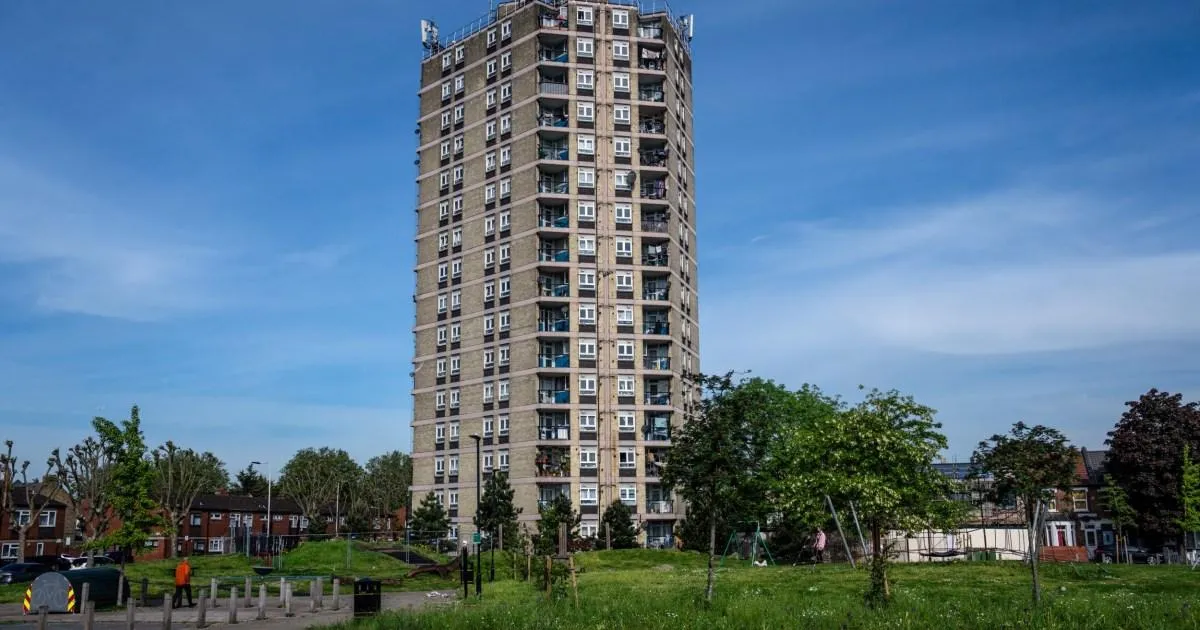
The tragic death of five-year-old Aalim Ahmed, who fell from the 15th-floor kitchen window of his family’s council flat in Plaistow, east London, has cast a long and painful shadow over an inquest that seeks to understand how such a devastating loss could have occurred. His mother, Sahra Osman, has used the platform of the coroner’s court to express her profound grief and anger, stating unequivocally that her son “could have been here” if the local council had taken her repeated safety concerns seriously. The family’s life was shattered in the early hours of May 16, 2024, when Aalim’s father made the harrowing discovery of his son’s body on the railings at the bottom of the residential block. The incident has brought into sharp focus the precarious reality of families housed in high-rise buildings with inadequate safety measures and has left a community in mourning.
From the moment the family was offered the flat in Jacobs House, Sahra Osman was consumed by fear and horror. She knew immediately that the top-floor apartment with outstanding repairs was an unsuitable and dangerous environment for her two young children, particularly Aalim, who had autism and, as she described, “no sense of danger.” Her concern was not a matter of mere preference but a fundamental issue of safety. Despite her profound misgivings, she felt cornered by the system. She told the Walthamstow Coroner’s Court that she was advised to accept the property and raise her complaints after moving in, rather than refuse it and risk being made homeless. This coercive dilemma placed a mother in an impossible position, forcing her to choose between a roof over her children’s heads and their immediate physical safety. It was a choice no parent should ever have to make, and it set the stage for the unimaginable tragedy that was to follow.
The heart of Sahra’s testimony centered on the faulty window restrictors that she claims made the family’s living situation untenable. She described the windows as having “faulty” safety devices and recounted how her repeated complaints to the council were met with inaction. Her distress was palpable as she described how the bedroom window could be left “just wide open,” a fact that terrified her daily. On one occasion, an engineer visited to address the issue, but within a day of his visit, she found a window restrictor lying on the floor, proving the fix was either ineffective or had completely failed. She called the council again, desperate to speak to a manager, stressing that this was a critical safety issue for her children. However, she felt her pleas were not treated as the emergency they were, and the systemic negligence she perceived has become a central and agonizing theme of the inquest.
The night of the tragedy unfolded with a terrifying swiftness. The family had gone to bed with the windows closed, as was their routine. They were all abruptly woken by the screams of their toddler, who was shouting Aalim’s name, “window,” and “outside.” The chaos and confusion of that moment are almost impossible to comprehend. Sahra described how her partner rushed to the kitchen window and was met with a sight that would haunt him forever. He was “just crying and screaming in shock” upon seeing his son’s pyjamas below. For Makail Ahmed, the moment was one of utter “disbelief – it was a nightmare.” He raced down the stairs to the ground floor, where he found his son and was met with the full, brutal reality of their loss. The couple’s desperate attempt to understand the sequence of events led them to believe that Aalim may have been climbing towards a cupboard, perhaps in search of a biscuit, when he fell.
The inquest proceedings have become a battleground of conflicting narratives around the responsibility for the maintenance and safety of the flat. Sarah Osman maintains that she explicitly told the workmen about problems with the restrictors in all rooms, including the kitchen where the fatal fall occurred. The council’s representative suggested that the engineer had only been informed of issues in the living room, not the kitchen. Sarah fiercely rejected this account, accusing the council of not taking her situation seriously and failing to do their job. In a devastating moment of direct address, she told the council’s representative, “If you people did your job seriously and done what you should have my son could have been here. It was preventable.” She also refuted any suggestion that she might have forced the window open to manage the heat in the flat, maintaining that the entire situation was a result of negligence and a failure to protect her vulnerable son.
The inquest, presided over by assistant coroner Ian Wade, is now tasked with unearthing the facts surrounding the death, a process that carries the heavy weight of a family’s grief and a community’s demand for answers. In his introductory comments, the coroner acknowledged the “horrendous loss borne by Aalim’s family and indeed the community,” recognizing the profound impact of this tragedy. He stated that it was “very conscious that this should never have happened,” but that the exact manner in which it occurred “remains to be seen.” These words underscore the purpose of the proceedings: to navigate the complex details of the case, from the family’s housing situation and the condition of the windows to the council’s response to their complaints. The central question is not just how Aalim fell, but why such a preventable tragedy was allowed to happen, and whether a familiar, desperate plea for help was ignored until it was too late. The hearing continues, but the weight of the grief and the search for accountability remains a heavy burden for all those involved.