


On a quiet late-summer night, when the streets of Salisbury and the lanes of rural Wiltshire were hushed in deep slumber, an improbable journey was about to unfold—one that would leave a trail of shattered wood, broken wires, and a community in disbelief. A 12-year-old boy, whose name has been withheld for legal and compassionate reasons, made a decision that would baffle investigators and residents alike: he climbed behind the wheel of his mother’s white Volkswagen Tiguan, started the engine, and drove off into the darkness. His destination, according to police, was not a friend’s house or a late-night shop; it was simply away. For 38 miles, with little more than a learner’s confidence and a vivid imagination, the boy navigated the twisting country roads and main arteries connecting Salisbury in Wiltshire to Horton Heath in Dorset. It was nearly 2 a.m. when the roads were at their most desolate, and the headlights of the SUV cut through the misty hedgerows as the boy pressed onward, perhaps feeling the thrill of forbidden freedom or the weight of a decision already made. No one knows exactly what went through his mind during that hour-long drive, but the consequences of that recklessness would soon become starkly apparent, pulling his young life—and the peaceful residents of a quiet suburban road—into an unexpected drama.
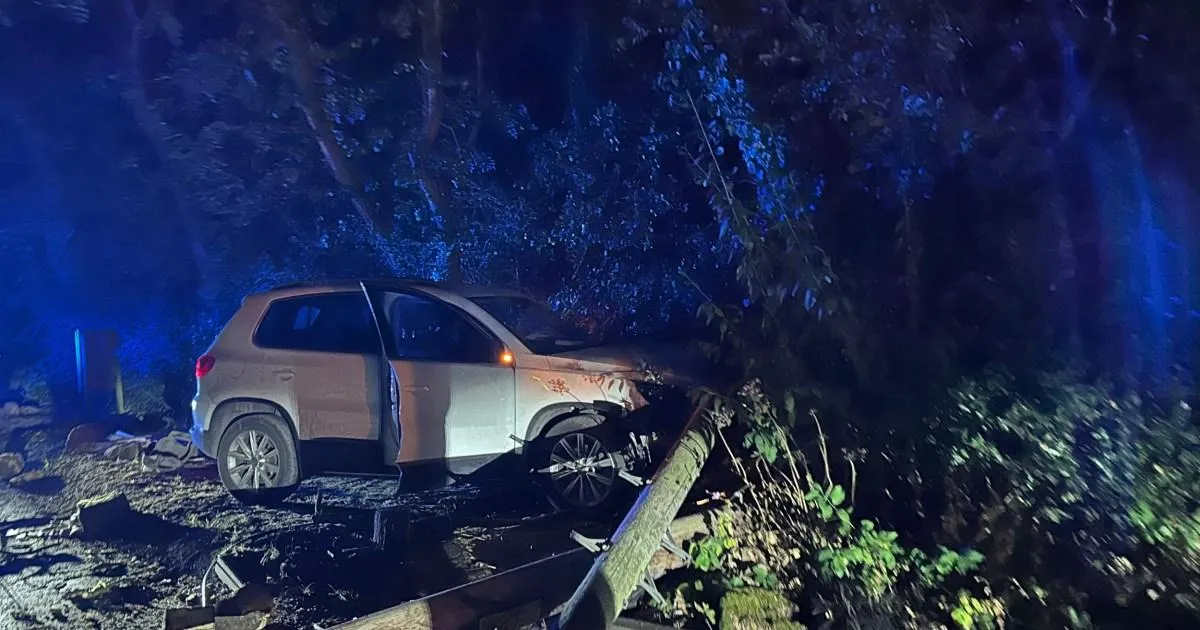
The first sign of trouble came at 2 a.m. when the Tiguan, for reasons yet to be determined, veered off Horton Road in the village of Horton Heath and ploughed into a wooden telegraph pole with a sickening, jarring crunch. The impact was deafening in the silence of the night, sending a spiderweb of cracks across the windscreen and leaving the front of the car crumpled like paper. The telegraph pole, a veteran of countless storms and summer heatwaves, snapped at its base and toppled over, dragging down live wires that danced dangerously across the wet grass like sinister electric eels. Inside the wrecked vehicle, the boy sat dazed but miraculously alive, suffering only minor injuries and cuts. As the last echoes of the crash faded, a new sound rose—the sharp crackle of electricity arcing, the hiss of fluid from a ruptured radiator, and the eerie quiet of a neighbourhood sleepily stirring in confusion. He had managed to travel 38 miles without incident, only to lose control on the final stretch of a journey that no one could explain. The road, usually lined with cars and the comfortable mundanity of everyday life, was now a hazard zone of twisted metal, shattered glass, and the acrid smell of burned rubber.
For Lorraine and Matthew Tricksey, the night began with a violent jolt. Living just feet away from the crash site, they were jolted from their sleep by a sound that they would later compare to a low-flying aircraft or a thunderclap in the middle of a clear sky. “We woke up suddenly at 2 a.m., I think that was the impact,” Lorraine recounted from her living room, her eyes still carrying the weary shadows of the past few days. “We suddenly realised we were in complete darkness, which was because the telegraph poles had been knocked down and our electricity was out.” The absence of light, combined with the disorienting shock of being wrenched from sleep, filled them with a primal fear. Through their flimsy curtains, they could make out muffled voices and, more disturbingly, laughter. It sounded, she said, like a wild party had erupted on their front drive. Peter and his wife huddled together, their imagination running wild, too frightened to even call the police for fear of drawing attention to themselves. “All we could hear outside was laughing; it sounded like a drunken party in our front drive, we weren’t sure what to do because we didn’t know who it was,” she admitted. They eventually managed to call the authorities, and the next forty minutes stretched out like an eternity, with every creak of the house sending a fresh spike of adrenaline through their veins.
When the police finally arrived and the full picture emerged, the Trickseys followed the officers outside, careful to avoid the scattered debris and the raw, exposed power lines that still hummed menacingly. It was only then that they saw the wreckage for what it was: not a random drunk driver, but a child. The boy, they were told, was only 12 years old. “He’s lucky he walked away from it,” Lorraine said, shaking her head in bewilderment. “They got his mum to come and pick him up, so he didn’t even get taken off in the police car.” The maternal nonchalance of that final detail seemed to strike her: a 12-year-old boy, who had just survived a serious car crash after a 38-mile joyride, would probably have to face his mother’s fury eventually, but the police ensured no criminal charges would follow immediately. Meanwhile, the physical aftermath was far from over. The impact had cut power to nearby homes, and engineers worked around the clock to re-erect the poles and rewire the system. For the Trickseys, the practicalities were daunting: no fridge for fresh milk, no stove to cook dinner, and, perhaps most painfully, no WiFi. They were forced to invest in a generator to keep their freezer running, a small mercy, while the remains of the VW Tiguan sat in their driveway for two days, a monstrous, crumpled monument to the night’s chaos. “We’ve still got the car stuck out there; it’s a hell of a mess and blocking our driveway, and we can’t get hold of the police,” Mrs. Tricksey added, a note of frustration creeping into her voice.
As the sun rose higher over Horton Heath on the morning after the crash, the full scale of the incident became clear. The VW Tiguan, once a proud family SUV, was a total loss, its airbags deployed and its front end concertinaed into a tangle of plastic and metal. A trail of oil and coolant snaked away from the crash site, a grim breadcrumb trail for the investigators who arrived to piece together the sequence of events. Dorset Police released a statement confirming that at 2:05 a.m. on August 14, officers were called to a single-vehicle collision on Horton Road. The occupant, a 12-year-old boy, had not sustained serious injuries. He was taken to the hospital by a third party as a precaution and was now assisting officers with their inquiries. The phrase “assisting officers” felt almost comically bureaucratic for a situation that was anything but ordinary—what could a child possibly say to explain away a 38-mile journey in the dead of night? The statement went on to note that no arrests had been made and that investigations were ongoing, leaving more questions than answers. The residents of Horton Road, whose morning routines had been brutally disrupted, were left to clean up the physical and emotional shards. They tended to their gardens, picking up fragments of plastic from the Tiguan’s indicator lights, and swapped stories of other nights of local excitement—an escaped sheep here, a windstorm there—nothing that came close to this peculiar caper.
In the days that followed, as the engineers drilled and the electricity flickered back to life, a strange sense of reflection settled over the community. Strangers on the school run would stop to point out the bare patch of ground where the telegraph pole once stood, a living monument to youthful folly and sheer luck. The boy, whose name the authorities guarded with unusual vigour, had not been arrested, his identity protected by laws that make his family’s relief palpable even in absentia. For the Trickseys, the event morphed from total shock to a more philosophical resignation. “We don’t think the boy was on his own, we think somebody came out and picked up some people,” Lorraine said, floating a theory that others in the area had begun to murmur about. Indeed, the official investigation may yet unearth whether the boy was acting alone or was goaded by friends, and why his destination was so close to the coast. But for now, the only certainties are these: a 12-year-old managed to bypass every parental safeguard, every CCTV camera, and every traffic light to drive 38 miles without being stopped; a community was plunged into darkness and left to sweep up the metaphorical and literal pieces; and a mother received a call she will never forget, from police asking her to collect her son at 3 a.m. It’s a story that will likely be told at family gatherings for years to come, a cautionary tale about the perils of growing up too fast, and a powerful reminder that even in our hyper-connected world, a child can still get away with something as reckless—and as human—as stealing a car for a night drive. As the new telegraph pole is hoisted into place, its wooden frame clean and unblemished, the village of Horton Heath can only wait to see if a road called Horton will ever seem so ordinary again.