

Every honeymoon begins with a sky full of promise. The morning after a wedding is supposed to be the threshold of a new life, a time when the excitement of celebration softens into the quiet intimacy of a beginning. For Alexander Cromie and Marie Ebert, two newlyweds from London, that promise was extinguished before they ever had a chance to feel the Greek sun on their faces. The couple had chosen Greece for their honeymoon, and they were being flown by private helicopter from Athens to the island of Sifnos, one of the quieter treasures of the Cyclades. Sifnos is known for its whitewashed villages, its ancient footpaths, its pottery, and its long, golden evenings; it is the kind of place where newlyweds come to wander along coastal paths and eat seafood beside the sea. But this particular descent would never reach that picture-postcard ending. Moments before the helicopter was due to land at the heliport, something went catastrophically wrong. CCTV footage from a nearby building captured the machine making a loud, unnatural sound before it began to spin violently, out of control, and then smash into a hillside close to the helipad. The pilot, Giorgos Raikos, was an experienced aviator who had served in the Greek Air Force before moving into private aviation. He, too, died in the crash. Police and local officials later spoke of a mechanical failure, the kind of sudden, devastating malfunction that pilots fear most because it leaves no time to react. In a matter of seconds, a routine transfer between Athens and a beautiful island became a scene of horror, and three lives were simply gone.
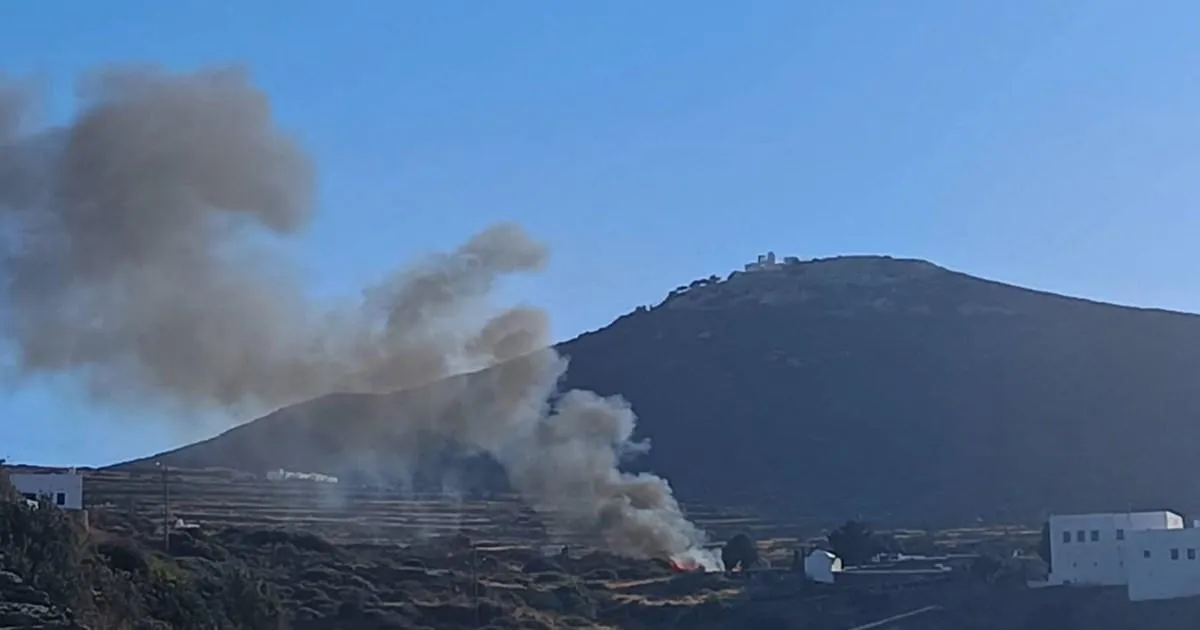
Those who lived on Sifnos knew before the sirens began that something terrible had happened. The sound that echoed across the hillside was unlike the familiar hum of tourist helicopters, and residents who ran to their windows saw black smoke rising from a dry field near the heliport. Deputy mayor Manolis Fountoulakis told local news that there was “nothing left, a shapeless mass” at the crash site, a phrase that captures the obliteration of a machine that had been carrying three living people only seconds earlier. He said the helicopter made a “loud, strange noise, like military aircraft,” and that the failure happened in the air. First responders arrived quickly, but there was nothing they could do except mourn and try to manage the aftermath. They found two bodies in the wreckage of the helicopter and a third body a few yards away, each burned beyond recognition in the fire that followed the impact. The blaze, fed by dry vegetation and aviation fuel, burned fiercely enough to set off an island-wide alarm, and for a time the little island was filled with fear as well as grief. Fire crews eventually managed to prevent the flames from spreading further, and no one on the ground was killed or injured. But the emotional damage was immediate and deep. Mayor Maria Nadali said: “This is a shocking event. We are shocked and are trying to manage, together with the right services, the consequences of this incident next to the helipad.” Her words, spoken in the careful tone of someone trying to hold a community together, betrayed the sadness underneath. An island that prides itself on hospitality had become the site of an unimaginable tragedy.
Behind the official statements and the police reports are two people who, only a few days earlier, had been surrounded by family and friends in celebration. Alexander and Marie were not just names in a news article; they were a son and a daughter, a brother and a sister, two individuals who had found each other and decided to spend the rest of their lives together. They had just exchanged vows, perhaps in a church or a registry office in London, perhaps in front of the people who knew them best. The wedding photographs would still be on their phones, the thank-you notes would not yet have been written, and their honeymoon was meant to be the first peaceful moment of married life, a chance to pause and breathe after months of planning. Instead, they were flown over the Aegean Sea, and then, in a horrifying flash, they were lost. For their families, the grief must be unbearable. The phone call that tells a parent their child has died in a foreign country is one that no one can ever be prepared to receive. The Foreign Office confirmed it was providing support to those affected and was in contact with local authorities, but there are no words that can make sense of this loss. There would be no first anniversary, no holiday photographs to share, no quiet mornings together as an old couple looking back on the day they were married. There is only the terrible arithmetic of a future stolen before it could be lived. Their families will have to navigate the logistics of returning home without them, the paperwork, the flights, the empty seats, and the impossible task of telling their story to people who will ask what happened.
Giorgos Raikos also deserves to be remembered not only as a pilot, but as a man who spent his life carrying others through the skies. A former member of the Greek Air Force, he had the kind of experience and composure that should have been a comfort to everyone who climbed aboard his helicopter. He knew the Greek islands, the winds that move between them, and the particular challenges of landing on small helipads. For him, a journey from Athens to Sifnos would not have been an adventure but a routine act of professionalism, a chance to give his passengers a gift of time and a spectacular view. He died doing a job he was trained to do, and his death is a loss to his own family and friends as well as to the aviation community. The location of the crash adds an extra layer of sadness. The helipad was in the middle of an arid field, close to the sea but somehow isolated, a patch of dry earth in a landscape that has known many summers. That field, ordinarily empty and quiet, became the final destination for three people. In the aftermath, investigators will sift through debris and study the mechanics of the helicopter, looking for the specific failure that caused the spin. Their findings may bring some closure to the families, or they may simply deepen the tragedy by confirming how little anyone could have done. Either way, the human cost is already clear. A private honeymoon flight, meant to be a memory of a lifetime, became a nightmare that no one on the island will forget.
Tragedy has a way of repeating itself in the same season. Earlier this month, two people were killed in another helicopter disaster that unfolded over the Greek mainland, and the footage of that crash was still fresh in the public mind when the Sifnos accident occurred. The earlier incident happened above wildfires in the Psatha region, on the Gulf of Corinth west of Athens, where helicopters were being used to fight fires that had been spreading through dry countryside. A video recorded the moment when one helicopter clipped the rotary blade of another below, sending it into a terrifying death spiral before it exploded into flames. That crash killed a Danish pilot and a Greek fire service liaison officer. A British pilot and a Greek crew member miraculously survived and were taken to hospital with injuries. The two crashes are not the same: one was a mid-air collision during an emergency operation, the other appears to have been a sudden mechanical failure on a private transfer. But together they cast a shadow over Greek aviation and over the summer months in which helicopters are such a familiar sight across the country. They also remind us that helicopters, for all their beauty and convenience, are machines operating under enormous forces, and that the sky, so often seen as a place of freedom, can also become a place of danger. For local people and emergency workers, the images of burning wreckage have become an unforgettable part of the season’s soundtrack, a reminder that while the islands are places of peace, the world around them is fragile.
In the end, we are left with images and questions, and with the difficult task of holding grief in one hand and hope in the other. A honeymoon is one of the most hopeful things two people can do. It is a statement to the world that they believe in the future, that they have chosen each other, and that they plan to build something enduring. Alexander and Marie made that choice. They travelled all the way to Greece to begin their marriage, and in the course of that journey, they were taken from their families with a suddenness that defies comprehension. The island of Sifnos, so small that everyone hears everything, has been shaken to its core. The helipad, once a simple point of arrival and departure, will now be associated with sirens and smoke and loss. But the couple’s love will not be erased by the fire. The vows they exchanged, the promises they made, the joy they carried onto that helicopter—these are not destroyed. They remain with the people who loved them, and they remain in the gentle memory of a place that was supposed to welcome them. In the coming weeks, there will be memorial services, tributes, flowers placed near the crash site, and quiet tears in London and in Greece. There may also be investigations that reveal more about what went wrong. But no report will ever be able to explain away the unfairness of a newlywed couple losing their chance at a lifetime together. Perhaps the most humane response we can offer is simply to hold them in memory: Alexander, Marie, and Giorgos, three people whose lives intersected for a few tragic minutes over the Aegean, and who are now part of the island’s history and of the hearts of those who mourn them.