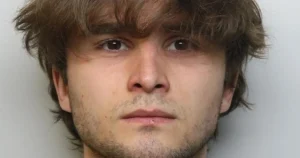
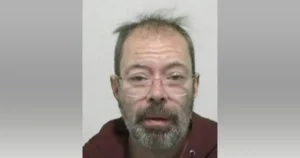

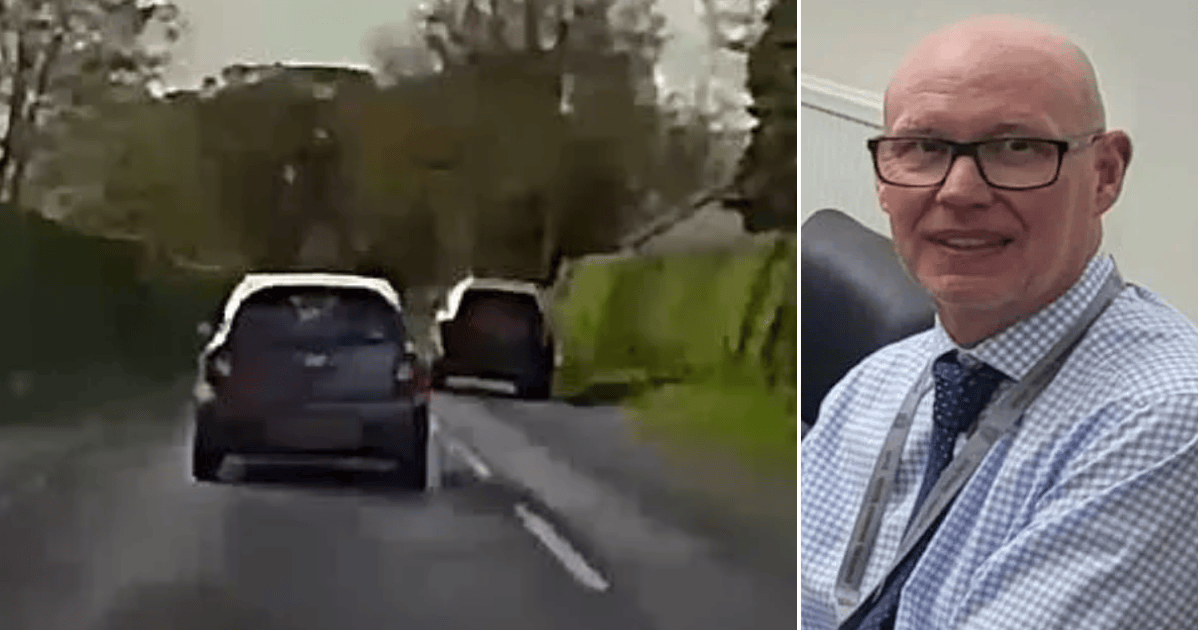
On April 20, a day that must have begun with familiar rituals, Michael Mullins left Stretford Grammar School and climbed onto his bicycle. He was 56 years old, old enough to be a seasoned educator, young enough to think he had many more years ahead of him. A married father of two, he had spent the day in classrooms, corridors, and conversations, perhaps doing the ordinary, unnoticed work that defines a school: reassuring a worried student, marking exercise books, planning tomorrow’s lessons. His route home, from Manchester through Stretford, Urmston, Flixton, Carrington, and then toward the Cheshire village of Lymm, would have been familiar to him. The roads at that time of day carried other commuters, people rushing to dinner, to evening plans, to the comfort of their own front doors. Among them was Simon Richardson, driving a black Volvo XC90. What happened next shattered an ordinary evening and turned it into a murder trial. Witnesses later described the Volvo being driven with terrifying aggression, “absolutely tanking it” toward the junction of Dunham Road and Warburton Lane. Richardson hit Mullins. Rather than stopping, rather than trying to help, he is accused of putting his foot down and fleeing at more than 60mph, with the headteacher trapped underneath the vehicle. The Volvo left a mile-long trail of blood on Wet Gate Lane, a grotesque road map of a body being dragged. By the time Mr Mullins was found on a grass verge, he was dying. This is the raw human tragedy at the centre of this case: a life, a family, a school, all changed in seconds because someone chose to drive on.
The prosecution has released dashcam footage after showing it to jurors, and it offers a chilling glimpse of the choices made before the collision. Witnesses saw the black SUV moving at speed, swerving into the opposite lane to overtake two vehicles driving ahead. Imagine sitting in a car behind, seeing a large 4×4 suddenly veer out, engine loud, tyres gripping, bodywork swaying; perhaps you mutter a warning to yourself. Then, moments later, a cyclist is hit. In such footage, the ordinary and the catastrophic are separated by a heartbeat. The prosecution says Richardson knew exactly what he had done. A photograph taken shortly after the crash shows Richardson sitting behind the wheel with visible damage to the front right of the bonnet. That damage, prosecutors argue, was caused by Michael Mullins being thrown onto the bonnet when the Volvo struck him. Phil Barnes KC put the point forcefully: “Putting it bluntly, there is no way on earth that Simon Richardson could not have known that he had just hit Michael Mullins and that he was very likely to be hurt.” This is why the charge is murder, not just causing death by dangerous driving. It is not merely the initial impact that matters, but the decision to keep driving, to drag a gravely injured man under the car, to leave him on a roadside and to tell no one. In law, murder is about intention and knowledge. The prosecution’s case is that by driving on with a human being under the wheels, Richardson showed he was prepared to cause at least really serious harm. The defence will resist that characterisation, but the image of a bonnet dented by a human body is difficult to forget.
The courtroom has also heard difficult medical evidence, and it is here that the humanity of the victim becomes most painfully clear. Dr Terrence McGloughlin, a consultant in emergency medicine, told the jury that the evidence suggested Mr Mullins survived the initial impact. He was alive when he went under the car. Whether he was conscious during the dragging remains unknown; Dr McGloughlin said the evidence made it impossible to say. But he was physiologically alive. One detail stands out: Mr Mullins’s Apple Watch continued to record his heart rate after he was released from the car. The watch on a 56-year-old headteacher’s wrist, a small piece of modern technology that counted steps and measured pulse, kept gathering data as its owner lay dying on a grass verge. It “supports that he was still physiologically alive,” the doctor said. There is something almost unbearably poignant about that. A device bought for convenience, for tracking exercise and maybe a heart condition, became a silent witness to his final moments. The defence, naturally, attacked the reliability of the data. Jaime Hamilton KC pointed to readings suggesting movement after 6.50pm, when Mr Mullins had been pronounced dead. Could that be movement of the wrist? The doctor agreed. There were 202 heart rate readings after the time of death, the defence said; the doctor suggested the watch might have been removed after 6.50pm. The exchange was technical, but the subject was profoundly human: exactly how long did Michael Mullins survive? Did he feel the car on top of him? Did he know what had happened? These are questions no expert can fully answer, and the family must live with that uncertainty.
Alongside the medical evidence, technology has been used to reconstruct the journeys of both men. Dr Chaz Dixon, an expert in navigation and GPS, explained how phones and watches connect to satellites and phone masts to track movement. The court heard that a phone belonging to Richardson’s passenger was in the vicinity of the Bulls Head pub before moving to Altrincham, going through the junction of Paddock Lane and Dunham Lane, and then onto Wet Gate Lane in Lymm. Mr Mullins’s Apple Watch told its own story: he left Stretford Grammar School, rode through Stretford, Urmston, Flixton, Carrington, then towards Lymm. The two routes came together at a junction, and then they collided. But there was a gap. Within the watch data, a period of 28 seconds simply is not recorded. Dr Dixon described it as “very unusual” to have a gap of that nature. “If I hadn’t known there was a collision, I would struggle to know why that occurred,” he said. “Knowing that there was a collision, it seems very likely that this was as a direct result of the collision.” The data is consistent with both devices being together at Dunham Road and Paddock Lane, briefly stopping at Mill Lane, then moving onto Wet Gate Lane before the phone went east and they parted ways. In a trial filled with lawyers, photographs, and legal arguments, that 28-second gap is a kind of silence: the moment when a headteacher’s journey ended. It is not simply data; it is the last measured trace of a man’s life, interrupted by violence.
Throughout the trial, the court has been confronted with the stark difference between how a life is remembered and how it is dissected in evidence. For the family and friends of Michael Mullins, he is not a case number. He is the man who taught generations of young people, who came home to his wife and children, who had a routine, who worried about ordinary things, who perhaps looked forward to retirement. For the jury, however, his death has become a sequence of forensic details: a damaged bonnet, a heart rate monitor, GPS coordinates, a trail of blood. The human instinct is to want to make sense of a death like this, to find a single decisive moment. The prosecution says that decisive moment came when Simon Richardson, with a cyclist under his car, chose to keep driving. The defence says the charge of murder is too high, and Richardson denies murder, the alternate offence of manslaughter, and dangerous driving. Richardson, of no fixed address but formerly of Sale, now sits in the dock, his future dependent on how twelve jurors weigh the distinction between an accident and a crime. The trial continues, and the evidence will go on. But no verdict can fully capture the loss of a man who was simply cycling home from work. The road where he was found has been marked by tragedy, and the community that knew him—teachers, students, parents, neighbours—must find a way to remember him without being defined by the horror of his final moments.
There is a broader, more sobering message in this case. Roads are places where ordinary people cross each other’s lives in seconds. A driver in a hurry, an impatient overtake, a cyclist making his way home: these are not rare events. Most end without incident. But when they go wrong, the consequences can be catastrophic, and the choices made afterwards can turn a terrible accident into something legally and morally worse. The prosecution’s case is not only about the initial impact; it is about what happened after. To leave a dying man under a car, to drive a mile with his body scraping along the tarmac, to abandon him on a grass verge—these are the actions that transform a collision into a possible murder. Michael Mullins’s Apple Watch kept recording his heart until the very end; his family must live with the knowledge that his life might have been saved if the driver had stopped. As the trial continues, the court will have to decide what Simon Richardson knew, what he intended, and what justice looks like for a wife who lost her husband, children who lost their father, and a school that lost its headteacher. Whatever the outcome, the image of that mile-long trail of blood will remain, a visceral reminder that behind every statistic in a courtroom is a human being whose life was cut short in the most brutal way imaginable.