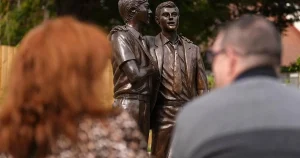


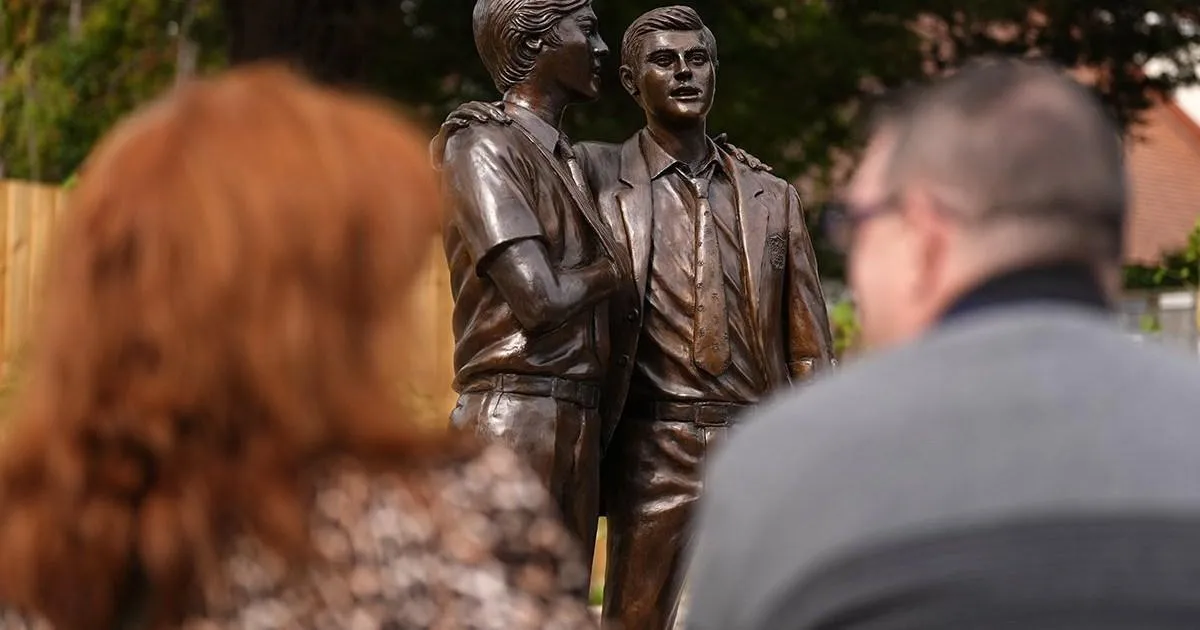
On a bright day in Hampshire, under a quiet and uncertain sky, a crowd gathered at the gates of the Lord Mayor’s Treloar’s College, a place that once promised care and safety but instead became the setting for one of the most painful betrayals in modern British medical history. They had come for the unveiling of a memorial: a statue of two young boys, one with a sling and the other holding a cane, holding each other in a tender embrace. Beneath their feet, an inscription read: “Remembering 122 haemophiliac pupils of Treloar’s. Infected as children, victims of unethical research.” For many of those gathered, this was not simply a ceremony. It was a moment decades in the making, a rare and bittersweet acknowledgement of a truth that had been buried for too long. The boys who once walked these grounds are now known as the Treloar Boys, and their suffering has come to symbolize the devastating human cost of medical arrogance. They arrived as children with a bleeding disorder and a simple trust in the adults around them, and they left carrying infections, secrets, and death sentences. Some never left at all. By 2024, when the Infected Blood Public Inquiry published its main report, only around 30 of the 122 pupils with haemophilia who attended the school between 1970 and 1987 were still alive. The memorial, then, is far more than bronze and stone. It is a public admission that the world failed them, a permanent place for grief, and a gesture of solidarity to the men who have spent their lives fighting for the truth.
Treloar’s College was a boarding school in Hampshire that offered education and support to children with disabilities, and for boys with haemophilia it seemed like a rare haven. Haemophilia is an inherited disorder in which the blood does not clot properly because of a shortage of the protein known as factor VIII. In the 1970s, a new treatment emerged—factor concentrate, made from donated human blood plasma—that promised to replace the missing clotting agent and allow these boys to live more normal lives. But the promise was a lie. The blood products used at Treloar’s, particularly the commercial concentrates, were frequently contaminated with HIV and hepatitis. The boys were exposed to these products repeatedly, often without their knowledge or that of their parents, and the consequences were catastrophic. Of the 122 pupils with haemophilia who attended the school during this period, the vast majority were infected. The inquiry found that very few escaped being infected. These were children, many of them far from home, receiving injections intended to help them, but which instead doomed them. The official report described them as having been treated as “objects of research,” and the evidence suggests that medical professionals at the school were aware of the dangers posed by the infected products. Rather than protecting the children, they continued to use the products, favouring the advancement of research over the best interests of the boys. It is difficult to imagine a more profound violation of trust. The school, which should have been a sanctuary, became the place where their futures were stolen.
The public inquiry, chaired by Sir Brian Langstaff, uncovered a chilling and detailed account of what happened at Treloar’s. The report concluded that from 1977, medical research was carried out at the college “to an extent which appears unparalleled elsewhere.” Children were treated unnecessarily with concentrates, especially commercial ones, even when safer alternatives existed. The inquiry found no doubt that the healthcare professionals at Treloar’s knew of the risks of virus transmission through blood and blood products, and yet they continued. The boys were not given the chance to consent to the experiments being performed on their bodies. They were not told that they were part of a study, or that the very substances being injected into them could kill them. They were vulnerable twice over: first as children, and second as patients living with a chronic inherited condition. They placed their faith in doctors and nurses, and those doctors and nurses exploited that faith in the name of research. The phrase “objects of research” is devastating because it strips away the humanity of those involved and reveals the cold, scientific way the boys were viewed. They were not patients to be cared for, but subjects to be observed, their bodies treated as data points. The inquiry’s findings gave the Treloar Boys a form of vindication, but it also brought back the weight of their suffering, confirming what many had suspected for decades: they were not merely unfortunate victims of a contaminated blood supply, but deliberate casualties of unethical practices.
Adrian Goodyear, now 55, stood before the crowd at the unveiling and spoke with a voice heavy with memory. He recalled arriving at Treloar’s when he was nine years old, accompanied by ten other boys, and feeling as though he had stepped into paradise. There were rolling country hills, swimming pools, canoes, and a Jacobean mansion—everything a young boy could dream of. He could not believe the place he was looking at. It felt like a new dawn, a chance at happiness and safety. But that dawn was false. The boys were being infected, and the consequences would soon become painfully clear. Adrian described leaving school with a death sentence. In 1985, a doctor tearfully told him he had two to three years to live. He was not alone in that moment; there were five other boys in the room. The doctor went around, pointing at each one, saying: “You have… you haven’t… you have… you haven’t… you have got HIV.” Adrian was the last remaining boy from that room. Those words, “the last remaining boy,” speak to an almost unbearable grief. He watched his friends die, one after another. One winter, they lost five boys. But before they died, they made promises to each other. They promised never to give up, to find out what had happened, to seek justice. Adrian has kept that promise. He survived, and he has spent years telling his story, hoping that the world would listen. Standing at the memorial, surrounded by other men who had lived through the same nightmare, he honoured his dead friends. The statue’s embrace reminded him of the bonds that sustained them through the darkest years, the friendships forged in fear and loss, and the love that continued to hold them together.
Gary Webster, 61, was another survivor who attended Treloar’s between 1975 and 1983. He was infected with HIV and hepatitis C during those years, as a child. He recalled being called to the doctor’s office one dinner time and being told that he had HIV and had two years to live. For a young boy, such news is impossible to process. There was no counselling, no support, no explanation—only a sentence delivered and then forty years of carrying it. Gary was one of the lucky ones in the sense that he survived, but survival came with a cost: the trauma of the diagnosis, the fear of stigma, the grief of watching classmates die, and the lifelong uncertainty of living with chronic illness. At the unveiling, Gary said that the memorial was important “to remember what happened and to make sure it never happens again.” His words were simple but profound. Remembrance, for him, is not about dwelling in the past; it is about protecting the future. He stood publicly beside the statue because he wanted the world to know that the Treloar Boys were not statistics. They were children with dreams and friendships and futures that were stolen from them. Gary’s presence was an act of defiance, a refusal to be silenced, and a testament to the resilience of the human spirit. He could have chosen bitterness or retreat, but instead he stood in the open, among other survivors, to bear witness. The memorial, for him, is a reminder that the fight is not over. There is still work to be done, accountability to be demanded, and lessons to be learned. But the statue itself is proof that their voices were finally heard.
As the crowd slowly dispersed, the bronze boys remained behind, standing together in the place where so much suffering occurred. The memorial transforms the landscape of Treloar’s, forcing all who pass by to remember what happened there. It is a quiet but radical act—placing the victims at the centre of a place once marked by betrayal. It says that the boys were not forgotten, that their lives mattered, and that their injuries were monstrous. The inscription, “victims of unethical research,” is not just history; it is a moral verdict. It tells future generations that medicine must never again treat human beings as means to an end. The Treloar Boys’ story is a warning: that the vulnerable are at risk when institutions operate in secrecy, when profit is placed above care, and when research is pursued without consent. The survivors, including Adrian and Gary, have turned their suffering into a campaign for justice, and the memorial is a step toward healing. But it is also a place of sorrow, a physical home for tears that have waited decades to fall. The two boys in the statue, one with a sling, the other holding a cane, are caught in an eternal embrace—two friends holding each other up, refusing to let go. They stand for all 122 pupils, for the lives that ended too soon, and for the men who lived on to tell the story. The memorial will stand for years to come, silent but powerful, reminding everyone that what happened to the Treloar Boys must never be allowed to happen again.