

1. The Sudden Halt of a Motorway Evening
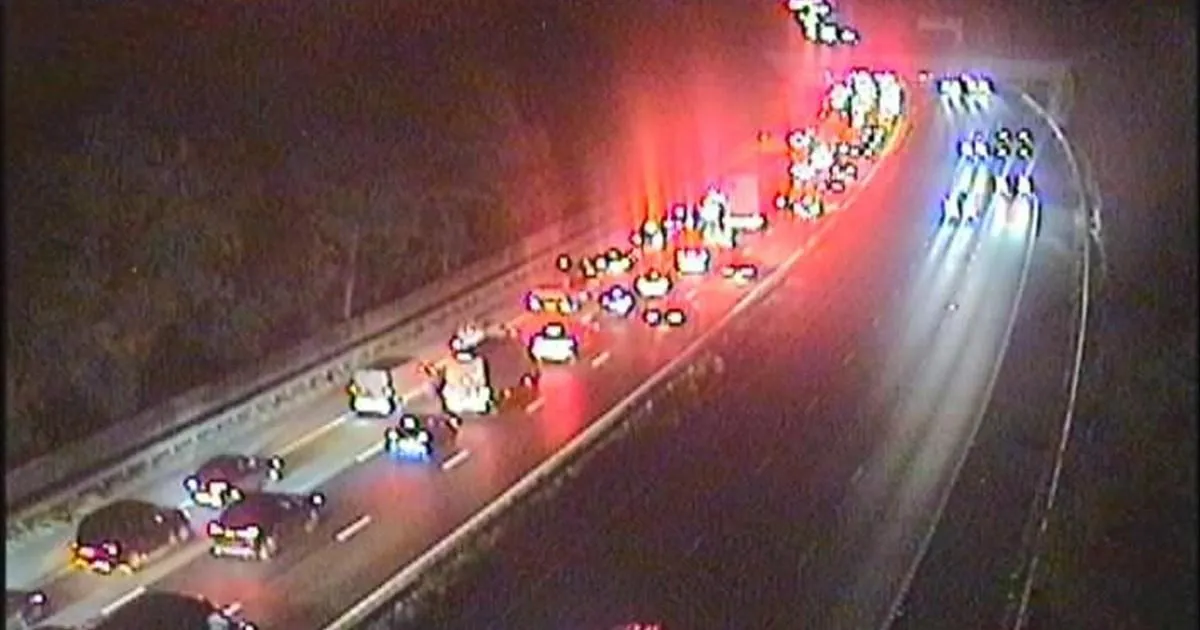
It began like any other Thursday evening on the M11, that long ribbon of tarmac that carries countless commuters, lorry drivers, and families away from the sprawling chaos of London and toward the relative calm of Essex, Cambridgeshire, and points further north. The sky had already surrendered to darkness, and the headlights of hundreds of vehicles cut through the chill air near Epping Forest, a vast, ancient woodland that has stood for centuries as a silent witness to the ebb and flow of human travel. For a while, everything moved in the usual rhythm: the steady hum of engines, the intermittent flash of brake lights, the occasional driver glancing at a phone, perhaps dreaming of dinner at home or a warm bed after a long shift. But that rhythm was about to be violently interrupted. Just after eight o’clock, news began to spread along the carriageway that something had gone terribly wrong. A collision had occurred on the northbound stretch between junction five at Loughton and junction six at Epping, and the motorway, that great artery of movement, had been clamped shut. All northbound lanes were closed, and what had been a routine journey suddenly became a desperate, immobile wait in the dark, with the ancient forest looming on either side and no clear answer as to when anyone would move again.
The closure was not a small thing. It was a total shutdown, a complete and uncompromising sealing of the road. Traffic cameras captured the eerie sight of brake lights stretching into the distance like a string of red jewels, fading into the gloom, while the flow of vehicles that had been moving at speed just moments earlier now sat perfectly still, engines idling, indicators flashing purposelessly. For those caught in the queue, the initial confusion quickly turned to frustration, then to a low, gnawing anxiety. What had happened? Was someone hurt? Would they be here for minutes or hours? There was no way of knowing. The only certainty was that the motorway, so often taken for granted as a reliable passage north, had turned into a parking lot, and the forest that usually provided a pleasant backdrop now felt like a walled corridor trapping them in place. Drivers began to emerge from their cars, stretching their legs on the hard shoulder, peering into the darkness ahead as if they could somehow see the cause of their delay. Others stayed inside, gripping their steering wheels, refreshing traffic apps, and trying to find any scrap of information that might explain why their carefully planned evening had been so abruptly derailed.
2. The Mechanics of a Crisis and the Official Response
Behind the wall of stopped traffic, a completely different scene was unfolding—one of flashing blue lights, hushed urgency, and focused professionalism. Emergency services had been dispatched to the scene moments after the crash was reported, and by the time the road was officially closed, police, paramedines, and fire crews were already working amid the wreckage. The precise nature of the collision was not immediately disclosed, but the very fact that every northbound lane had been shut suggested that this was not a minor fender-bender. This was a serious incident, one that demanded space, caution, and a thorough investigation. National Highways, the body responsible for managing England’s motorways and major A-roads, issued a stark statement to the waiting public. “The road is now closed following a collision,” it read. “All emergency services are on scene. There are 60 minute delays and 3 miles of congestion on the approach.” Those few sentences, delivered in the flat, bureaucratic language of officialdom, carried an immense weight for the thousands of people trapped in the growing tailback. Sixty minutes. Three miles. These were not just numbers; they represented lost time, missed appointments, cold dinners, and frightened phone calls home.
For the emergency crews, the priority was never the congestion. It was the people directly involved in the crash—those who had experienced the terrifying split second when metal met metal, when everything changed. Paramedics tended to the injured, assessing their conditions with practiced calm while police officers began the painstaking process of reconstructing what had happened. The road closure was not an inconvenience to them; it was a necessary safety measure, a way to protect both the victims and the responders. It allowed ambulances to come and go without fighting through traffic, gave investigators the freedom to measure tyre marks and debris patterns, and ensured that curious or impatient drivers did not stumble into a dangerous scene. Meanwhile, the stranded motorists further back could only wait, staring at the red lights ahead, some listening to radio bulletins that offered little fresh information, others simply sitting in silence with their thoughts. Every minute felt like an hour, and the initial hope that the road might reopen quickly began to fade as the night wore on and the reality of a serious incident set in.
3. The Human Toll of an Unplanned Wait
It is easy to talk about delays in terms of minutes and miles, but behind every vehicle in that three-mile queue was a human story, a set of plans, and a web of people waiting on the other end. There was the father who had promised his daughter he would be home in time to tuck her into bed, now forced to call his wife and hear the disappointment in her voice as she said, “Take your time, just be careful.” There was the young couple heading to a weekend cottage, their car packed with bags and a book of crossword puzzles, their excitement at escaping the city slowly curdling into exhaustion as they sat in almost complete stillness. There was the lorry driver on a tight schedule, his delivery window slipping away with every passing minute, his mind already racing through the excuses he would have to make to his dispatcher. There were nurses heading to night shifts, students returning to university, and elderly passengers who had not thought to bring water or a warm coat, now shivering slightly as the night air seeped through poorly sealed doors. All of them, in their separate capsules of glass and steel, were connected by one shared experience: the sudden, humbling awareness that they were not in control of their journey anymore.
The emotional impact of such a wait should not be underestimated. For some, there was a real edge of fear. Was it someone they knew? Was the crash fatal? Rumours began to circulate among drivers who had wound down their windows to talk to each other, passing along half-heard fragments of information that multiplied and distorted as they travelled back through the queue. Others felt a deep, restless frustration, a sense of injustice at having their evening stolen by circumstances entirely beyond their influence. Mobile phones glowed in the darkness as people contacted loved ones, updated social media, and tried to find alternative routes. Some even attempted to turn around and escape via the hard shoulder, only to be met with stern gestures from fellow drivers and, in some cases, the distant sight of a police car blocking any exit. The forest, usually a place of tranquil beauty, seemed to press in on them, its dark trees whispering in an unfriendly way. Time stretched and bent, and the simple act of waiting became a test of patience, resilience, and, ultimately, compassion. For underneath the frustration, there was also a powerful sense of shared vulnerability. Every person in that line understood, if only dimly, that the crash ahead could have happened to any of them.
4. The Vigilant Work Behind the Reopening
While the drivers waited and the night deepened, the emergency services continued their meticulous, demanding work. Paramedics assessed and stabilised the injured, deciding who needed immediate hospital treatment and who could be treated more calmly at the scene. Fire crews, ever prepared for the worst, dealt with any hazards, checking for fuel leaks and making sure that the damaged vehicles were safe to approach. Police officers took statements, photographed the scene, and began the difficult task of piecing together the chain of events that had led to the collision. It is a slow, deliberate process, and for those watching from a distance, it can seem inexplicably drawn out. Why does it take so long? Why can’t they just move the cars and let everyone get on with their lives? The answer lies in the duty of care that the emergency services owe not only to the living but also to the dead, to the injured, and to the cause of truth. Every crash is a puzzle, and the solution can have profound implications: it might determine whether charges are brought, whether road safety measures are improved, or whether a grieving family finally learns what happened to their loved one.
Eventually, though, the work reached its conclusion. The damaged vehicles were removed, the debris was swept clear, and the road surface was inspected to ensure it was safe for traffic to resume. Then, as suddenly as it had been imposed, the closure was lifted. A message appeared on traffic information systems, then on the National Highways website: “The carriageway has since reopened and there are no delays currently.” Those words, so simple and so final, announced the end of the ordeal for thousands of stranded drivers. Engines restarted, one by one, like a waking giant. The first cars began to creep forward, tentatively at first, then with more confidence as the road ahead opened up. The three-mile queue slowly dissolved, its members scattering into the night, each carrying with them the memory of an evening stolen by circumstance. But beyond the relief of the motorists lay a quieter, more sombre reality. For those directly involved in the crash, the reopening of the road did not erase the trauma. Their night was defined not by inconvenience but by shock, injury, and the painful aftermath of a sudden, violent event. As the last of the emergency crews packed up their equipment and left the scene, the forest returned to its peaceful stillness, but the echoes of what had happened would linger long after the tarmac had cooled.
5. The Wider Ripple: A Motorway That Carries More Than Cars
The M11 is more than just a road; it is a lifeline for the region, carrying goods, people, and hopes between London and the east. Its closure, even for a short time, sent shockwaves far beyond the immediate traffic queue. Local roads in Loughton, Epping, Theydon Bois, and the surrounding villages would have felt the pressure as drivers scrambled for alternatives, turning narrow country lanes into temporary arteries clogged with frustrated motorists. For residents of those quiet communities, the sound of engines and the glow of headlights in unexpected places was a reminder that their tranquil existence was always connected to the larger world. The ripple effect would have been felt by delivery companies, whose drivers found their routes blocked; by businesses, whose employees arrived late or not at all; and by families, whose dinner plans were disrupted by a partner stuck on the carriageway. It is a fascinating, almost humbling thought: a single collision, a single moment of misfortune on one stretch of tarmac, can alter the evening plans of tens of thousands of people who never even saw the crash itself. In a society that prides itself on efficiency and punctuality, events like this are a blunt reminder of our fragility.
Yet there is another side to that fragility: resilience. Humans have an extraordinary capacity to adapt to disruption, to find new routes, to offer help to strangers, to accept uncertainty with grace. The drivers who waited in the queue for an hour or more would eventually reach their destinations. The emergency services who worked so tirelessly would go home to their families, tired but satisfied in the knowledge that they had done their duty. The road itself, once the last barriers were removed and the final cones were collected, would resume its smooth, monotonous rhythm, as if nothing had ever happened. The next morning, thousands of drivers would travel that same stretch of the M11 without a second thought, unaware that just hours earlier it had been the scene of a dramatic incident. That is the nature of motorways: they are places of constant motion, where moments of crisis are quickly swallowed by the endless flow of traffic. But for those who were there, for those who sat in the darkness beneath the trees, the memory would persist. They would tell the story the next day at work: “Did you hear about the crash on the M11? I was stuck for over an hour.” And in the telling, the experience would become a small part of their personal history, a reminder that even the most ordinary journey can suddenly become extraordinary.
6. Reflection, Relief, and the Quiet Aftermath
As the night wore on and the last of the recovered vehicles were towed away, a strange quiet descended over the M11 near Epping Forest. The flashing lights were gone. The queue of vehicles had vanished. The only evidence that anything had happened was a faint sheen of rubber on the road, some scattered glass in the gutter, and perhaps a few traffic cones still waiting to be collected. For the drivers who had finally made it home, the relief was palpable. They pulled into driveways, shut off their engines, and stepped out into the cool night air, feeling the unfamiliar sensation of solid ground beneath their feet. Some hugged their loved ones a little tighter, grateful that they had made it back safely. Others simply collapsed onto sofas, exhausted by the emotional toll of an evening spent waiting in uncertainty. But for the families of those involved in the crash, the night was far from over. They faced anxious hours in hospital waiting rooms, phone calls from doctors, and the slow, anxious process of learning what injuries had been sustained and what the road ahead would look like.
In the days that followed, the story would be reported in the news, a brief item in the local paper or a mention on the evening bulletins. Metro would contact the police and ambulance service for comment, and their carefully worded statements would trickle out, offering facts but no closure. The drivers who had been delayed would move on, their frustration gradually fading into an anecdote. But the crash itself would leave a permanent mark, however small, on the lives it had touched. For some, it would lead to a greater caution behind the wheel. For others, it would be a painful reminder of the fragility of life, a spur to cherish every moment and never take a safe journey for granted. The M11 would continue to hum with traffic, day after day, night after night. The forest would stand its ancient watch, indifferent to the dramas unfolding on its edges. But every now and then, a driver would pass that spot between Loughton and Epping, and perhaps they would remember: this is where it happened. This is where a routine evening turned into a moment of crisis, where strangers were connected by a shared halt, and where the simple act of moving forward was, for a brief time, the most precious thing in the world. And then they would press the accelerator, and the road would carry them on, into the rest of their lives.