

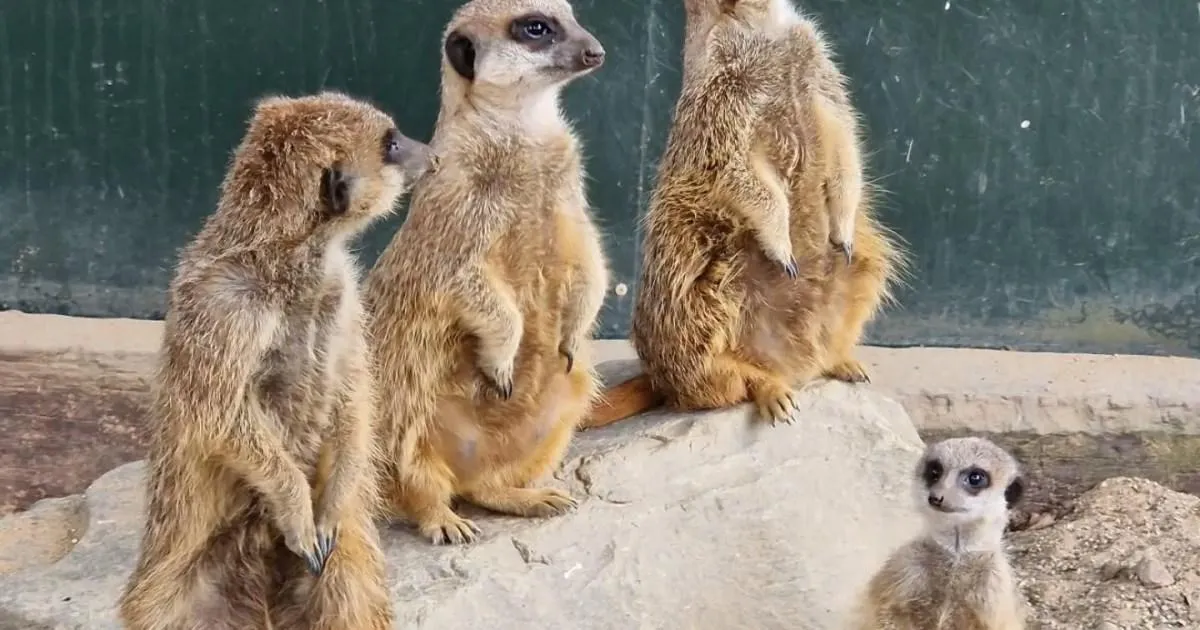
In the quiet countryside of Desford, Leicestershire, a heart-wrenching tragedy has unfolded at Tropical Birdland, a beloved family-run wildlife attraction. The park’s resident mob of meerkats, a tight-knit family unit led by their wise and experienced matriarch, affectionately named “Big Mama,” perished in a sudden and catastrophic tunnel collapsed. For years, this little family had been a source of joy, captivating visitors with their playful antics, vigilant watchtower poses, and the intricate, bustling underground cities they carved out of the earth. The wildlifes park, known for its intimate, close-up experience with its animals, was suddenly thrust into a state of profound mourning. The accident was not caused by any neglect or oversight, but by a betrayal of the very earth beneath their feet—a structural failure triggered by a violent clash of weather patterns that turned their safe haven into a tomb in a matter of moments. The loss has sent ripples of grief not only through the park’s dedicated staff but also through the wider community of animal lovers, patrons, and conservationists who followed the lives of these charming creatures with a sense of personal connection, their shared joy now replaced with an overwhelming sense of devastation.
The mob of meerkats was a tight-knit family unit, and at its heart was Big Mama. She was more than just a leader; she was the linchpin of their existence, the repository of their collective knowledge, and the one who commanded their unwavering loyalty. Throughout the past week, she had been engaged in one of the most crucial duties of her matriarchal life: preparing for her next litter. Under her vigilant, steely gaze, the mob had been excavating the dry, hardened earth, diligently, instinctually digging a new chamber deep below the surface. This was to be a maternity ward, a safe, soft, temperature-controlled sanctuary for the arrival of her impending pups. The meerkots were “very well practised” in these engineering feats, a testament to their intelligence and to Big Mama’s own, proven, experienced bloodline. She had overseen the successful birth and rearing of many generation, and the pack moved in synchronized harmony, a dance of tiny paws and flying dirt, all brave and dedicated to sculpting the perfect subterranean home. The entire zoo team would watch this daily routine with admiration, a beautiful natural ballet that had always ended in triumph. It was, with Big Mama at the helm, a sign of hope and the continuing cycle of lively creaturely life.
However, the elements, which had set the stage for this hopeful re-emergence, conspired to bring about their ruin. The United Kingdom has been in the grips of a sweltering, extraordinary heatwave, and the meerkats had taken advantage of the hot, dry earth that was easy to dig for the expansion of their domain. The climate was perfect. But in a sudden and unforeseen turn, the heavens opened and, unleashing abrupt, torrential rain. The scorched ground, baked to a brick-like hardness, could not absorb the sudden abundant moisture. The weather turned, and the very structure of the tunnels became compromised. The heavy torrents of rain soaked the substrate, changing its composition from a solid, reliable architecture to a destabilized, viscous mud. The tunnels and chambers, so meticulously constructed, lost their integrity, initially pushing a weak point, and finally collapsing without mercy. As the rain continued to fall, the earth, once the source of their deepest foundation, turned into a crushing weight designed for freezing sense, burying it in a deep, suffocating blanket of damp, heavy rubble. At the very moment they were working to create a future, and those futures were violently, rather tragically.
When the catastrophic collapse occurred, there was to be no advance, no alarm for the animals. It was simply instantaneous. Upon staff realize the danger, the priority was to immediately locate their location and begin a frantic, heart-breaking excavation. With a mix of fear and hope, zoo employees began sifting through the mud, carefully using their hands on the wet earth, listening for sounds, and trying to pick up any traces of life. It was a dramatic, tense race against time. When the team dug carefully, guided by the knowledge of the meerkats’ habits, they found a video of the disaster. After a long, anxious hours, they were able to pull a single member from the debris, a fragile survivor, but that survival was tinged with a devastating, grieving. The rest of the mob—including the great matriarch and entire rest of the family—had been lost. The joy of pulling one from the mud was immediately eliminated by the profound, numbing sorrow of discovering the others had been hiding beneath, unmoving.
The entire team at Tropical Birdland was overwhelmed with collective, heartbroken numbness. In their official statement, they expressed with a heavy-hearted, “gone of our beloved “Meerkats.” The note was an acknowledgment of the heroism of the meerkats and a confession of the random cruelty of fate. They highlighted the precision of Big Mama’s teamwork and the purposeful to build a new chamber, which was in place for the imminent arrival of new pups. “Only after an unexpectedly long heatwave,” they said, “the ground was a becoming a perfect place for digging.” But the sudden, catastrophic of the weather turned it into that impact. In their grief, they acknowledged the violence of the loss; their words were a testament to their daily intimacy with the animals they had to oversee, a testimony that they were much more than just the attractions—they were individuals, and they had loved.
Now the zoo team is locked in a new, more delicate responsibility: the care for the sole survivor’s emotional well-being. Meerkats are intensely social, communal animals— mammals whose bonds to their group are integral to their psyche and survival. The well-being of the massive singular individual is a high concern, since a solitary meerkat is almost a contradiction in terms, left alone it can become incredibly stressed, and anxious prone to a lack of contact and safety of a group. The park’s staff has made a commitment to not leave the survivor alone, taking turns and spending dedicated time, providing constant company, seeking to comfort the, and offering tense monitoring for their physical health, watching to ensure the creature does not wither from grief. It is a somatic test of human-animal diplomacy, a conscience attempt to step in for an entire colony. Their concern is matching the visitors, and social responses from the visitors: messages of condolences and are flooding in, along with suggestions for companionship—many asking if there collaboration with another park can take note to provide a companion, for the sake of their psychological health.
This incident is a painful highlight of the vulnerability, and resilience of life, but also of the constant, restless impact of the climate. It’s a heavily, humanized tale of disaster against such a tiny community and those that had invested their love and care in doing their daily work. As the only survivor grieves in its own state, and the staff await guidance on the next proper path, a quiet moment of pause hangs over the Desford horizon. The carcass must be adapted, and the lessons of this tragedy will linger; In the world of a small sanctuary, the memory of Big Mama’s rod- a disciplined, optimistic, and loving matriarch, and her brave, diligent brood—will remain as a lesson and a reminder of kind, and, and the powers of immense of the forces beyond our control, yet, and us to offer our humility and care to ever energy that we hold dear in honor of their lives.