

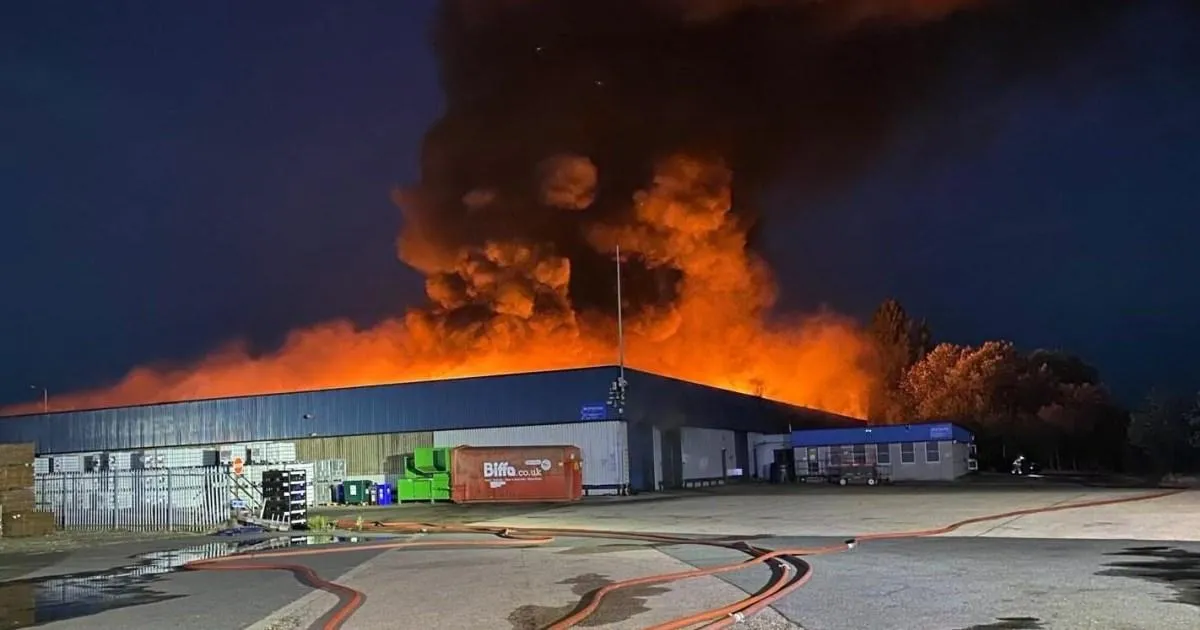
At approximately 3:36 in the morning, the quiet coastal town of Harwich, in Essex, was torn from its sleep by the urgent wail of fire sirens. Thick, angry plumes of smoke were already rising into the darkness from a large warehouse on Stour Road, and by the time firefighters arrived, the flames had taken hold with terrifying speed. What began as a single incident quickly escalated into a major operation as Essex County Fire & Rescue Service deployed around 35 firefighters to the scene. The building, according to officials, soon became “fully alight,” its structure consumed by an inferno that would demand an all-night battle. For the people living nearby, it was a night of fear, confusion, and endless waiting, as the glow of the fire lit up the sky and the smell of smoke drifted into homes. The fire service moved quickly to urge local residents to keep their windows and doors shut, a simple but crucial instruction that made the severity of the situation plain. Nobody was yet able to say what had started the blaze or whether anyone had been hurt, but the immediate priority was to contain the flames, protect the surrounding area, and prevent the thick, potentially toxic smoke from causing further harm.
For many residents, the first sign that something was deeply wrong came not from the sirens, but from the ash. One woman described on Facebook how the fire had covered her entire garden in “hot ash,” a stark and unsettling image that brought the disaster right to people’s doorsteps. The idea of waking up to find your outdoor space littered with the remnants of a raging fire, still warm to the touch, is the kind of experience that leaves you feeling vulnerable in your own home. Others reported hearing crackling and popping sounds, the distant roar of flames, and the constant hum of fire engines moving in and out of the area. Children woke up confused, asking why the sky was changing colour, and parents tried to explain something they did not fully understand themselves. The instruction to stay indoors, with windows and doors sealed, turned ordinary homes into temporary shelters, and for many, the night stretched on with very little sleep. There was a strange mixture of anxiety and relief, anxiety because the fire was still burning and no one knew how far it could spread, relief because at least the emergency services were there, battling bravely through the darkness. It is in moments like these that the fragility of ordinary life becomes so clear; a building you have passed a hundred times suddenly becomes a source of danger, and a quiet neighbourhood becomes the frontline of an emergency.
Behind the red and blue flashing lights, a remarkable effort was unfolding. Firefighters from Essex County Fire & Rescue Service worked relentlessly, rotating through the night, using powerful hoses to attack the flames from every possible angle. The sheer intensity of the heat meant that they could not simply walk into the building; they had to fight the fire from outside, using aerial appliances and high-volume pumps to douse the warehouse in water. This is exhausting, dangerous work, made even harder by the fact that the structural integrity of the building would have been seriously compromised by the fire. Every creak and groan of the burning metal and timbers was a warning, a reminder that the building could collapse at any moment. Crews from Suffolk Fire and Rescue Service were also involved, and they too were inundated with calls from concerned members of the public who could see the smoke from miles away. Reports came in from Ipswich and Felixstowe, where worried residents looked across the River Orwell estuary and saw what appeared to be a enormous column of smoke darkening the horizon. It must have been a strange and alarming sight, a distant plume of grey and black hanging in the air, making it feel as though the world was on fire. Suffolk firefighters were quick to reassure people that the smoke was in fact from Harwich, on the other side of the water, but the fact that the incident was visible from such a distance spoke volumes about its size and severity.
As dawn began to break, the reality of what had happened started to sink in. The warehouse, once a solid and functional building, was now little more than a blackened shell, with smoke still curling from its remains. Investigations into the cause of the fire were likely to begin, but for the immediate community, the focus was on the aftermath. Nearby roads would have been closed, traffic diverted, and businesses affected, as the emergency response continued into the morning. For residents, there was a deep sense of unease that lingered long after the flames were brought under control. They looked at their ash-covered gardens, their smoke-tainted homes, and wondered what else the day would bring. Many would have sat together in kitchens, drinking tea, sharing what they had seen and heard, trying to make sense of the chaos. The woman who found hot ash on her garden probably spent the morning sweeping it up, but she may have been wondering whether the particles were dangerous, whether the smoke had seeped into her home, and whether her family was safe from any lingering effects. These are the quieter, more personal consequences of a major fire, the ones that do not always appear in official statements but are no less important. In the days to come, residents will need answers: what caused the fire, could it have been prevented, and what can be done to support those who have been affected.
Fires like this one are a sobering reminder of how quickly things can go wrong. A warehouse, especially one that may contain unknown materials, can become a deadly hazard in a matter of minutes. The work of firefighters is not just about putting out flames; it is about protecting people, property, and the environment from harm. The decision to tell people to keep their windows and doors closed was not an overreaction; smoke from such fires can contain toxic chemicals, irritants, and fine particles that pose a risk to health, particularly to the elderly, children, and those with breathing conditions. It is a relief that no injuries were reported in the immediate details of the incident, but the event is a stark warning to everyone about the importance of fire safety and preparedness. It also highlights how connected communities truly are. The fact that Suffolk fire crews received calls from people in Ipswich and Felixstowe, long before the morning news, shows that people look out for one another, that they notice when something is wrong, and that they are willing to reach out for help. It is this instinct, this shared sense of responsibility, that can make all the difference during an emergency. Even from across the estuary, strangers cared enough to call, to warn, to ask what was happening, and that is a quiet form of heroism in itself.
By the time the morning sun had fully risen, the scene on Stour Road was one of quiet devastation. The fire had been largely tackled, but the air still smelled of smoke, and the once-familiar warehouse was now a twisted monument to the night’s destruction. Fire engines remained on the scene, their crews tired but watchful, damping down hot spots and making sure that nothing could flare up again. For the residents of Harwich, life would slowly return to normal, but it would be a different kind of normal, one marked by a new awareness of what can happen without warning. They closed their windows and doors during the night, and in the morning they opened them again, letting in fresh air, hoping to erase the lingering smell of the fire. The woman with the ash-covered garden would eventually clean it all away, but perhaps she would pause for a moment and think about how something so small could be a piece of something so big and frightening. The firefighters who spent the night battling the blaze would go home exhausted, their faces blackened with soot, but with the quiet satisfaction that they had done their duty. The cause of the fire remains to be determined, but the resilience of the community is already clear. Harwich is a place that has seen storms, wars, and hardship before, and it will weather this too, not by forgetting the fear, but by holding onto the strength that comes from standing together. For now, the smoke has cleared, the sirens have fallen silent, and a community begins the slow process of healing, grateful for the firefighters, for the calls from across the water, and for the simple safety of another morning.