


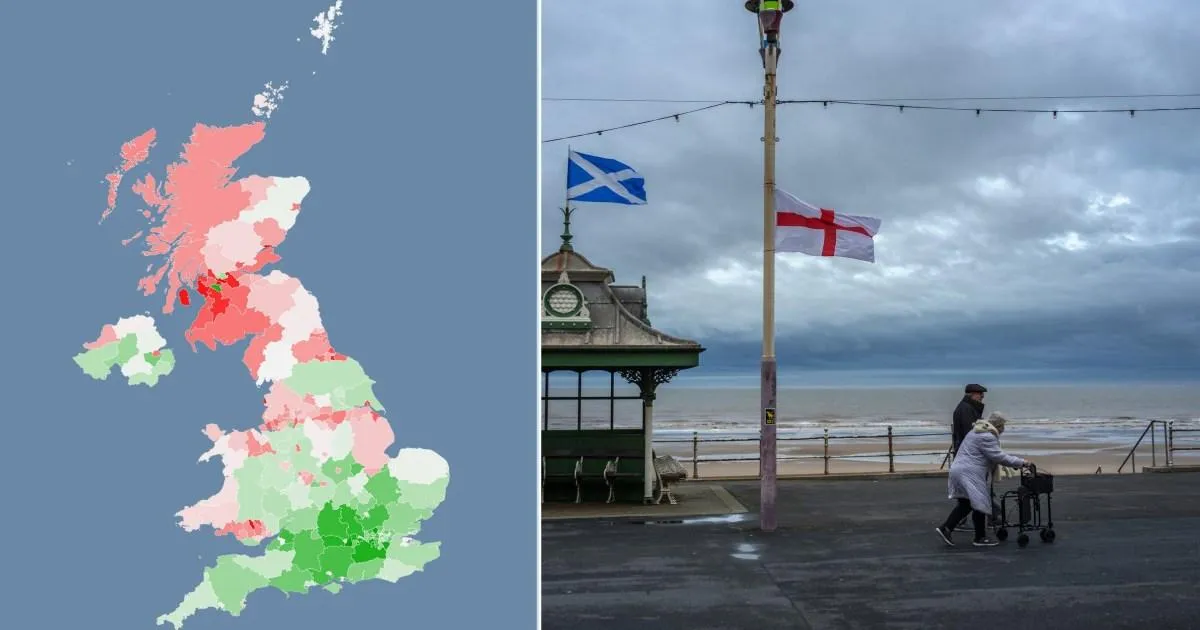
Imagine being told that your life may be shorter because of where you happen to be born. Not because of your genes, not because of the choices you make, but simply because of the postcode on your front door. That is the uncomfortable reality facing people in parts of the United Kingdom, according to new analysis by the campaign group Health Equals. The research, based on official mortality data from 2022 to 2024, reveals that people in Blackpool are roughly four times more likely to die before reaching the age of 60 than people living in Hart in Hampshire. In Blackpool, the rate is around one in seven. In Hart, it is one in 25. Think about what that means in human terms. It means a child born in Blackpool is starting life with a serious disadvantage before they have taken their first steps. It means families in one part of the country are carrying a burden of grief that families in other parts barely think about. And it is not just Blackpool. Glasgow, Dundee, Middlesbrough and communities across Scotland, Wales and the north of England are all affected. Campaigners call it a postcode lottery, but there is nothing playful about it. It is a lottery where the stakes are life and death, and the odds are set long before the numbers are drawn. The research has been shared with Metro, and an interactive map now allows people to see how their own area compares. It is not a comfortable read. The map is a patchwork of inequality, with dark clusters in post-industrial towns, coastal communities and parts of Scotland, and bright spots in the leafy suburbs and commuter belts of southern England. The gap is so wide that it is almost impossible to explain away. It follows a clear pattern of poverty, deprivation and unequal access to opportunity. It is a pattern that begins before birth and continues through childhood, education and working life. And it means that a child growing up in one seaside town can expect a very different future from a child growing up in a wealthy southern suburb. This isn’t about inevitability. It is about choices, resources and priorities. It is about whether we, as a society, are willing to accept that some lives are worth less than others. The answer, if the statistics are anything to go by, has been yes for far too long.
Across the UK as a whole, one in thirteen people dies before their 60th birthday. That is a sobering national statistic. But it hides a much deeper divide. In Blackpool, the figure is 14.7% — the highest in the country. In Glasgow, it is 12.8%. Merthyr Tydfil in Wales follows at 12.7%, Dundee City at 12.6%, North Ayrshire at 12.5% and Middlesbrough at 12.3%. North Lanarkshire, East Ayrshire, West Dunbartonshire and Inverclyde complete the list, with rates ranging from 11.7% to 12.2%. These are not abstract numbers. Every percentage point represents real people: mothers, fathers, sons, daughters, friends and neighbours. It means grandparents who never see their grandchildren grow up. It means empty chairs at birthday dinners and names on memorial benches. It means communities that have become used to loss, because the system keeps letting them down. The places on this list have something in common. They have faced decades of industrial decline, job losses, housing problems and cuts to local services. People who live there often work harder, earn less and have fewer choices. Stress and insecurity take a toll on the body as well as the mind. It is no wonder that life expectancy is shorter. But it is not a mystery. It is a consequence of decisions made by governments, councils and businesses over many years. And it is a tragedy that is largely preventable. The people who die early in these areas are not dying of some exotic illness. They are dying of heart disease, cancer, respiratory problems and other conditions that are made worse by poverty, pollution, poor housing and lack of access to care. They are dying because the conditions for good health were never put in place. That is the real scandal. It is also a reminder that health is not simply a matter of personal responsibility. It is shaped by the world around us, and for too many people, that world is harsh, unequal and unforgiving.
At the other end of the spectrum, the picture is very different. The places where people live longest before turning 60 are overwhelmingly affluent, leafy and concentrated in southern England. Hart in Hampshire has the highest rate of survival, with only 4% of people dying before 60. Uttlesford follows at 4.4%, while Surrey Heath and Richmond upon Thames both stand at 4.5%. Wokingham, Sevenoaks, Waverley, Winchester, Tandridge and Kensington and Chelsea all appear in the top ten, with rates between 4.7% and 4.8%. What do these places have in common? They have good schools, high house prices, reliable jobs, easy access to parks and green spaces, and healthcare that feels accessible. They are not healthier by accident. Money buys stability, and stability buys health. A person living in Richmond upon Thames can expect to live years longer than someone in Blackpool, not because of biology, but because of their surroundings. This is what campaigners mean when they talk about the social determinants of health. It is the air you breathe, the home you live in, the work you do, and the money you have left at the end of the month. The data from the Office for National Statistics covers deaths from 2022 to 2024, so this is not a historical anomaly. It is happening right now. And the gap between the best and worst areas is not just a statistic. It is a measure of how unequal our society has become. It is also a measure of how much we are willing to accept. If a child born in Hart can expect to live well past 60, and a child born in Blackpool has a one in seven chance of not making it, we have to ask ourselves what kind of country we want to live in. The answer should be obvious. Yet the pattern persists, year after year, with only minor changes. The map of early death in Britain has barely changed in generations. That is not bad luck. That is policy.
Those who have seen the impact of these inequalities up close say the findings should be a wake-up call. Labour MP Allison Gardner, whose own constituency of Stoke-on-Trent has a one in ten rate of death before 60, has urged her party to act. “No one should face poorer health and a shorter life simply because of where they live,” she told Metro. “This Labour government has pledged to raise the healthiest generation ever, through a cross-government health mission, and a shift to preventing us becoming ill. We now need this to happen, with a clear strategy ensuring all government departments are working towards a healthier society. We have an opportunity to address the wider factors that shape health and ensure everyone has a fair chance of living a longer, healthier life.” Her words reflect a growing frustration among politicians, health professionals and campaigners who see the same areas appear again and again in statistics like these. It is not a lack of understanding that is the problem. It is a lack of action. Health is shaped by housing, employment, education, transport and environment — not just by doctors and hospitals. Until those wider factors are addressed, the gap will remain. Paul McDonald, Director at Health Equals, was even blunter. “Your postcode shouldn’t determine your shelf life. But in the UK, it does,” he said. “Behind every statistic is a person, a family and a community experiencing loss that is often preventable. We should not accept a country where your chances of reaching 60 are so heavily influenced by where you live. If governments want growth and opportunity in every postcode, they must also deliver the basics of good health in every postcode.” That means investing in early years support, in affordable homes, in mental health services, and in the kinds of places where people want to live and can thrive. It means taking health inequality as seriously as any other national crisis. And it means measuring success not by how many hospitals we build, but by how many lives we save before they are cut short.
The roots of this inequality can be seen long before adulthood. A landmark report by the Children’s Commissioner, Dame Rachel de Souza, has highlighted the shocking disadvantages faced by children depending on where they grow up. In Blackpool, children are 27 times more likely to miss school than those in Lambeth, south London, and 46 times more likely to be excluded than those in Wiltshire. In Richmond upon Thames, around 70% of pupils achieve a good pass in English and Maths GCSE. In Knowsley, near Liverpool, that figure falls to barely 31%. These are not separate issues. They are the same story told at different stages of life. Children who miss school fall behind. Children who are excluded feel abandoned. Children who don’t get qualifications face poorer job prospects, lower incomes and worse health. By the time they reach their 50s, the damage has already been done. The fact that one in seven people in Blackpool dies before 60 is not a sudden event. It is the result of decades of neglect, of opportunities not taken, of support not given. The phrase “preventable deaths” is often used, but it is worth pausing to think about what it really means. It means that with the right help at the right time, some of these lives could have been saved. It means that every missed school day, every exclusion, every child who goes hungry or unsupported is a warning sign. The road to better health starts in childhood, and it is a road that needs to be built by every part of society. Politicians often talk about breaking the cycle. But cycles are not broken by speeches. They are broken by early intervention, by family support, by good teachers, by safe places to play, and by a sense of hope. Without those things, the statistics will not change. And the children born today in the worst affected areas will continue to pay the price with their lives.
The government says it has heard the message. A Department of Health and Social Care spokesperson said: “Someone’s postcode should never dictate how long they live, and this government is determined to tackle the stark inequalities that still exist in our country, and halving the gap in healthy life expectancy between the richest and poorest regions.” They pointed to new Neighbourhood Health Centres in the areas that need them most, and to plans to devolve power to local communities. “We will now go further in devolving power to local communities, putting decision-making into the hands of those who know their areas best, and driving lasting change across the country.” It is a positive message, but campaigners and local leaders say the proof will be in the results. The new figures are a reminder that every year, thousands of people in the UK die before reaching an age that should be considered a basic milestone. Their deaths are not inevitable. They are the product of policies, priorities and choices. The challenge now is to make sure that the government’s words become action. That will require more than good intentions. It will require sustained investment, long-term planning and a willingness to make difficult decisions. It will also require a shift in mindset, so that health is seen not just as a matter for the Department of Health, but as something that affects every department and every decision. If that happens, future maps of early death will look different. The hope is that one day, no child’s life chances will be determined by the postcode they happen to be born in. Until then, the figures serve as both a warning and a call. We can close the gap. We know how. The question is whether we have the will.