

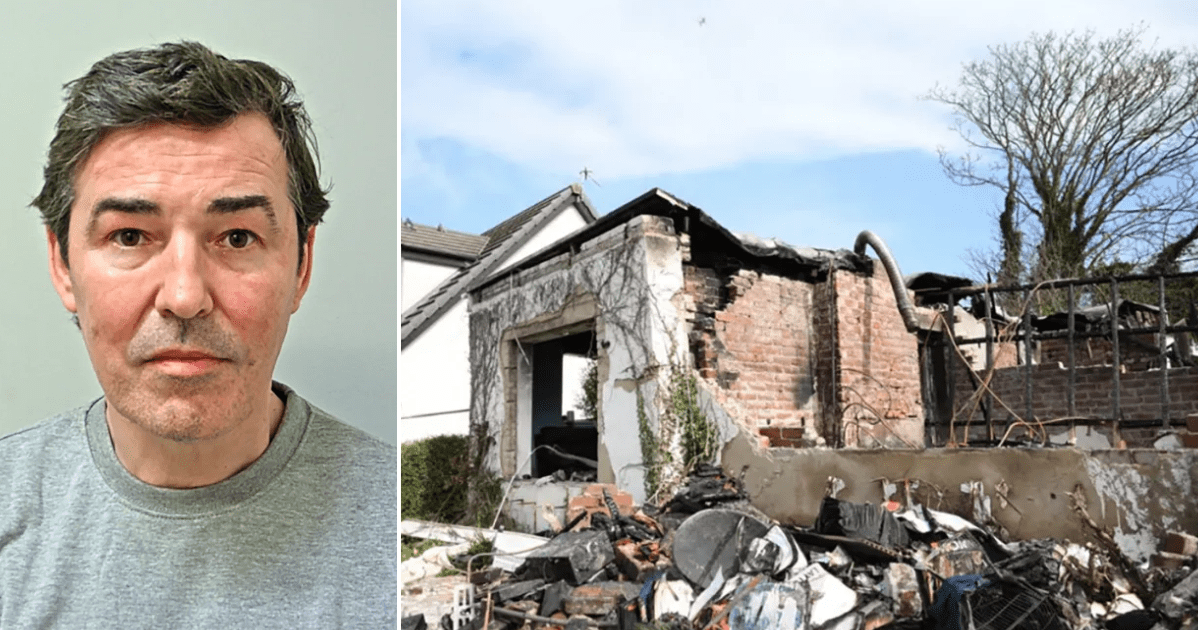
The tragedy that unfolded in the quiet residential streets of Hambleton, Blackpool, on March 27 remains a stark reminder of how unchecked mental distress can manifest in catastrophic, irreversible ways. Darren Davies, a 55-year-old man, committed an act of arson that leveled his childhood bungalow, fueled by a deep-seated and entirely unfounded delusion. Believing he had been spitefully cut out of his parents’ will, Davies poured petrol throughout his home and ignited it with a candle. The resulting explosion, which ripped through the structure and sent debris raining down onto the street, was a desperate, violent manifestation of his internal turmoil—a claim of ownership over a home he felt was being stolen from him.
The scene in the aftermath was one of total devastation. As the bungalow erupted in a plume of thick black smoke, neighbors were rattled by a blast powerful enough to collapse the roof and endanger everyone in the immediate vicinity. Emergency responders later discovered that Davies had placed gas cylinders throughout the property, underscoring the premeditated and dangerous nature of his actions. Despite the scale of the destruction, Davies emerged miraculously unharmed, reportedly telling a passer-by that if he couldn’t have the house, no one would. He was arrested on the spot, later pleading guilty to arson with reckless disregard for human life.
At the heart of the case is the profound suffering of Davies’s brother, Craig. The two had been left an equal share of the property by their parents, but a tragic misunderstanding had taken root in Darren’s mind. Despite Craig’s attempts to communicate, Darren became convinced of a secret plot to disinherit him, a narrative he constructed entirely in his own isolation. When the explosion happened, Craig lost everything: not just the physical structure, but decades of irreplaceable family history. His childhood diaries, precious jewelry, and intimate family photographs were incinerated in an instant, effectively erasing the physical remnants of the life they had built together.
The court proceedings revealed a man whose life had been shaped by long-term struggles with autism, bipolar disorder, and profound depression. Having spent years as the primary caregiver for his aging parents, Davies found himself untethered after their deaths, his mental health spiraling as he grew increasingly alienated. His defense argued that the arson was the result of an “autism crisis” rather than a malicious intent to harm others, noting that he had genuinely intended to take his own life. The judge acknowledged the complexity of the situation, noting that while the offense was undeniably severe, Davies’s mental health had fundamentally diminished his ability to make rational decisions at the time.
In a letter written to the court, Davies expressed deep remorse, apologizing not only to his brother and family but to the neighbors whose lives he had endangered. His legal team emphasized that since his incarceration, Davies has made significant strides in managing his conditions, receiving proper psychiatric treatment and medication that were previously absent from his life. This progress offers a small, silver lining in an otherwise bleak narrative, suggesting that the “slippery slope” he had been on for years might finally be leveling out as he begins to gain true insight into his own mental health challenges.
Ultimately, Judge Philip Parry handed down a four-year prison sentence, noting that the case was as heartbreaking as it was criminal. While the legal system can address the arson, the emotional fallout for the Davies family remains profound. As the Crown Prosecution Service noted, no sentence can restore the lost memories or the sense of security that was shattered that morning. As Darren Davies serves his time, his brother is left to rebuild his life from the ashes, supported by a community whose kindness has provided a rare beacon of hope in the wake of such a life-altering and senseless tragedy.