

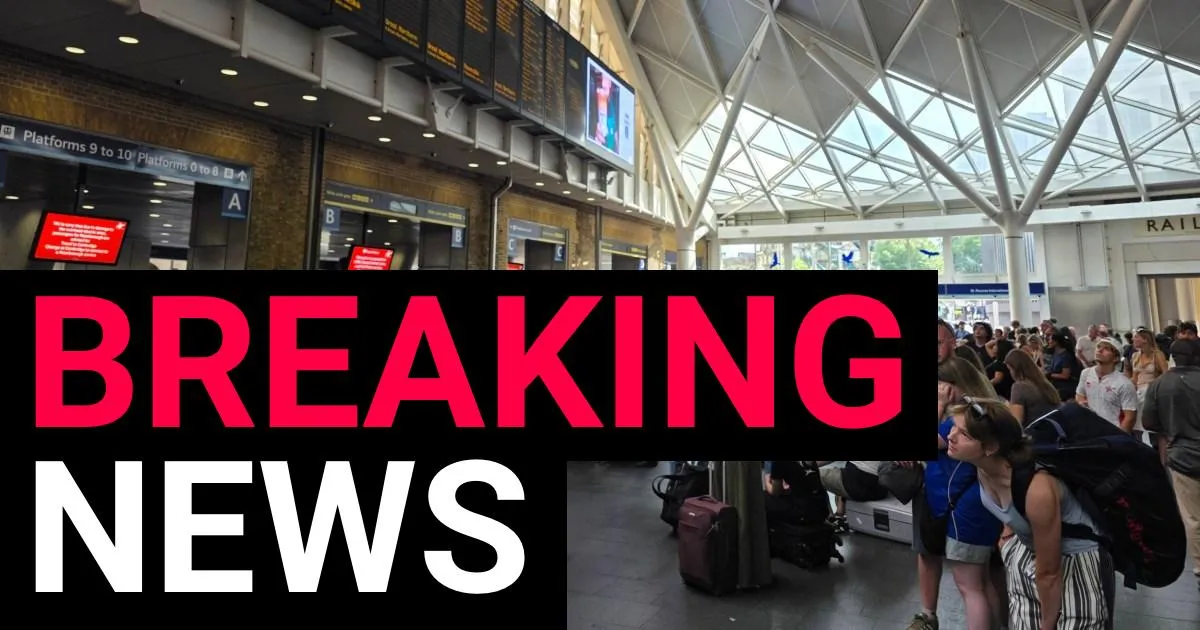
Chaos at London King’s Cross: Thousands Stranded as Major Rail Disruption Grips the Capital
The historic London King’s Cross station descended into scenes of utter chaos this morning as thousands of passengers found themselves trapped in a web of confusion, frustration, and uncertainty. The normally bustling concourse, which typically hums with the organized rhythm of commuters and travelers, transformed into a sea of anxious faces and mounting tension as news spread of a catastrophic failure in the overhead electrical wires along a critical stretch of the East Coast Main Line. Between the towns of Peterborough and Stevenage, the vital infrastructure that powers the nation’s rail network had given way, bringing Sunday travel plans to a grinding halt and leaving countless individuals stranded, confused, and desperately seeking answers that seemed nowhere to be found.
The scale of the disruption cannot be overstated, as this particular rail route serves as nothing less than a main artery connecting Scotland, the East Midlands, Yorkshire, and the beating heart of London itself. With the wires down, the entire network began to feel the ripple effects almost immediately, creating a bottleneck effect around the Doncaster area that threatened to cascade into other parts of the country’s already fragile rail infrastructure. National Rail officials, clearly overwhelmed by the magnitude of the situation, issued grave warnings that delays could spill over into other regions, affecting travelers far beyond those directly impacted by the initial failure. The affected operators read like a who’s who of British rail travel: Grand Central, Great Northern, Hull Trains, LNER, Lumo, and Thameslink all found themselves caught in the crossfire of this infrastructure nightmare, with train cancellations and delays of up to two hours becoming the unfortunate norm rather than the exception.
For the passengers caught in this transportation nightmare, the experience has been nothing short of harrowing. The station concourse, designed to handle the efficient flow of thousands of travelers, instead became a pressure cooker of anxiety and frustration as people struggled to make sense of the chaos unfolding around them. One passenger, their voice heavy with exasperation, described the scene as “chaos” with “no announcement” to guide the bewildered masses. The lack of communication only added to the sense of helplessness that permeated the air, as travelers desperately sought information about their journeys, their connections, and their ability to reach their destinations. The human cost of this infrastructure failure became painfully apparent as stories emerged of individuals whose lives had been thrown into disarray by circumstances entirely beyond their control.
Among the countless personal stories of disruption, one father’s tale stood out as particularly heart-wrenching. Craig Cotterill, his concern evident in every word, described how his 18-year-old daughter found herself “stuck at London King’s Cross” with no help forthcoming, trapped in seemingly endless queues with a crucial job interview awaiting her back home in the morning. His desperate attempts to reach the rail company through social media, pleading for advice and assistance, went unanswered, highlighting the profound disconnect between the corporate machinery of the rail industry and the very real human beings whose lives depend on its functioning. This young woman, on the cusp of her professional career, faced the very real possibility of missing a life-changing opportunity through no fault of her own, a stark reminder of how infrastructure failures can have profound and lasting impacts on individual lives and futures.
The technical explanation for the chaos, while necessary, offered little comfort to those affected. National Rail officials explained that the overhead line equipment, which carries high-voltage electricity to power the trains, had been damaged and was down in the affected area. The safety protocols, while essential, meant that extensive checks had to be completed before any repairs could even begin, with specialist engineers needing to assess the full extent of the damage before they could even contemplate restoration work. The complexity of the repair process, particularly if multiple sections of equipment had been damaged, meant that recovery could take considerable time, leaving passengers in a state of limbo with no clear timeline for when normal service might resume. The message to travelers was stark and unambiguous: check your journey before traveling, allow extra time, and be prepared for significant disruption throughout the day.
In a move that underscored the severity of the situation, LNER, one of the primary operators on this crucial route, issued an unprecedented advisory telling passengers simply “do not travel” today. For those who had already purchased tickets for Sunday travel, the company offered a small measure of flexibility, announcing that tickets marked for today could be used on Monday and Tuesday instead. Yet for many passengers, particularly those with time-sensitive commitments like job interviews, medical appointments, or family obligations, this flexibility offered little consolation. The ripple effects of this disruption extended far beyond the immediate inconvenience of delayed travel, touching the very fabric of people’s lives, their livelihoods, and their ability to fulfill their responsibilities and commitments.
The broader context of this disruption adds another layer of concern to an already troubling situation. The UK rail industry has endured a particularly difficult couple of days, marked by two separate train derailments that have raised questions about the safety and reliability of the nation’s rail infrastructure. The first incident occurred on Thursday when a Southern train veered off the tracks near Lewes during what was described as one of the hottest days of the month, while less than 24 hours later, a Greater Anglia train derailed near Wickford in Essex with dozens of passengers on board. These incidents, coming so close together, paint a troubling picture of a rail network under strain, struggling to cope with the demands placed upon it and the challenges of maintaining aging infrastructure in the face of increasing usage and environmental pressures.
For those caught in today’s disruption, there is at least some hope of financial recourse through the delay repay system. Passengers whose journeys are delayed by more than 15 minutes or whose services are cancelled may be entitled to claim compensation, with the amount depending on the severity of the disruption. For delays, passengers are advised to note down the length of the delay and keep hold of their tickets if they are not e-tickets, with claims needing to be submitted directly to the train company within a specified timeframe. While this financial compensation cannot fully address the inconvenience, stress, and potential lost opportunities caused by the disruption, it does provide some measure of acknowledgment that passengers have been let down by the system they rely upon.
As the day wears on and engineers work to repair the damaged infrastructure, the human cost of this disruption continues to mount. The scenes at King’s Cross, with its crowded concourse, frustrated passengers, and desperate attempts to find alternative routes, serve as a powerful reminder of just how dependent modern society has become on the smooth functioning of its transportation networks. When these systems fail, as they have today, the consequences ripple outward in ways both predictable and unforeseen, affecting not just the immediate travelers but also the businesses, families, and communities that depend on their safe and timely arrival. The resilience of the human spirit, however, remains evident in the faces of those who, despite the chaos and frustration, continue to seek solutions, help one another, and find ways to navigate the obstacles placed in their path. For now, all anyone can do is wait, hope, and pray that the engineers can restore service quickly and that the thousands of stranded passengers can eventually reach their destinations, their dreams, and their loved ones.