
Paragraph 1: The Ordinary Journey Turns Catastrophic
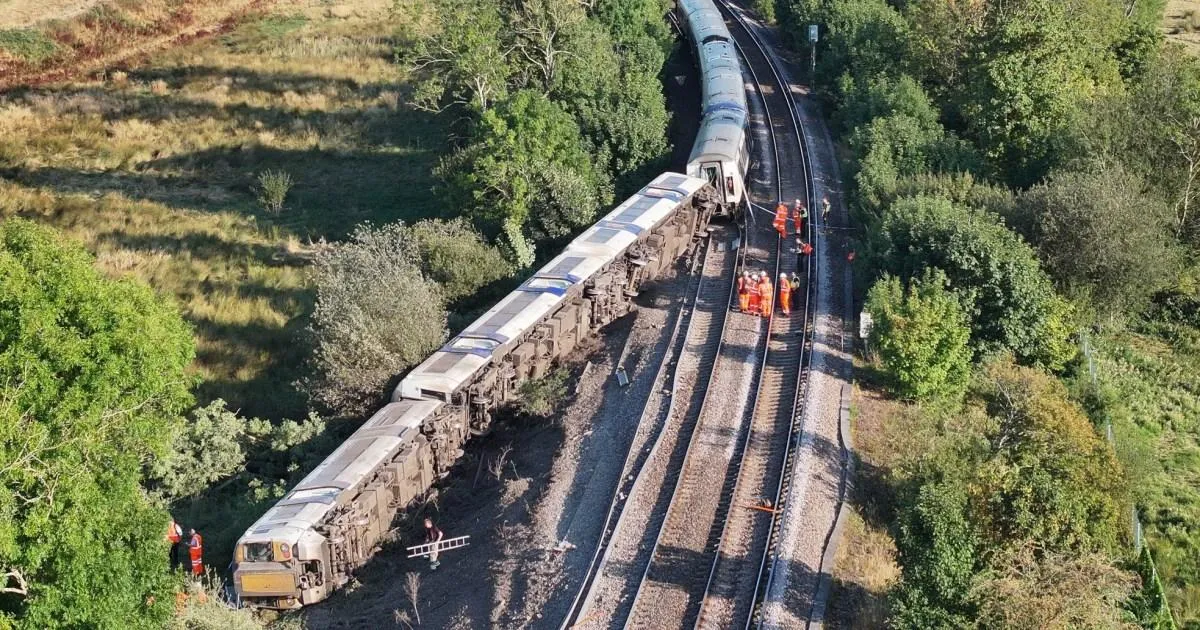
It was an ordinary Thursday afternoon when the 3:50 PM London Victoria to Eastbourne service departed, carrying roughly one hundred and fifty passengers who were likely daydreaming about the seaside, heading home from work, or perhaps simply absorbed in their phones. For the majority, the repetitive rhythm of the tracks was a familiar lullaby. However, in a terrifying split second, the mundane was ripped apart. Without warning, three carriages violently left the rails, throwing the train into a chaotic, grinding halt. The sudden, violent deceleration sent bodies flying from seats, luggage crashing from overhead racks, and a cloud of thick, acrid dust and smoke billowing through the corridors. For the passengers inside, there was no time to prepare. They described the sensation as a sudden lurch into a state of “topsy-turvy” pandemonium, where up and down became meaningless as the train skidded and buckled. The initial shock was immediately followed by a wave of primal fear, as people realized they were trapped. Some were pinned, while others struggled to make sense of the splintered wreckage surrounding them. While eighteen people escaped with non-serious injuries, two individuals were tragically flung with enough force to sustain severe injuries requiring immediate medical attention at major trauma centres. Miraculously, despite the sheer violence of the impact, initial reports confirmed that those severe injuries were not considered life-threatening, offering a fragile relief against the backdrop of chaos that had just unfolded. However, for the hours that followed, those trapped inside the mangled carriages experienced a desperate wait, relying on ladders and the steady hands of emergency services to be extracted from the twisted metal. The idyllic route to the coast had become a nightmare, leaving a community shaken to its core.
Paragraph 2: The Aftermath and the Closing of a Critical Artery
In the immediate aftermath of the derailment, the primary focus shifted from rescue to recovery and logistical damage control. As emergency services heroically worked to free the remaining passengers and transport the injured to nearby hospitals, a “major incident” was declared, triggering a blanket “do not travel” warning across the affected network. However, it soon became clear that the repercussions of this incident would extend far beyond the initial few hours of chaos. On Friday, Network Rail and Southern Rail issued a joint update that delivered a stark reality to commuters and residents in the region: the rail line between Lewes and Haywards Heath would remain completely closed for at least the next ten days. This wasn’t a simple overnight fix; the infrastructure had suffered significant damage. The authorities explained that teams needed an extended window of time to safely recover the derailed carriages—a painstaking process involving heavy lifting equipment and careful engineering to prevent further damage—and then to begin the complex task of repairing the railway lines, signaling systems, and overhead catenary wires that had been torn or bent out of shape. For daily commuters and leisure travelers alike, the closure of this vital artery between the Sussex coast and London presents a daunting fortnight of disruption. While rail replacement buses have been promised to bridge the gap between Lewes and Haywards Heath, serving stations like Cooksbridge and Plumpton, Southern Rail was quick to warn that these services have limited capacity. The announcement carried an implicit plea for patience, asking customers to check their journeys before departing and to consider alternative routes, such as traveling via Brighton, which adds significant time to daily commutes. The closure has effectively severed a critical link, leaving thousands of people to scramble for crowded buses or navigate long detours, turning a simple journey into a logistical puzzle.
Paragraph 3: The Human Toll – Echoes of Fear and Trauma
Beyond the broken tracks and the logistical nightmares lies the profound psychological impact that the derailment has inflicted on the passengers who lived through it. The human stories emerging from the wreckage paint a harrowing picture of terror and resilience. Among them was Rob Bradley, who was traveling with his six-year-old daughter. His recollection of the events is chillingly vivid; he described feeling the train inexplicably “speeding up and starting to rock” just moments before the catastrophic skid. As the emergency brakes slammed on, the laws of physics turned hostile—everything in the carriage was thrown forward with immense force, launching people from their seats into heaps on the floor. Bradley admitted that the scene was sheer “pandemonium,” with smoke and dust pouring into the carriage, mingling with the cries of the injured. He saw people lying with severe head wounds and bloody cuts, a sight no parent should ever witness, especially with a child in their care. Another passenger, 56-year-old Yana Ludwig, who was traveling alone, described herself as “pretty banged up” following the ordeal. She recounted the agonizing twenty minutes it took for emergency services to reach the stranded and broken train, a period of immense anxiety where the injured had to rely on the makeshift first aid of fellow passengers. The trauma isn’t solely physical; the mental scars of being trapped in a metal box, uncertain if help was coming, will likely linger long after the bruises fade. The memory of the ladders, the jagged metal, and the overwhelming smell of burning brakes will remain a haunting flashback for these survivors, who now face the difficult journey of recovery, both in hospitals and in their own minds.
Paragraph 4: A Bizarre Coincidence – A Second Derailment Rocks the Nation
As if the Lewes incident wasn’t enough of a shock to the nation’s transport system, a bizarre and unsettling sequel unfolded less than twenty-four hours later. In Wickford, Essex, another train derailed, this time carrying approximately forty to forty-five passengers on a route from Southend. Witnesses at the scene recalled hearing an “almighty crunching” sound that immediately led them to believe a catastrophic crash had occurred, a noise so violent that it shattered the normal ambient sounds of the railway. Miraculously, the outcome of this second incident was drastically different; the train carriages remained upright, and there were no reported injuries. The passengers were shaken, but physically unharmed, left to disembark and face the confusion of a halted journey. Yet, the sheer proximity of these two events—occurring within a single 24-hour window—sent a ripple of anxiety and a wave of questions through the public consciousness. What was happening on Britain’s railways? Was this a mere statistical coincidence, or did it point to a deeper, systemic vulnerability? The visual evidence of bent and buckled steel tracks photographed at the Essex site seemed to provide a potential clue. With the United Kingdom gripped by an intense heatwave, thermometers soaring to sweltering 38°C temperatures, the tracks appeared to be physically warping under the immense stress of the heat. The connection between the extreme weather and track integrity became impossible to ignore, transforming the second derailment from a bizarre anomaly into a worrying indicator of how vulnerable the infrastructure might be to the changing climate.
Paragraph 5: The Heat, the Infrastructure, and the Official Reassurance
The spotlight immediately turned to the blistering heat and its effect on the metallic nerves of the railway network. Steel tracks, laid continuously for smooth journeys, expand when heated. In extreme temperatures, this expansion can cause the rails to buckle and bend, effectively creating a physical hazard that can derail a train. The bent and misshapen tracks photographed in both Lewes and Wickford provided stark visual proof of this phenomenon. In the face of mounting public concern, Network Rail executive Martin Frobisher stepped forward to address the nation. He admitted candidly that the “unprecedented hot and dry weather that we have experienced this summer” has presented exceptional challenges to the railway. It was a rare admission of the strain placed on the aging Victorian-era infrastructure by modern climate extremes. Despite this, officials were quick to point out that the exact cause of the Lewes derailment remains unknown, with the Rail Accident Investigation Branch (RAIB) deploying a full team of experts to painstakingly gather evidence from the scene. The public was urged not to speculate, as the investigation would look into all possible causes—from track faults and mechanical failures to human error and thermal buckling. Meanwhile, the Department for Transport attempted to calm frayed nerves by reiterating that Britain’s railways remain “among the safest in the world,” a statement intended to offer assurance, though it did little to quell the immediate fears of those now facing a disrupted fortnight of travel or the lingering doubt of those who had witnessed the terrifying power of the derailments firsthand.
Paragraph 6: A Look Toward Recovery and the Road Ahead
As the investigations continue to dig for concrete answers, the immediate priority for the Lewes and Haywards Heath line is the slow, grinding process of physical recovery. The next ten days will be dominated by the arrival of cranes, engineers, and maintenance crews who will work to clear the wreckage of the derailed carriages and rebuild the damaged track bed. For the local community, this means a period of prolonged patience, longer commutes, and a reliance on replacement services that cannot possibly match the capacity or speed of the regular rail service. The phrase “do not travel” has become a familiar, anxiety-inducing refrain. Yet, beyond the logistical annoyance, these twin incidents serve as a powerful wake-up call. They highlight the precarious balance between the comforting reliability of daily transport and the ruthless forces of physics and extreme weather. The resilience shown by the passengers in Lewes—crawling out of ladders, helping the injured, comforting strangers—is a testament to the human spirit. As the RAIB sifts through the debris for clues, the railway industry must also look forward, grappling with how to maintain a century-old network against a very modern climate crisis. The focus now is on healing—healing the injured, healing the damaged tracks, and healing the shaken trust of the traveling public. While the immediate answers may remain buried in the wreckage, the determination to get the trains running again, safely, and to learn from this terrifying ordeal, remains the central goal. The sea air of Eastbourne will await, even as the passengers who never made it there carry the memory of that fateful Thursday with them for a long time to come.