

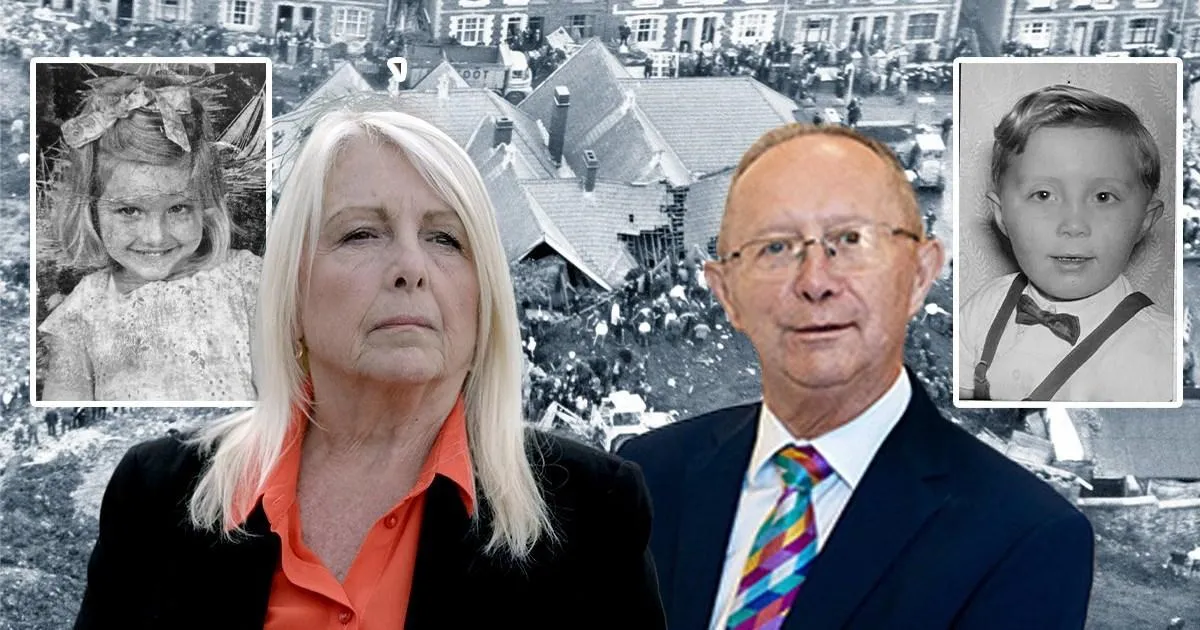
Sixty years ago today, the village of Aberfan in South Wales was torn apart by a wave of black coal waste that came without warning. Among the rubble of Pantglas Junior School, eight-year-old David Davies lay still, his small body placed with the dead in the school playground and covered with a blanket. He had been knocked unconscious by debris that crashed through his classroom when the colliery spoil tip above the village collapsed and sent thousands of tons of slurry, mud and mining waste hurtling down the mountainside. It was only when someone saw his foot move that hope flickered through the chaos. Doctors were called back, and the boy presumed dead was rushed to hospital. In a matter of minutes, half of his classmates had been killed. In total 116 children and 28 adults lost their lives on 21 October 1966, bringing heartbreak to every corner of a close-knit mining community. The disaster happened on the last day before the half-term holiday, a day that should have been filled with excitement and the promise of a week off school. Instead, the morning became a nightmare. David was eight and a half years old, a child in a classroom full of children, none of them prepared for the sudden roar from the mountain. The avalanche of black coal waste smashed through windows and walls, swallowing desks, books and young voices in a suffocating tide. Rescuers, many of them parents and neighbours, dug with bare hands through the slurry and bricks, desperate to reach the children beneath. The scene was one of unimaginable devastation. When David was carried out, his face and body were so still that nobody dared to believe he might be alive. His survival, as he would later explain, came down simply to where he happened to be sitting in the room. Half of his 36 classmates did not make it. That single detail—a desk, a position, a moment of chance—separated life from death.
For years, villagers and even the school’s headteacher had warned about the danger of the No. 7 tip, an enormous pile of mining waste that loomed over Aberfan and had been built on top of two underground streams. Rain fell for weeks before the fateful day, soaking into the mound of colliery spoil until it could not hold itself together. Then the mountain itself seemed to give way, sending a tsunami of slurry, mud and colliery waste down the slope towards the school. David remembers the drizzly, grey weeks leading up to the disaster. He was in his classroom when debris came crashing down from above and from the side, as he later described it. Some children were trapped at their desks, pinned by the weight of the rubble; others were buried completely. Something fell from above and struck him on the head. He was trapped and pinned at his desk, not unconscious immediately, but fairly quickly. For a long time, the boy lay hidden beneath the debris while the world above him searched, dug and prayed. When he was finally pulled out, he was unconscious and presumed dead. Placed with the children who had been killed, he might have been overlooked if not for the tiny movement of his foot. His recovery in hospital was slow enough to test the patience of an active child, and he begged to be allowed home by Bonfire Night, on 5 November. The head injury would heal, but the memory of that morning was not something a child could simply leave behind. The questions came later, in quiet moments: why did he survive when so many others did not, and what was he supposed to do with the strange gift of being alive?
Across the hospital ward, in a bed opposite David, lay Gaynor Madwick, a girl whose survival felt both miraculous and unbearably painful. Gaynor had been in her classroom when she heard an overwhelming rumble from the mountains above. Before she could run, the slurry swept her away. A radiator was torn from the wall by the force of the flood and smashed into her leg, breaking it badly. It was a brutal injury, but in a strange twist of fate it may have saved her life, because it kept her in a pocket of space where the waste could not fully bury and suffocate her. She was rescued by her own grandfather, Stan, and other men who had raced to the school to dig out the children. But the joy of her rescue was crushed by grief: her brother Carl, aged seven, and her sister Marylyn both died in the disaster. Gaynor remained in hospital for three months, a long, lonely separation from a home that would never again be the same. Sixty years later, the pain is still close to the surface. “It’s taken 60 years,” she said, “and it’ll probably take many, many more years – until I die – to actually have some peace from it. You can only live in hope and try to live your life as best you can.” Her words reflect a truth that many survivors carry: the disaster did not end when the digging stopped. It lived on in birthdays, anniversaries and quiet moments of guilt for being the one who came home. For years, Gaynor carried feelings of guilt and isolation as she tried to make sense of the loss of her siblings, and only slowly has she come to understand that survival was not something to be ashamed of.
The village that David and Gaynor grew up in was no longer the place they had known. In the aftermath, there was no counselling and no public language for what children had experienced. “You came home and you got on with life as best as you could,” David said. “There was an awareness that a lot of the friends and children in the class and in other classes had sadly died. Parents didn’t really speak to the children in many cases about it all, and vice versa.” Silence became a way of surviving, but it also turned grief into something heavy and unspoken. The official inquiry blamed the National Coal Board for the disaster, finding that the tip had been unsafe and that warnings had not been properly heeded. Yet nobody was prosecuted, and the bereaved families received only £500 in compensation. The insult felt even sharper when the government later took £150,000 from the Aberfan charity fund to help pay for removing the spoil tips around the village. For many, that decision was a second betrayal, and the anger did not subside until the New Labour government returned the money in 1997. The sense of injustice has never fully gone away. Gaynor met former Labour leader Andy Burnham in the village on Monday and told him plainly that Aberfan had never had justice. But she also made clear that bitterness is not a path forward. “You’ve either got to let the demons in your life go because they will eat you up the rest of your life,” she said. “So we have to now go forward with hope.” That difficult balance—between remembering injustice and choosing hope—has defined the lives of many survivors.
Over the decades, David and Gaynor have both turned their sorrow into something that might help others. David now chairs the Aberfan Memorial Charity, working to keep the memory of the disaster alive and to support the community he loves. He showed Andy Burnham around the memorial garden on Monday, and he was instrumental in negotiating a £2 million grant from the Welsh government in 2007 for the Aberfan memorial and education charities. “I have always had a feeling of wanting to put something back into our local community and to honour the memory of those who were not able to have the life opportunities that I was able to,” he explained. That sense of purpose is also a way of living with survival. For Gaynor, the journey has been slower and more private, but in recent years she has found that survivors are beginning to speak openly. When Andy Burnham visited, she said, “I was sat with a few other survivors, and we were all chatting normally about that day. That has never happened.” More people are now sharing their stories, she added, and survivors are encouraging each other to come forward and pay their respects. David, however, is wary of the extra intensity that comes with a big anniversary. For those who lived through the disaster, every year is the same. “You have the same feelings from one year to the next,” he said. “You learn to live and cope with these things within reason.” The moments that are hardest are not necessarily the biggest milestones; they are the everyday reminders, the empty chairs at family tables, the names of classmates who never grew up.
On this anniversary, the country will stop to remember. King Charles, Queen Camilla and Prince William are travelling to South Wales on Wednesday to pay tribute to those who died, and their presence will underline the importance of the day. For Gaynor, the community’s courage will be visible in the crowds that gather and in the shared silence. “That minute silence for me is the worst part,” she admitted, “because you go back to that actual day and those feelings are so overwhelming you can’t shut them out and you can’t stop them.” Yet she also sees the anniversary as a demonstration of solidarity and resilience. The village has learned, slowly, to talk. Gaynor hopes that future generations will carry the story forward long after the last survivor is gone. “When we all pass away, we need people to come to our cemetery every year. We need that to be carried forward. It is the children of today who have to continue that legacy for Aberfan.” David echoes that sense of duty. “There’s not much relevance to there being a big anniversary number,” he said. “You have the same feelings from one year to the next.” What matters, perhaps, is not the size of the anniversary but the willingness to remember. Sixty years after a black avalanche destroyed a school and shattered a village, the people of Aberfan are still standing. They have carried their grief, their anger and their love through decades of silence and struggle. They have honoured the 116 children and 28 adults who died by refusing to let the world forget. And in their stories, told now with more openness than ever, there is a quiet lesson: even the heaviest sorrow can be borne, and even the deepest scar can become the foundation of a more tender kind of strength.