
In the thin, dark hours of Saturday morning, when the roads are usually quiet and the world is still turning over in its sleep, the A66 near South Bank in Middlesbrough became the scene of an unimaginable catastrophe. A Volkswagen Passat, travelling on the wrong side of the carriageway, collided head-on with a police patrol vehicle. Seven people were killed in an instant: five young men inside the Passat and two police officers who had been on duty, protecting the public. The young men were Cole Worthy, just seventeen; Theo Rae, also seventeen; Makai Saddington, eighteen; and two twenty-three-year-olds, Michael Robert Cahill and Jacob Matusiak. The officers were PC Tom Clough, thirty-eight, and PC Matthew Blades, thirty-seven, each described by colleagues as devoted public servants. The shock of that single moment has spread far beyond the crash site. It has rippled through the streets of Eston, Grangetown, South Bank and Acklam, through homes and pubs and school gates, leaving a community struggling to make sense of the loss. Five young men with their whole lives ahead of them; two officers who clocked in for a shift and never came home. The grief is raw, and it is complicated by the fact that the aftermath has brought anything but peace. Since the crash, Middlesbrough has seen a stabbing, a house fire, a car rammed into a home, and a wave of rumours that have made an already grieving town even more anxious and uneasy. In the middle of all this, people have tried to do the only thing they can: they have laid flowers at the crash scene, held one another a little tighter, and waited for answers that may still be a long way off. The A66 is not just a road; it is a daily route for thousands, and now every driver who passes that stretch carries the weight of what happened there. The normality of everyday life has been suspended, and nothing feels certain anymore.
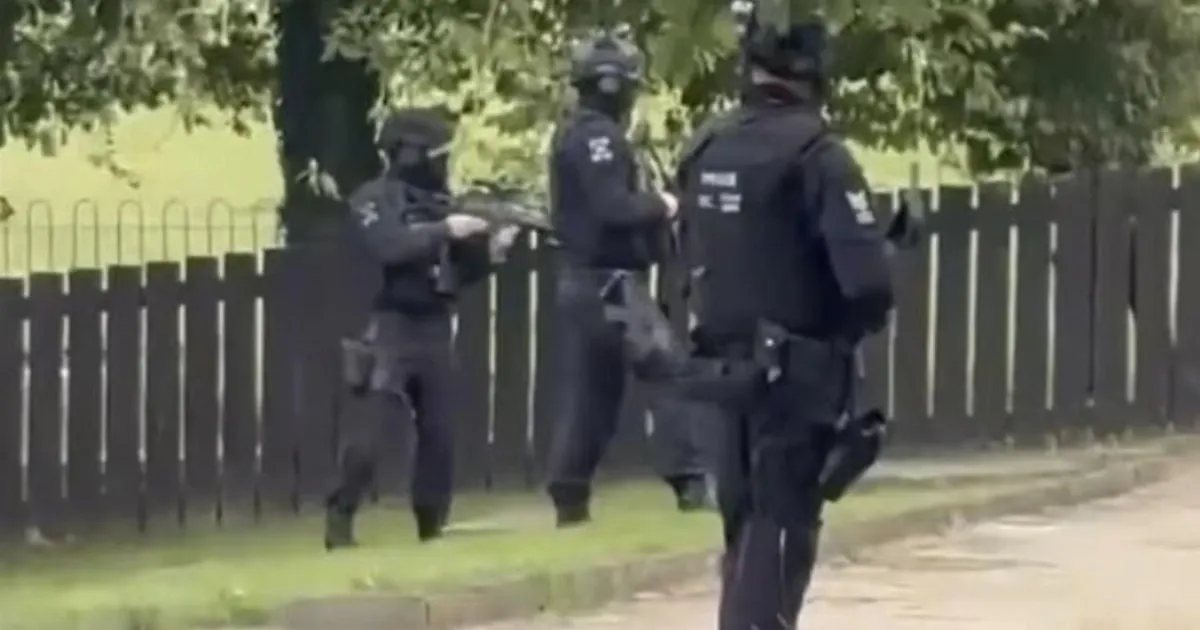
Those answers have not come quickly, and the silence has allowed fear to spread. On Wednesday afternoon, armed officers were seen in Eston after a 39-year-old man was stabbed on Sedgemoor Road. The sight of police in tactical gear on an ordinary street, in a town that has seen more than its share of trouble, was another jolt to the system. A vehicle rammed into the wall of a home in South Bank on the same morning, leaving residents shaken and property damaged. In Grangetown, a mysterious house fire on Birchington Avenue killed Natalie McDonald, thirty-four, and her niece Valentina Foster, just seven, and two men, aged twenty-three and thirty-one, have been arrested on suspicion of murder. In Acklam, a home damaged by a vehicle linked to the Volkswagen Passat is said to have belonged to the father of one of the young men who died in the crash. Each incident has its own victims, its own crime scene, its own family torn apart. Together, they paint a picture of a community under siege. Police have not confirmed any connection between the stabbing and the A66 crash, but they have also not ruled it out, and that ambiguity hangs over every conversation. Online, rumours are swirling: that the five young men in the Passat had gang links, that the fire was an act of revenge, that more violence is coming. The rumours are repeated in WhatsApp groups and comment sections, growing with each telling. None of it has been verified, and much of it may be false, but in the absence of official information, speculation has become its own kind of terror. Neighbours are locking their doors. Parents are keeping children indoors. A town that always prided itself on its warmth and solidarity is now looking over its shoulder. The crime scene cordons have become a familiar sight, and the sound of sirens no longer fades into the background but draws people to their windows to see what has happened now.
The authorities have responded with a visible and significant show of strength. More than two hundred additional police officers have been drafted in to assist Cleveland Police, one of the smallest forces in the country. They have come from forces around the United Kingdom, and they include detectives as well as armed response officers. Councillor Alec Brown, the leader of Redcar and Cleveland Council, confirmed that officers were already on the ground or on their way, and said he would be sending a letter to the Prime Minister asking for even more resources. The scale of the deployment is a measure of how seriously this is being taken. It is also a measure of how much strain the local force is under. Cleveland Police has had to deal not only with the crash itself and its complex investigation, but with a sudden eruption of serious violent incidents across a small geographic area. The extra officers are there to reassure the public, to maintain order, and to prevent the situation from escalating further. But their presence is a double-edged sword. For many people, seeing an armed officer on their street is comforting; for others, it is a reminder that something has gone badly wrong. The stabbing in Eston has not yet led to any arrests, and the investigation continues. Detectives are still working to establish whether the assault was linked to the crash, and until they do, no one can feel entirely safe. The community is being asked to be patient, to trust the process, to let the police do their work. But patience is hard when every siren sounds like the beginning of yet another tragedy. It is also hard when the plea for help has to go all the way to the Prime Minister, because the local force simply does not have the numbers to cope. The arrival of officers from other areas is welcome, but it also reveals how stretched public services have become, and how fragile the peace has become. For now, the visible presence of law enforcement is the most immediate comfort the town has, even if it is a comfort born of necessity.
Amid the official statements and police cordons, the human cost is being felt most acutely by the families. Josh Kirton, the brother of Natalie McDonald, who was killed in the Grangetown house fire alongside her seven-year-old niece Valentina, has spoken out against the online rumours that her death was gangland retribution. His words have the rawness of grief and the firmness of someone defending a loved one’s memory. “My sister was not involved with anything to do with gangs, or the crash on the A66,” he said. “That’s what makes this so senseless. People think they can do whatever they like. There’s some terrible people in the world and now my sister and Valentina have gone.” It is a devastating sentence: “now my sister and Valentina have gone.” A woman in her mid-thirties, a little girl who had barely begun to live, both gone because of something that, according to her brother, had nothing to do with her. Terry Chapman, who grew up in Grove Hill and returned to Middlesbrough to pay his respects, described the house fire as an extreme example of the violence that has been affecting the area. He said that the vast majority of people are law-abiding and “are having to put up with all this feral behaviour.” His choice of words may be blunt, but it reflects the frustration of many residents who feel that a small, violent minority is dictating the climate of fear. Flowers have been left near the scene of the fire, small tributes of colour against the grey of tragedy. They are for Natalie and Valentina, but they are also for everyone who has been caught up in the chaos: the families of the five young men, the families of the two officers, and all the ordinary people of Middlesbrough who just want to live their lives in peace. Grief, in this context, is not a private affair. It is shared, and it is made heavier by the suspicion that these deaths may not have been random at all. The living now have to carry both their own sorrow and the weight of a town’s fear.
The legal process, meanwhile, has begun the slow and painful work of establishing exactly what happened. Inquests opened today into the deaths of PC Tom Clough and PC Matthew Blades, the two officers killed in the A66 crash. The provisional cause of death for both was head and neck injuries, and the inquests were adjourned while the criminal investigation continues. Separate inquests were also opened for the five young men. The coroner gave the causes of death: Jacob Matusiak died of neck injuries; Michael Robert Cahill of head and torso injuries; Makai Saddington and Theo Rae of head injuries; and Cole Worthy of chest injuries. All five were identified by fingerprint analysis, a grim detail that speaks to the severity of the collision. In a separate development, seventeen people have been arrested as part of the ongoing investigation, including a sixteen-year-old boy and two men aged eighteen and twenty-one, all on suspicion of taking part in organised crime. The revelation that all of the young men who died, apart from Cahill, had criminal records, including motoring offences, adds another layer of complexity to the public’s understanding of the tragedy. It does not make their deaths any less sorrowful, nor does it diminish the grief of their families. But it does mean that the investigation is not straightforward. The police are dealing with questions of gang involvement, organised crime, and the possibility that the crash was connected to a wider pattern of violence. For the families of the two officers, the pain is clear: two good men went to work to protect the public and never came back. For the families of the five young men, there is the double burden of grief and stigma. Every detail released in court adds to the story, but the full truth remains elusive, and the inquests may only be the beginning. The process will be long, and for every answer it provides, it may raise new questions. In the meantime, the families wait, and the town waits with them, hoping that the justice system can bring some clarity to a situation that currently feels chaotic and deeply unfair.
For now, Middlesbrough is left in a strange and painful limbo. The extra officers are on the streets, but they cannot bring back the dead, and they cannot instantly dissolve the anger and suspicion that have been mounting. The inquests will continue, the arrests will be tested in court, and the investigations will unfold over months. But a community does not heal on a legal timeline. People need to feel safe in their homes, to walk down their own streets without fear, to let their children play outside again. They need to know that the deaths of Natalie and Valentina were not senseless, that the stabbing in Eston will be solved, that the violence will stop. They need accountability, yes, but they also need peace. The rumours that spread online have done their damage, and it will take time for trust to be rebuilt. Yet there are signs of hope. The flowers left at the scenes, the vigils, the neighbours helping neighbours, the determination of local leaders to demand more resources from the Prime Minister: these are the things that will carry Middlesbrough through. Terry Chapman was right that the vast majority of people are law-abiding. They are also resilient, compassionate and stubbornly committed to their town. The tragedy of the A66 is no longer just a road accident; it has become a test of the community’s character. In the face of violence and grief, the people of Middlesbrough are being asked to choose what kind of town they want to be. Everything that happens in the coming weeks and months will shape that answer. But if the humanity shown by victims’ families and neighbours is any guide, the answer will be one of courage, not fear. The healing will not be quick, and it will not be easy. But the first step is simply to keep caring, to keep paying attention, and to refuse to let the darkness have the last word. That is the quiet, stubborn act of hope that defines a community in mourning, and it is the only way forward.