


The Mysterious Sword of Chiddingstone Castle: A 200-Year-Old Secret Revealed
In a discovery that seems straight out of Arthurian legend, a remarkable sword has emerged from the depths of a castle lake in Kent, England, after remaining hidden for over two centuries. The blade, which has already earned the nickname “Kent’s Excalibur,” was uncovered when scorching summer temperatures caused the lake near Chiddingstone Castle in Edenbridge to dry up completely. What makes this discovery even more extraordinary is that it wasn’t found through careful archaeological excavation or sophisticated underwater scanning equipment, but rather by pure chance when volunteers clearing fallen branches from the exposed lake bed spotted something glinting in the sun. The team, working to maintain the castle grounds during the unprecedented drought, noticed the metal object partially buried in the dried mud and managed to fish it out using a grappling hook, unaware that they had just pulled a piece of history from the murky depths.
The moment the volunteers revealed their find to the castle’s curator, Naomi Collick, she was rendered speechless with amazement. A 33-year-old who has devoted nine years to working at the historic property, Collick immediately recognized that this was no ordinary discovery. The volunteers who made the find, named Gordon and Paul, might not carry the legendary name of King Arthur, but Collick humorously noted that they still bear quite noble names. She playfully suggested that perhaps they too might be destined for greatness, much like the mythical king who pulled a sword from a stone. The excitement among the discovery team was palpable, with Collick describing how the volunteers were absolutely thrilled and proud of their find. For someone who has spent nearly a decade exploring and maintaining the castle grounds, never before had anything remotely similar been uncovered, making this discovery all the more extraordinary and fascinating.
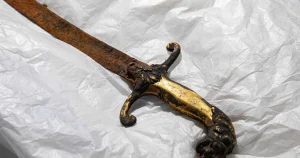
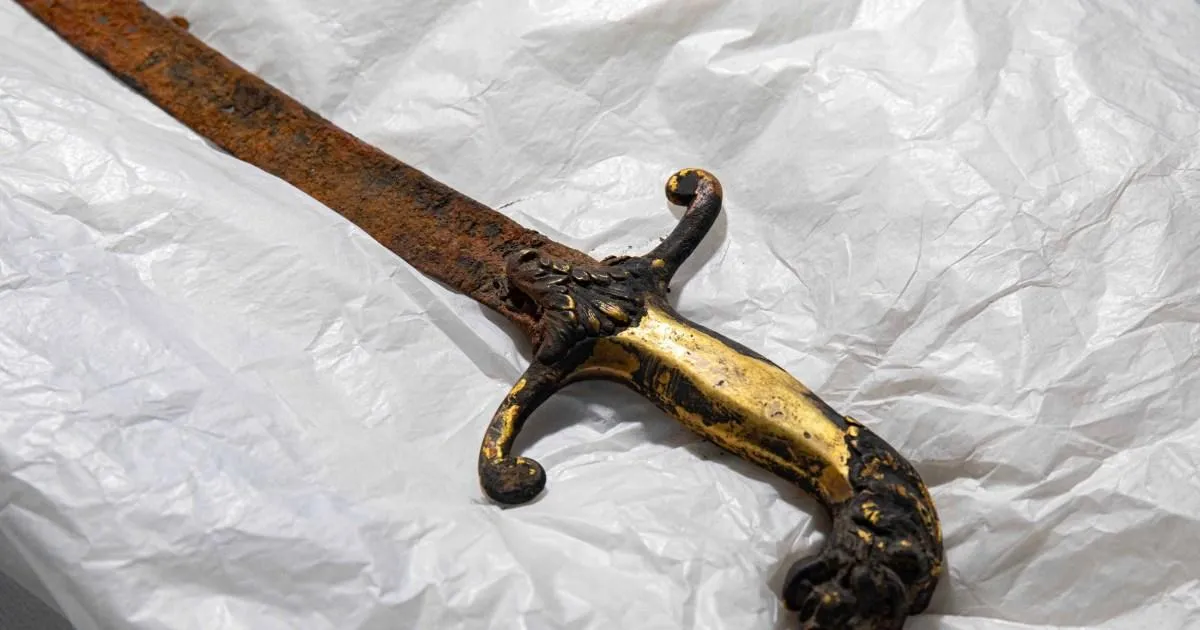
The sword itself is a study in contrasts, featuring a beautifully preserved gilded hilt with an ornate lion’s head adorning its end, crafted from brass and still in remarkably good condition despite its long submersion. The curved blade, however, tells a different story, coated entirely in rust and caked with lake mud that has accumulated over its centuries-long underwater sojourn. Castle staff have taken meticulous care in handling this precious artifact, wrapping it in acid-free tissue paper and donning gloves whenever they need to touch it, recognizing both its historical significance and its delicate state. The initial research into the sword’s origins has opened up a fascinating detective story with multiple possible explanations for how this magnificent piece ended up at the bottom of a lake. The most likely theory suggests it may be a ceremonial bandsman’s sword from the early 1800s, which would align perfectly with the estimated age of the lake itself, which was constructed during that same century, making the sword’s maximum potential age around 200 years.
But the theories don’t stop there, and each potential explanation adds another layer of intrigue to the mystery. One particularly compelling possibility is that the sword belonged to Denys Eyre Bower, the castle’s former owner, who was known as something of an eccentric character and had a passion for collecting antique swords as part of his work as an art dealer. Another theory suggests the blade could have been left behind by troops stationed at the castle during World War Two, when the grounds were pressed into military service. However, the most enchanting and romantic explanation involves local folklore, speaking of a ghostly soldier said to haunt the lake, with legends telling of a military man who tragically fell into its waters and was never seen again. This spectral theory captures the imagination and adds a supernatural element to the already remarkable discovery, even if Collick admits that such ghost stories cannot be verified through any historical records. The curator embraces the uncertainty, acknowledging that with so many possibilities to consider, the truth behind the sword’s watery resting place remains an engaging unresolved mystery.
The search for answers continues as Collick and her team have reached out to numerous museums and historical experts, hoping someone might be able to provide definitive identification of the sword’s origins. They have delved deep into the castle’s archives, painstakingly reviewing records and documents in search of any mention of a missing sword or the circumstances that might have led to it being discarded in the lake. The ongoing investigation represents a labour of love for those involved, who understand that the truth might forever remain elusive but are determined to piece together whatever information they can uncover. Meanwhile, the surrounding grounds continue to suffer from the effects of the severe drought that has plagued England, with more than two-thirds of the country now officially classified as being in drought conditions. The castle’s lawns have turned completely brown and dry, trees are shedding their leaves much earlier than normal, and Collick has observed the dramatic impact of the heatwaves on the entire landscape. Rather than viewing this environmental crisis purely as a negative, she reflects on the silver lining, noting that if water levels continue to drop due to the persistent heat and drought conditions, perhaps more historical treasures might be waiting to be revealed from beneath the receding waters.
This remarkable discovery at Chiddingstone Castle serves as a poignant reminder that history often lies hidden just beneath the surface, waiting for the right moment to reveal itself. The sword, once a symbol of ceremony and status, lay forgotten in the cold, dark waters for generations while countless visitors walked the castle grounds above, unaware of the treasure below. Its emergence during one of England’s most severe droughts in recorded history adds another layer of significance to the find, as climate change continues to reshape landscapes and expose secrets that were meant to remain hidden. While the true story of how this beautiful blade came to rest at the bottom of a castle lake may never be fully known, its discovery has captured the imagination of all who hear about it. The sword now rests safely in the castle’s care, its rusted blade and gleaming hilt telling a silent story of mystery and wonder that spans two centuries. As researchers continue their investigation into its origins, the legend of “Kent’s Excalibur” has already secured its place in local folklore, joining the ghost stories and historical tales that make Chiddingstone Castle such a fascinating destination. Whether it belonged to a Victorian musician, a wartime soldier, an eccentric art collector, or a ghostly figure from local legend, this magnificent sword has found a new life as a symbol of enduring mystery, reminding us that even in our modern, understandable world, there are still secrets waiting to be discovered beneath the surface. With the ongoing drought potentially revealing even more artifacts in the future, perhaps this is just the beginning of what the parched landscapes of England have yet to reveal about their hidden past.