

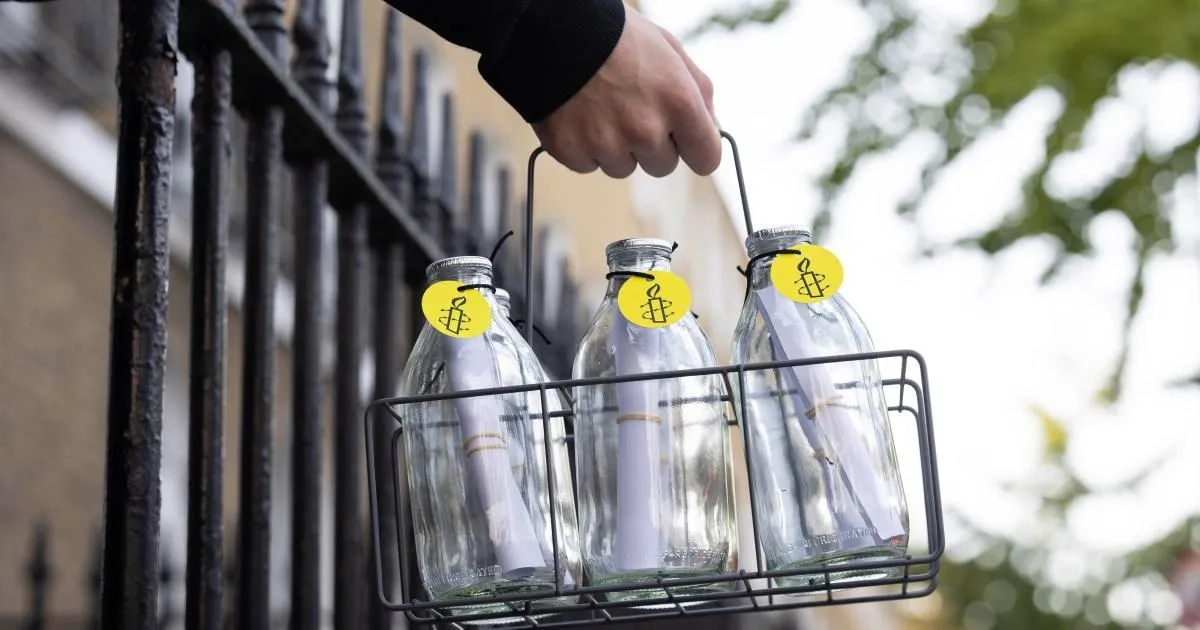
The morning light had barely touched the streets when families across Britain opened their front doors to find something unexpected waiting on the step: a glass milk bottle, cool and familiar, with a letter rolled inside. It was a scene that could have belonged to a gentler era, but the contents were unmistakably modern. These were not harmless notes from a nostalgic past. They were confessions written by neighbours, colleagues, parents, and teachers, people living in the same communities who had been silently struggling to put food on the table. In London, Manchester, Birmingham, and Oxford, the bottles appeared on doorsteps as if left by the milkman, but they were delivered by Amnesty International, carrying a simple yet devastating question: “Will you stand with me by supporting the right to food?” The letters described the raw, grinding reality of food poverty in Britain today, the skipped meals, the darkened rooms, the deep weariness of choosing between heating and eating, and the quiet shame that so often keeps people from asking for help. The timing was deliberate. On the same day, the Office for National Statistics announced that inflation had jumped to 3.5 percent, the highest level in nearly a year, a reminder that the cost-of-living crisis was not fading but tightening its grip. In the fragile light of an ordinary morning, each bottle became a small monument to a national crisis, one that is not far away or invisible, but right here, at the threshold of home.
The letters carried stories that many people recognise all too well. They spoke of the impossible arithmetic of modern life, how wages stretch just so far, how rent or mortgage payments eat into the money meant for food, how energy bills climb higher each season, and how something as simple as buying groceries can become a source of anxiety. The cost-of-living crisis, driven in large part by surging fuel prices and cascading inflation, has continued to squeeze household budgets in ways that charities have warned will push even more families into food poverty this winter. New research by Amnesty International has laid bare the scale of the problem, revealing that three in four British people have worried about the cost of food themselves or know someone who has. That is not a niche concern or a problem confined to the margins of society; it is a reality embedded in schools, workplaces, and neighbourhoods across the country. The research also found that 85 percent of British people believe it is unacceptable that anyone cannot afford to eat, and 82 percent said there should be a legal right to food. These are remarkable numbers, suggesting an overwhelming consensus that no one should go hungry in a country as wealthy as the United Kingdom. And yet hunger persists. The gap between what people believe and what people experience is where the real tragedy lies, and it is exactly that gap that the Amnesty campaign seeks to close, not merely with charity, but with law.
Among those who shared their story with Amnesty is Tyler from London, a young man whose words cut through the statistics and reach toward the human heart of the crisis. “Sharing my story isn’t easy,” he said, “but food insecurity goes so much deeper than just what’s on your plate; it’s tied up in high housing costs, benefits, and energy bills.” Tyler understands that hunger is rarely an isolated problem. It lives in the shadow of unaffordable rent, of benefits systems that are slow and punishing, of utility bills that grow faster than wages. He describes sitting in the dark so that his family can eat, skipping meals so that someone else at the table can take a little more. His words are not self-pitying; they are defiant and clear. “No one should have to sit in the dark or skip meals just so their family can eat,” he said. “Having access to affordable food and being able to choose what you eat should be a basic right for everyone, not a luxury.” Tyler’s voice echoes the experiences of millions, but in the campaign he has found a way to turn his private struggle into public action. By sharing his story, he is asking not for sympathy, but for solidarity. He is asking strangers to understand that food poverty is not a character flaw or a personal failure, but a systemic injustice that demands a systemic response. His words are a reminder that the people who suffer most are often those who remain silent, and that silence is not the same as acceptance.
The milk bottle letters came from ordinary people in different parts of the country, each with their own perspective on hunger. Sam, a secondary school teacher in Manchester, wrote about what hunger does to a child’s mind and body. “Being hungry is one of the biggest barriers to learning,” he said. “It’s a problem we see as teachers every day, but a lot of children try to hide it as they’re worried about getting their parents in trouble.” For teachers, the signs are unmistakable, the tired eyes, the empty lunchboxes, the way a child’s attention slips when their stomach is growling. Sam knows that schools cannot solve this on their own. “There’s only so much schools can do,” he said, “we need the government’s help.” He joined Amnesty’s campaign to ask the people of Manchester to stand with him and support the right to food. Khan, from Birmingham, carries the weight of caring for his disabled mother while facing rising food costs. “I’m sharing my story because the pressure of rising food costs has made life incredibly difficult for me and my disabled mother, and I know we won’t be alone,” he said. He speaks of too many people in Birmingham struggling in silence, and he calls for a lasting solution, not another temporary patch, not another food parcel that only helps for a week. Alex, a former secondary school teacher in Oxfordshire, remembers what it was like to be the hungry child in the classroom, and later, to see the same struggle in her own pupils. “Children can’t learn when they’re hungry,” she said. “The experiences I saw as a teacher stay with me and I know many families are still facing the same challenges today.” For Alex, the campaign is about breaking a cycle that has persisted for generations, because no child should be held back by hunger.
These personal testimonies are the beating heart of Amnesty International UK’s campaign for a right to food, and the organisation is urging people across the country to back it by signing a petition to the UK Government. The demand is not for more charitable gestures or emergency food parcels, but for a legal commitment that would protect people from food poverty in the same way that other fundamental rights are protected. Kerry Moscogiuri, the CEO of Amnesty International UK, said: “With three quarters of people in the UK at least knowing someone who worries about putting food on the table, the harsh reality facing millions of our friends, neighbours and families is clear.” Her words are a call to recognise that this epidemic is not happening somewhere else, to someone else. It is happening in our own streets, in the houses next door, in the classroom seats our children sit in. Moscogiuri continued: “These messages in bottles are a reminder to everyone across the nation that this isn’t a problem far from home; it’s right here in our communities.” The campaign is built on the simple but powerful idea that food is not a privilege for those who can afford it, but a human right that should be protected by law. The petition asks the Prime Minister to protect the right to food in UK law, a move that would oblige the state to take meaningful action to prevent hunger rather than leaving families at the mercy of food banks and charitable goodwill. For Amnesty, this is not a radical demand, it is a necessary one. If British people overwhelmingly believe it is unacceptable that someone cannot afford to eat, then the law should reflect that belief. Rights, after all, are only meaningful when they are enforceable, and the right to food cannot be left to chance.
In the end, these milk bottles are more than a clever publicity stunt or a fleeting social media moment. They are an invitation to look at the country we live in with fresh eyes. The image of a milk bottle on a doorstep carries with it a sense of shared community, of neighbours looking out for one another, of the intimate routines of daily life. By placing letters inside those bottles, Amnesty has turned that nostalgic symbol into a vessel for truth. The letters are an opportunity to listen, to feel, and to respond. They remind us that hunger is not a remote problem on the other side of the world, but a crisis unfolding in our own families, among our friends, and in the lives of the children we see in the playground. They ask us to choose sides, not in a partisan sense, but in a moral one. Will we stand with the single mother who eats less so her children can eat more? Will we stand with the teenager who hides hunger from his teachers? Will we stand with the young man sitting in the dark so that his family can have a little light? The right to food is not a complicated idea. It simply says that no one should have to go without the nourishment they need to live, learn, grow, and thrive. It is a promise that a civilised society makes to its people, not as charity, but as justice. The letters in those bottles are not just stories of suffering; they are stories of resilience and hope. They are a reminder that change begins when ordinary people refuse to accept the unacceptable. And they are an urgent call to every one of us to sign the petition, to raise our voices, and to help build a world where no one has to skip a meal just to make it through the day. Because food is not a luxury. It is a right. And the time to make that right real is now.