


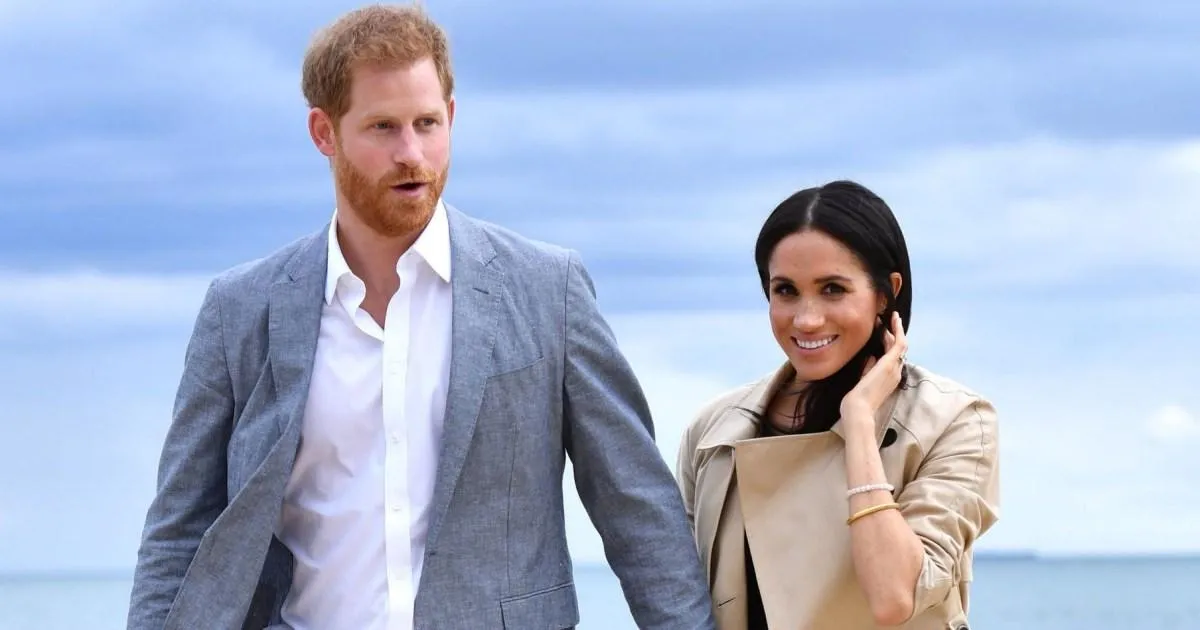
After more than six years away, Prince Harry and Meghan Markle are preparing to do something that once seemed almost unthinkable: move back to the UK and establish a proper British home. The news, which broke this week, has understandably stirred a mix of excitement, curiosity, and more than a little skepticism. For the first time since they stepped back from royal duties in 2020, the Duke and Duchess of Sussex are said to be setting up a base in their home country, with their two children, Archie and Lilibet, expected to begin the new school year there. The exact location is being kept tightly under wraps, which only adds to the intrigue. But the symbolism is hard to ignore. This is not a fleeting visit or a weekend caught between flights; it’s a deliberate attempt to put down roots in a place Harry once described as the anchor of his identity. And yet, even as the headline takes hold, quieter whispers are beginning to surface. According to a Sunday Times report, sources close to the couple are cautioning against reading the return as a permanent ending. The move, they suggest, might be more of an extended chapter than a final conclusion. For a couple whose lives have been defined by dramatic reinvention, abrupt exits, and carefully timed announcements, the ambiguity feels entirely in character. They’re coming home—but they may not be staying home, and perhaps they don’t yet know the difference themselves.
That sense of uncertainty is one of the most human aspects of the whole story. Home, after all, is rarely a fixed address. For Harry and Meghan, the past six years have been a whirlwind of new beginnings: first Canada, then California, a sprawling Montecito mansion, podcasts, Netflix deals, and a carefully curated public image of freedom and purpose. But beneath the surface, there has always been a quieter tug—the pull of the place that shaped Harry, the country where his mother is buried, where his father still lives, and where his brother and sister-in-law continue to raise their own family. Moving back is not just a logistical decision; it’s an emotional one. It means enrolling Archie and Lilibet in British schools, navigating the rhythms of British weather, and walking the same streets Harry once walked as a child. It also means re-entering a world the couple left behind under the most contentious circumstances imaginable. The sources close to the Sussexes describe the plan as open-ended. One quoted in the report says: “It’ll be an extended period of time—it could be six months, it could be a year, it could be more—I don’t think even they know yet.” That quote captures something deeply relatable. Most of us don’t know exactly where we’ll be in a year; we make decisions based on what feels right now. The couple might suddenly decide to try Canada for a while, or Australia, or somewhere else entirely. The world is their oyster, but that freedom can be as disorienting as it is exciting. Coming back to Britain may be less about making a permanent commitment and more about taking a deep breath in familiar air.
For Harry, the return also carries a deeply personal weight. He has spent years telling interviewers how much he misses his home country, and now he has a chance to prove it with action. Being back will make it far easier for him to visit his father, King Charles, and to introduce his children to their grandfather and to other relatives in person rather than over video calls. There is something tender about that image—a son trying to reconnect with an aging parent, a father hoping to give his children some sense of their heritage. But the bigger question, the one that hangs over every conversation about this move, is whether it will do anything to heal the rift between Harry and his brother, William. Royal expert Duncan Lanscombe told Metro earlier this week that he cannot imagine an easy reconciliation. After everything Harry and Meghan have said and done during their time away—the accusations, the interviews, the documentary series, the memoir—the wounds are deep. Lanscombe notes that in Harry’s ITV interview, he effectively placed the ball in the royal court’s court, suggesting it was up to them to reach out. But William, according to the expert, feels the exact opposite. He believes an apology is owed to him and to his wife, Catherine, for the things that have been said. If Harry and Meghan are not willing to offer that apology, Lanscombe argues, there may be no hope at all for ending the estrangement.
This is the strange truth about family conflict: geographical proximity doesn’t automatically heal emotional distance. You can be in the same country, even the same city, and still feel miles apart. Moving back to the UK may create opportunities for contact, but contact is not the same as connection. It’s easy to imagine a scenario where Harry and Meghan settle into their new British home, the children settle into school, and yet the phone still doesn’t ring. There may be a formal meeting or a carefully staged photograph, but the underlying strain—the suspicion, the pride, the unspoken grievances—could remain exactly where it has been for years. The notion of an apology has become a kind of standoff. Harry seems to feel that the institution should have protected him and Meghan more, that the royal household should have pushed back against racist press coverage and welcomed his wife with warmth rather than wariness. William, meanwhile, seems to feel that his brother has publicly humiliated his family and his wife, and that no reconciliation can begin until there is some acknowledgment of that harm. Both sides believe they are owed something. And neither appears ready to blink. It’s a painful, very human impasse, made even more complicated by the fact that it’s playing out on a global stage. Every glance, every handshake, every absence at a major event is scrutinized and interpreted. For a family that once seemed so close, it’s heartbreaking to watch.
As if navigating family tensions weren’t enough, reports have also emerged about Meghan’s professional prospects in the UK, and they add another layer of complexity to the couple’s return. At one point, it was suggested that Meghan had been offered a role in the Netflix series The Gentlemen, created by her friend Guy Ritchie. The idea seemed to make sense on paper: a high-profile streaming project with a well-known director, shot in the UK, giving her a chance to ease back into acting while living in Britain. But according to reports, that role is no longer on the table. Well-connected royal author Tina Brown wrote on X that the offer had fallen apart, citing fierce public backlash. “I have heard that Meghan Markle’s role in Guy Ritchie’s Netflix series The Gentlemen is OFF,” she wrote. “Public backlash was too fierce. This does not bode well for Meghan’s acting comeback in the UK.” Whether or not the report is completely accurate remains to be seen, but the fact that it is being taken seriously speaks volumes about the couple’s complicated relationship with the British public. Some people will never be ready to welcome Meghan back, no matter how much time has passed. Others see her as a talented, charismatic woman who was treated unfairly. The truth, as always, lies somewhere in the messy middle. But for Meghan, returning to a country where she has been both adored and vilified must feel like stepping onto a stage where the audience is still divided. It takes courage to do that, or perhaps stubbornness, or maybe just a deep, quiet belief that she belongs there too.
In the end, the move feels less like a final destination and more like a pause—a chance for the family to gather itself, to give the children a grounding in British life, to let Harry be close to his father, and to test whether the UK can ever feel like home again. It is not a fairy-tale ending. It’s not even necessarily a new beginning. It’s just a step, and sometimes that’s all we can take. The coming months will likely be filled with scenes that feel both ordinary and loaded: school runs, quiet dinners, maybe a public appearance or two, perhaps a brief encounter with a royal relative. There could be progress, or there could be more tension. The couple themselves don’t seem to know how long they’ll stay, and there is something honest about that admission. Life is rarely a neat narrative. We move for love, for work, for family, for escape—and sometimes we move because we’re not sure what else to do. Harry and Meghan have spent years searching for a place where they can feel safe, valued, and free. They tried North America, and they built a life there. Now they’re trying Britain again, carrying with them all the hope, hurt, and unresolved history that makes any homecoming complicated. Whether they stay for six months, a year, or longer, this decision is a reminder that home isn’t always a permanent place. It can be a feeling, a memory, a question we keep asking ourselves. And for Harry and Meghan, right now, the question is: Can we go back? They’re willing to find out. That alone is something worth recognizing.