


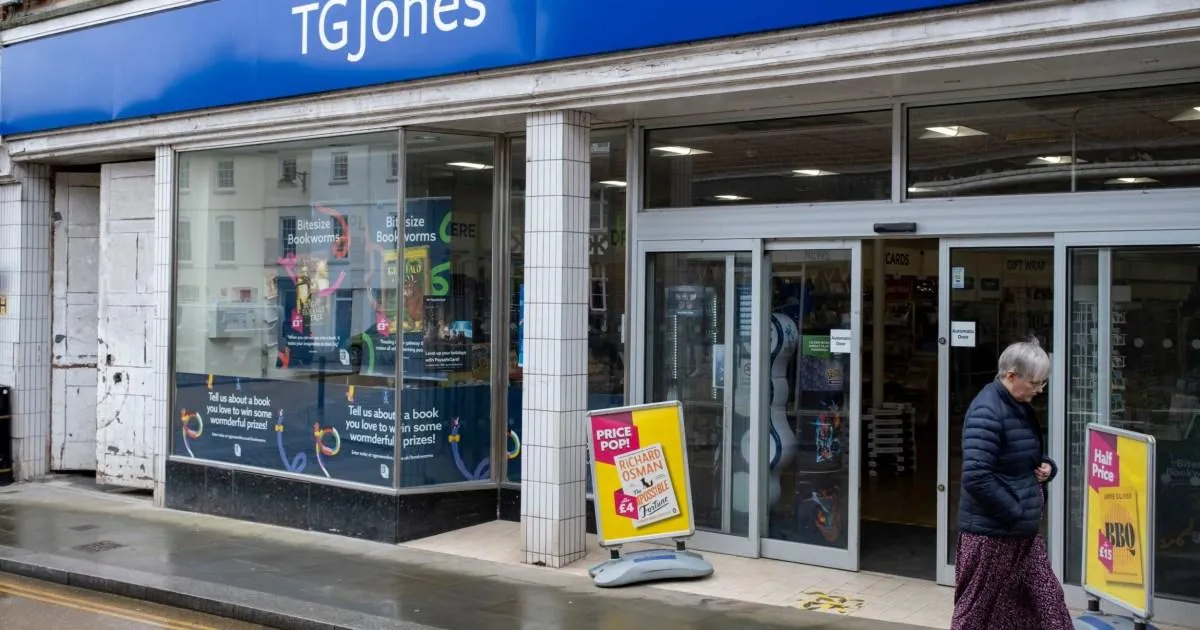
It is a strange and melancholy season on Britain’s high streets, and the latest news will only deepen that feeling for anyone who has ever ducked into a branch of TG Jones for a last-minute birthday card, a refill pad, or a packet of chewing gum before a long train journey. The retailer, which was once known as WH Smith before a dramatic rebrand, has announced that it is shutting more than a dozen more shops this October as part of a sweeping restructuring plan that will ultimately see 150 stores close across the country. In total, the chain is closing 22 branches this month, adding to the 19 that already closed their doors in September. The owner, Modella Capital, has said it needs to shut roughly a third of the chain’s 450 shops in order to keep the business from slipping into administration. The news comes with a certain inevitability, yet it still stings, because these are not faceless warehouse units on out-of-town retail parks. They are familiar, often historic storefronts in the hearts of towns like York, Truro, Stratford-upon-Avon, and Inverness. For many communities, the closing of a TG Jones store is not just another retail casualty; it is the quiet snapping of a thread that has connected the present day to childhood trips, school shopping lists, and lazy afternoons browsing the stationery aisles.
The full list of October closures reads like a sombre roll call of British town centres, each date marking the end of an era for a particular high street. In Bishop’s Stortford, the South Street branch has already shut, as has the Cornhill store in Bury St Edmunds, both closing on October 3. The following week brings more farewells, with Inverness High Street, Belle Vue Terrace in Malvern, and Pydar Street in Truro all expected to close on October 6. Maldon High Street in Essex follows on October 9, and Market Place in Melton Mowbray on October 10. Bradford’s Broadway store is scheduled to close on October 11, while Wickford High Street in Essex will shut on October 12. Bridgnorth High Street in Shropshire and Hythe High Street in Kent are both due to close on October 13, followed by Bridge Street in Pinner and Coney Street in York on October 14. The second half of the month brings closures in Rickmansworth and Marlborough on October 17, West Wickham on October 19, Stratford-upon-Avon on October 20, Ormskirk on October 21, Orpington on October 28, and Droitwich on October 31. Two more shops, in Billericay and Leek, are expected to shut at some point during October, although exact dates have not yet been confirmed. Every one of these branches has launched a closing-down sale, and the TG Jones website is also offering discounts on books, stationery, and even LEGO sets, but there is no disguising the sadness behind the bargains. These are shops where people have bought their first diaries, their children’s school supplies, their holiday reading, and their emergency gifts. The closing-down signs may draw in bargain hunters, but they also draw out memories.
September had already provided a painful preview of what was to come, with 19 stores locking their doors for the final time across England and Wales. The list included well-known locations such as Bath, Cambridge, and Swindon, as well as smaller towns like Redcar, Redhill, Market Harborough, Uckfield, Helston, Deal, Basildon, Rustington, Clevedon, Greenford, Kenilworth, Southend-on-Sea, Exmouth, Frome, Cardigan, and Wells. These closures were part of the same restructuring plan, and they have left hole in the middle of many high streets. To understand how we got here, it helps to look back at the chain’s recent history. WH Smith, a name that had been a fixture on British high streets for more than two centuries, was bought last year by private equity firm Modella Capital, which also owns Hobbycraft and previously owned Claire’s Accessories. After the purchase, Modella made the bold and somewhat controversial decision to rebrand almost all of the shops as TG Jones, keeping the WH Smith name only in airports and train stations, where the brand still carries a kind of travel kiosk magic. The idea was presumably to give the chain a fresh identity, but the hoped-for sales revival never materialised. Before long, Modella was warning that the company could face insolvency unless its restructuring plans were approved. Those plans, which have now been given the go-ahead, involve closing stores, writing off debt, and negotiating lower rents with landlords. In other words, the company is being shrunk in order to survive, but the shrinking is happening in public, town by town, with all the awkwardness of a long farewell.
It is easy to focus on TG Jones as an isolated story, but the truth is that it is part of a much wider wave of closures that has been sweeping across the British high street for years. The same September that saw 19 TG Jones branches disappear also brought the news that Premier Inn owner Whitbread was closing around 200 of its popular restaurants and pubs, including Beefeater, Brewers Fayre, Table Table, Cookhouse + Pub, and Bar + Block. These are not obscure little venues; they are household names, places where families have celebrated birthdays, Sunday lunches, and post-work drinks for decades. Morrisons also announced that it was closing around 100 of its Daily convenience stores, while the small corner shop chain Foreways shut all five of its locations in Carlisle in one go. Luxury accessories brand Radley closed all of its branches, and Quiz Clothing also disappeared from the high street. Even Betfred, the bookmaker, has warned that it may have to close more than 100 betting shops. Each of these closures has its own reasons, its own corporate logic, and its own set of shareholders, but for the people who live in the affected towns, they all blur together into a single story of loss. Every shuttered window, every “closing down” banner, every empty unit that once held a familiar name chips away at the sense of place and community. The high street was never just a place to buy things; it was where you ran into neighbours, where you went for a coffee after school, where you knew the shop assistants by name. When those businesses disappear, they take a little of that texture with them.
The closure of TG Jones stores feels particularly personal because of the chain’s long history and its unique place in British culture. For generations, WH Smith was the place you went when you needed something with pages, whether that was a newspaper, a magazine, a paperback, or a notebook. It was on the way to school for so many people, the place where you picked up a last-minute homework file or a pack of coloured pencils. It was where grandparents bought puzzle books and where teenagers skimmed the magazines while pretending to look for a birthday present. The name itself was so familiar that it almost felt like a piece of the furniture of everyday life. When the signs changed to TG Jones, it felt odd to many customers, almost like a stranger wearing a familiar coat. People still went in, still bought their pens and their greetings cards, but the magic of the old name was gone. Now, with scores of branches closing, it feels less like a rebrand and more like a slow disappearance. The company insists that the restructuring is necessary to keep the chain alive, and that may well be true. Writing off debt and closing unprofitable stores can give a business a fighting chance. But for the towns losing their branches, the distinction between restructuring and closing down is small comfort. A shop that has closed for good is gone, and all the financial logic in the world does not bring it back.
In the end, this is a story about change, and about what happens when the institutions we took for granted are no longer sustainable. The high street has been in crisis for years, buffeted by online shopping, changing consumer habits, soaring rents, and the lingering effects of the pandemic. Every few months, it seems, there is another announcement of closures, another familiar name disappearing from the shopfronts. The response from retailers is often the same: we are restructuring, we are focusing on our strongest locations, we are adapting to the digital age. All of that is sensible, and sometimes it even works. But when you stand outside a TG Jones store on its last day, watching people filter in to grab a final bargain, you see the human cost of those corporate decisions. You see the staff who are losing their jobs, the shopkeepers who have been part of the local community for years, the customers who are losing a small but meaningful part of their daily routine. The best advice for anyone who wants to show support is simple: visit the shops before they close. Buy a book, buy a notebook, buy a LEGO set you do not really need. Strike up a conversation with the staff and wish them well. Take a moment to notice the architecture, the town square, the high street that is still there, even as it changes. TG Jones may be shrinking, and the high street may be hurting, but it is not gone yet. The memories remain, the communities remain, and somewhere in the middle of all the closing-down sales, there is still a chance to keep a little bit of the old spirit alive. Whether those familiar shops will ever return is uncertain, but the people who loved them will not forget them. And perhaps that, in the end, is the most human thing of all.