
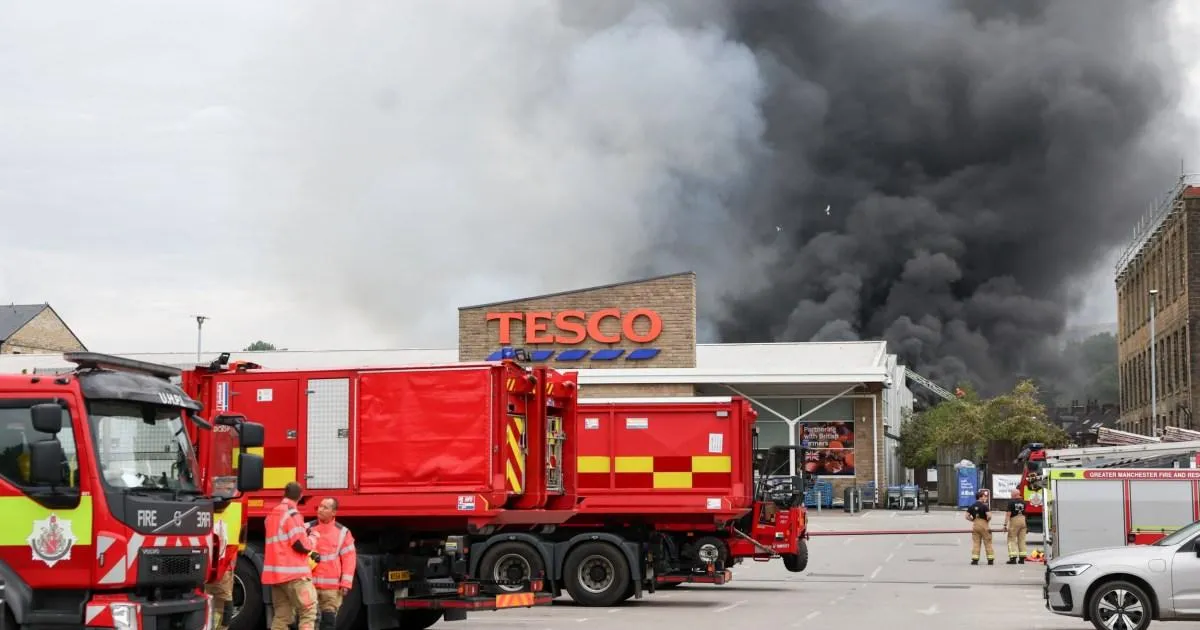
One quiet Sunday morning in Greenfield, on the edge of Saddleworth, Oldham, the peace was shattered by the roar of engines and the crackling of flames. A massive fire had broken out in an industrial building on Chew Valley Road, just behind the local Tesco superstore, and within minutes the area had become a scene of urgent chaos. Residents who had expected a sleepy weekend were instead met with thick plumes of smoke rising into the sky, sirens wailing, and the unmistakable smell of burning materials drifting through the air. The Tesco, along with other nearby businesses and homes, was swiftly cordoned off by emergency services, and more than forty homes were evacuated as a precaution. For the people living in those houses, the morning suddenly became a blur of confusion and fear: grabbing essentials, gathering pets, stepping outside into streets already lined with fire engines and police tape, not knowing how close the blaze was or how long they would be kept away. Families stood on corners in dressing gowns, watching dark clouds roll upward from the warehouse, while firefighters in heavy gear moved purposefully between the vehicles and hoses. Local roads were closed, and drivers were advised to avoid the area entirely, but for those whose homes sat within the exclusion zone, there was nowhere else to be but on the periphery waiting. The sight of a supermarket car park transformed into an emergency staging ground was a stark reminder of how suddenly disaster can arrive. It was no longer just a news story from somewhere else; it was unfolding in their own community, behind the familiar aisles and bright lights of a store where they did their weekly shopping. The fire was big, the smoke was heavy, and even at that early hour it was clear that this was going to be a long, anxious day.
Firefighters from across Greater Manchester responded in force, with ten fire engines and a number of specialist appliances arriving at the scene after the first call was received just after 7:45 a.m. on Sunday 16 August. Crews immediately began pumping thousands of litres of water into the burning industrial unit, working relentlessly to prevent the flames from spreading further into the surrounding buildings and homes. The heat was intense, and the smoke was so thick and toxic that the fire service issued an urgent warning to residents nearby to keep their windows and doors firmly closed. A spokesperson explained the scale of the operation, saying that crews were working hard to bring the fire under control, but that a cordon was in place and people should avoid the area if at all possible. For the firefighters inside the building, it was a battle against time, temperature, and unpredictable currents of air that could change the direction of the blaze in an instant. Outside, neighbours and onlookers could hear the crack and deep rumble of the fire, punctuated by the sound of glass shattering and metal twisting under the intense heat. Every now and then, a firefighter would emerge from the smoke, pulling off a helmet to wipe dripping sweat from a forehead, before heading back into the fray. The sheer volume of water needed to make any impact was a testament to how powerful the fire had become. It was not just a warehouse burning; it was a threat to the whole neighbourhood, and everybody knew it. The smoke pressed against the sky, visible for miles, a grim sight for anyone driving toward Greenfield. Even with the constant efforts of the crews, there was an underlying tension in the air, because fires like this are unpredictable and dangerous, and no one could say with certainty when it would finally be extinguished or what would be left behind among the ashes.
This latest blaze has inevitably reignited longstanding anxieties about Saddleworth Moor and the surrounding landscape, which has suffered through a summer of repeated wildfires. The moors, usually beloved for their wild beauty and sweeping views, had already been scarred by a series of fires that stretched the resources of countless fire crews and filled the region with smoke for days. The most recent of those fires had struck only days before, near Holmfirth Road, where firefighters remained on site for more than twenty-four hours to contain the flames and dampen out the last glowing pockets of peat and vegetation. The ground was dry and tinder-like after weeks without meaningful rainfall, and the combination of low humidity, strong sun, and relentless heat had created conditions that made every spark dangerous. Saddleworth Moor is vast and wild, but its edges meet residential communities, and that is where the danger becomes deeply personal. When fire takes hold in a landscape, it moves with terrifying speed, not always as a wall of flame but often as a creeping, smoking burn that can travel underground through dry peat for days, only to reappear somewhere unexpected. The mental toll on local residents has been enormous; every wisp of smoke on the horizon now causes a flicker of fear. The moors are not simply scenery; they are part of the fabric of life here. For many, they are the backdrop to childhood memories, dog walks, family picnics, and quiet escapes from the busy world below. Watching them burn feels like watching a part of the community itself being consumed. And with the summer being the driest on record, punctuated by back-to-back heatwaves and sunshine, the landscape has been left dangerously vulnerable. The fire near the Tesco superstore, though in an industrial building rather than on the moor, was a stark illustration of how the dry conditions have made everything more combustible and how easily the landscape, and the communities that live in it, can catch fire.
The national context has been hard to ignore. England and Wales have been under a wildfire risk warning, and the repeated blazes across the country have forced a reckoning with how seriously people take the danger. In recent weeks, millions of people received a rare government emergency alert directly to their phones, a message that arrived with a loud, intrusive alarm and warned against lighting anything that could lead to a wildfire, such as barbecues, campfires, and fireworks. For some, the alert was unsettling, a reminder that the familiar summer rituals of picnics and sparklers now carried a far more serious risk. For others, it was a necessary call to action, an acknowledgment that the traditional excuses of “it won’t happen to me” no longer held. The emergency alert system is reserved for the most serious threats, and receiving it on a phone felt, for many, like a strange and sobering experience. It was not just a recommendation; it was a direct message from the authorities that the place people live, the air they breathe, and the land they walk on were all at risk. Behind the dry statistics about rainfall and temperatures, there is a human story of constant vigilance, of families watching the horizon, of communities coming together to share information and support one another, and of firefighters being stretched to their limits. Every crew called out to a wildfire is tired, and every new fire reduces the capacity to respond to the next. The warning system was designed to change behaviour, to make people stop before they drop a cigarette, light a disposable barbecue, or set off fireworks. But warnings only work if they are heeded, and as the smoke continued to pour out of the building in Greenfield, the fragility of this long, dry summer was impossible to ignore.
Perhaps the most visceral illustration of how quickly fire can devastate ordinary life came in Stourbridge, West Midlands, where families fled their homes after a blaze engulfed several houses in a matter of seconds. Nineteen homes on five streets were completely gutted as people ran for their lives, grabbing whatever they could and urging neighbours to get out. Among them was mother Rose-Anne Vinten, who ran through her garden with flames closing in behind her, the heat so intense it felt as though the world itself was burning. The terror she described was not abstract; it was the primal fear of any parent who realises that home, safety, and everything familiar can be taken away in an instant. CCTV footage from the area showed how appallingly fast the inferno moved, spreading through gardens and properties with a speed that seemed almost impossible. In one moment, the neighbourhood looked normal; in the next, it was an inferno. The residents were not facing a distant threat; they were living through their worst nightmare, and their losses were not just physical but emotional. The house where children had grown up, where photographs hung on walls, where birthday cakes were cut and bedtime stories were read, was reduced to ashes and rubble. Even those who escaped physically unharmed carried the psychological scars of that morning, the noise of the fire, the smell of smoke, the sight of their street transformed into a disaster zone. That fire in Stourbridge, and the fire in Greenfield, are connected by the same thread of dry conditions and heightened risk. They are reminders that fire does not distinguish between industrial units and family homes, between moorland and hedgerows, between a warehouse in Oldham and a row of terraced houses in the Midlands. It simply burns, and it does so with a hunger that is both terrifying and humbling.
As the flames in Greenfield continued to be battled by firefighters, the wider picture was one of a country on edge, a summer of heat and drought that has fundamentally changed the relationship between people and the land they live in. The blaze behind the Tesco was not caused, as far as anyone knew, by the same forces as the moorland fires, but it was part of the same story of a world under pressure, where dry, hot conditions and a changing climate have made fire a more frequent and more ferocious presence in everyday life. What makes these stories so human is not only the damage to buildings and the disruption to roads, but the quiet courage of the people who face them. There is the mother who gathered her children and fled, the firefighter who stepped into the smoke because it was the job, the neighbour who knocked on doors to make sure everyone was awake, and the community that came together around the evacuation point offering blankets, water, and places to stay. There is grief for things lost that cannot be replaced, and there is gratitude for the fact that, in most cases, the human cost has been much lower than it could have been. But there is also growing frustration that more is not being done to address the conditions that make such disasters more likely. Every wildfire, every industrial blaze, every house fire is a product of a complex set of circumstances, but the common thread is a lack of rain, an accumulation of dry fuel, and a recklessness that still sees fires started by careless behaviour. The emergency alerts, the closed roads, the warnings about closed windows and doors, all of these are the language of a society learning to live with fire in a way it never expected. And yet, amid the smoke and the sirens, there is also resilience, the stubborn refusal of ordinary people to give in to fear. They stand on the edges of the cordon, arms folded, eyes fixed on the flames, waiting for the news that it is safe to go home. They thank the firefighters as they pass, and they open their homes to strangers. They tell each other that they will rebuild, that the moor will recover, that the community will endure. The fire will eventually be brought under control, the smoke will clear, and the road will reopen. But the memory of that Sunday morning, the smell of smoke, the sound of sirens, and the sight of an industrial unit consumed by fire will linger in Greenfield for a long time, a reminder that in a summer so hot and dry, it takes very little for life to go up in flames.