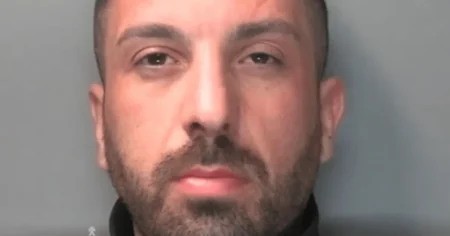




Every once in a while, a story emerges that sounds more like the script of a dark comedy than a real police report, and the tale of Joel Louis is precisely that. On a warm July day, police officers stood outside a property in Wembley, having followed a chain of digital breadcrumbs across London. Inside, Louis, a 34-year-old man who thought he had perfected the art of disappearing, was doing something that felt almost childlike: squeezing himself into a wardrobe, holding his breath, and hoping that the officers would simply go away. Yet the moment they opened the doors and found him crouched among coats, his first words were not an apology or an admission, but a surprised question: “How did you find me?” The answer, he learned, lay in his own inability to stay off the internet. While hiding from the Metropolitan Police, Louis had connected his phone to a public WiFi network, a seemingly harmless act that turned out to be the digital equivalent of leaving the front door wide open. It was a spectacularly human mistake for a man who had worked so hard to make himself invisible, and it signaled the beginning of the end of his carefully constructed criminal enterprise.
At the centre of the investigation was the ‘Bobby’ drugs line, an underground operation running through north London and specifically targeting the streets of north Kilburn. For months, detectives from the Metropolitan Police had been digging into this illicit network, watching the phones of children linked to its supply chain. Those young people had been recruited, often under duress, to act as runners and dealers, moving packages of dangerous substances from one spot to another while the person actually in command kept his hands clean and his tracks carefully covered. That person, police came to believe, was Louis, a resident of Ealing Road, Wembley, who had no intention of surrendering his empire without a fight. His method of avoiding detection was one of surprising sophistication. Every device he used to coordinate the line was rerouted through a virtual private network, a VPN, which made his activity much harder to trace. It was a “digital cloak,” a shield of encryption designed to stop investigators from identifying him. For weeks, detectives found themselves blocked, chasing IP addresses that looped through servers across the globe. But Louis made one fatal error: he had to go online. While hiding out in a property, he connected to an open WiFi network, a local public connection that did not offer the same privacy protections. In doing so, he gave up his location more effectively than any mapping device ever could, and the police pounced. The high-tech criminal mastermind who used complex encryption to stay one step ahead was undone by the digital equivalent of ordering a pizza for delivery.
At the same address where Louis was discovered, the reality of his operation became starkly visible, the glossy undergrowth of drug money exposed in all its brutal simplicity. The officers found Class A narcotics, cocaine, and heroin with a street value of nearly £8,800. They also found around £8,000 in cash, the sort of sum that makes itself at home in a drug den, and six mobile phones, one of which was the very phone used to run the ‘Bobby’ line. But the scene was just overwhelmed by the arsenal sitting in the same walls. In a box, hidden among ordinary household belongings, was a loaded firearm. Alongside it were 13 rounds of 9mm ammunition, three of those rounds already in the gun’s magazine, ready for use. If that was not enough, police also uncovered a machete and a flip knife, proof that this was not a man dealing from a corner shop but someone prepared to turn to extreme violence in an instant. The phone analysis painted an even more chilling picture: Louis was receiving over 100 calls a day from around 250 separate drug users. That is the rhythm of a thriving business, but also of a public health crisis broadcast, and every call tied him to the suffering of the people who used his product. He had even bragged to some of his customers that he was the owner of a firearm, making sure they understood that he was not just a dealer, but a figure who could intimidate, threaten, and protect his turf with lethal consequences.
When Louis was charged, eleven charges were put down, two counts of possession with intent to supply Class A drugs, possession of an offensive weapon in a private place, possession of a firearm, and possession of ammunition. The charges revealed the scope of his operation: more than fifteen years of irresponsible liberty that had caused so much harm. The court handed down a sentence of twelve years and nine months on a Friday in September, months of his life were removed as a direct result of his choices. But what matters is not just the length of the sentence; it is the pattern of what it says about how London deals with networks like this. Louis had advertised himself as a businessman, a man of control, but the reality was far more desperate. He used young, vulnerable people as cannon fodder to carry the drugs, line his own pockets, and absorb the risk. He exposed them to violence, intimidation, and the possibility of criminal records themselves, while he pushed further into the background, hiding behind encryption and public WiFi. He was not an entrepreneur in any legitimate sense; he was a predator in market stalls of listlessness. The judge’s sentence was not merely a punishment for the drugs inside the walls; it was a statement that the old and centuries of silence no longer protect the people from those willing to bring poison, guns, and fear into a ordinary neighborhood.
Detective Constable Lauren Gresty, the officer who led the investigation, put it in terms that went beyond the simple legal detail. She stressed that Louis “recruited numerous young people to move drugs around north Kilburn, exposing them to violence, intimidation and criminality for his own financial gain.” Her words are full, but what they capture echoes more than one family: the 15-year-old boy sent out with a phone full of messages, the teenager forced to stand on a corner with a knife tucked into his jacket, the Mother who does not know why her child has not come home. Gresty continued: “County lines devastate lives. It is far more than drug dealing. It causes damage to local communities through its connections to acquisitive crimes and anti-social behavior.” Those lines are not simply arrests; they are the destroyed habits, the screaming arguments, the abandoned playgrounds, the worried eyes of shopkeepers and neighbours watching deals go down in broad daylight. The whole network that Louis operated was not a victim less crime. It left drugs in the hands of children, guns in the reach of disturbed people, and fear on doorsteps. It normalised the idea that you can be invisible, that you can profit from suffering while hiding behind encryption, cash, and violence. But this case says no: the steel walls of encryption are not truly permanent, and public WiFi can be the pebble that brings the beast down.
If we step back, the story of Joel Louis is not just about technology and crime; it is a reminder of how vulnerable we all are to our own habits. He was a man who could cleverly avoid detection, who understood that VPNs can cloak his email, who insured every device was behind a curtain of digital privacy. But he could not help himself, perhaps he needed to check messages, perhaps he was bored or nervously looking for distraction. The connection to the open WiFi network turned his entire digital fortress upside down. It meant police officers were able to physically get to his hiding place. They found him in his hiding spot, possibly the same simple household object we have all used in childish games of hide-and-seek. Yet this was no game. Wardrobe doors are not shields in real life, and anyone who has ever trusted a fibre optic signal to keep its identity hidden has eventually learned that signals leave footprints. Louis’s arrogance was not that he committed crimes; it was that he believed himself untouchable. He thought that all the layers of encryption and all the low-talent runners would be enough to keep himself two steps ahead. But law enforcement officers, guided by the overwhelming confidence of their case, the evidence seized at the property, and the tiny damage he caused when he logged into that network, did what they do best: they kept their promise and stayed tenacious.
The significance of this case, however, reaches far beyond one arrogant man in a cupboard. It serves as a warning about how deeply units like the ‘Bobby’ line reached into the community. They are not remote, faceless organizations in London’s cyber space; they are also, often using children as shields while their leaders remain separated in safehouses. The public money in the case, more than eight and a half thousand pounds worth of Class A substances, plus cash, plus a gun and an assortment of knives, shows how much damage the business model can generate for every month it operates. While Louis may now spend years behind bars, the fallout of his choices continues to echo: parents who need to explain to their kids why the police raided, neighborhoods that need to rebuild trust, and young people who need to unlearn the dangerous idea that criminal behavior can make them rich and untouchable. Detective Gresty shared a message that stands as a clear conclusion: “Louis believed he could hide from police to further his offending, but this result shows our tenacity in going after those who cause the most harm in London.” It is that tenacity that is the real lesson. In the end, the villain’s biggest mistake was not the gun, the drugs, or the children he exploited. It was assuming that he was the only clever person in the room, and that a wardrobe door could stop a team of investigators who, in the digital age, have learned what to listen for. They heard a signal, they followed it, and they found their man. In the endless game of criminality and justice, there will always be another pack of drugs and another network to dismantle, but for a moment, at least, the closing of the wardrobe door in Wembley sounds like a small but satisfying step toward justice.