


For anyone who has ever lost a dog, even for a few anxious hours, the story of Teddy is the stuff of nightmares and miracles twisted into one. The dog’s ordeal began on a bright summer’s day, August 2, when he disappeared on Helvellyn, the third-highest peak in England. The Lake District, with its breathtaking beauty, is also a rugged and almost brutal place — a landscape of sliding scree, sharp ridgelines, shifting mist, and ravines that can swallow a hiker whole. For a dog, especially one separated from the familiar scents of home, it was a terrifying place to become lost. Teddy did not have a lead or a plan. He simply vanished. As hours turned to days, and then to weeks, the thought of Teddy somewhere out in the open, cold, hungry, alone, with nobody calling his name, was unbearable to those who knew him. The mountain itself seemed to hold its breath, offering no clues. There were no tracks, no sightings, only the silence that so often fills a community when a beloved animal is missing. Still, no one stopped praying, no one stopped looking, and no one allowed hope to die.
Then, on August 21, after nineteen days of uncertainty, something changed. Volunteers — those dedicated, sun-worn people who know the hills and the valleys better than almost anyone — were still searching the lower slopes, refusing to abandon the mission. They were not rescue professionals; they were just people who heard about a missing dog and felt their hearts crack. They walked the trails, scanned through binoculars, and listened hard to the sound of wind breaking over the rocks. It was one of those quiet moments of focus when one volunteer heard it: a faint bark. Not the bark of a dog happily chasing sheep or playing by a stream, but a lonely, weary bark, coming up from Dry Gill, a steep and unforgiving ravine cutting deep into the mountain’s side. That fragile sound was enough to turn a day of search into a moment of adrenaline. They followed the sound down into the gorge, slipping in loose stones, crouching through narrow ledges, and finally, there was Teddy — a dog who had somehow, miraculously, kept himself alive for nearly three weeks in the open wilderness. He was in trouble, unable to climb out of the ravine, but he was alive. The volunteer team could see him clearly, could see the outline of his ribs and the haunted look in his eyes, but above all, they saw a story that was still waiting to have a happy ending.
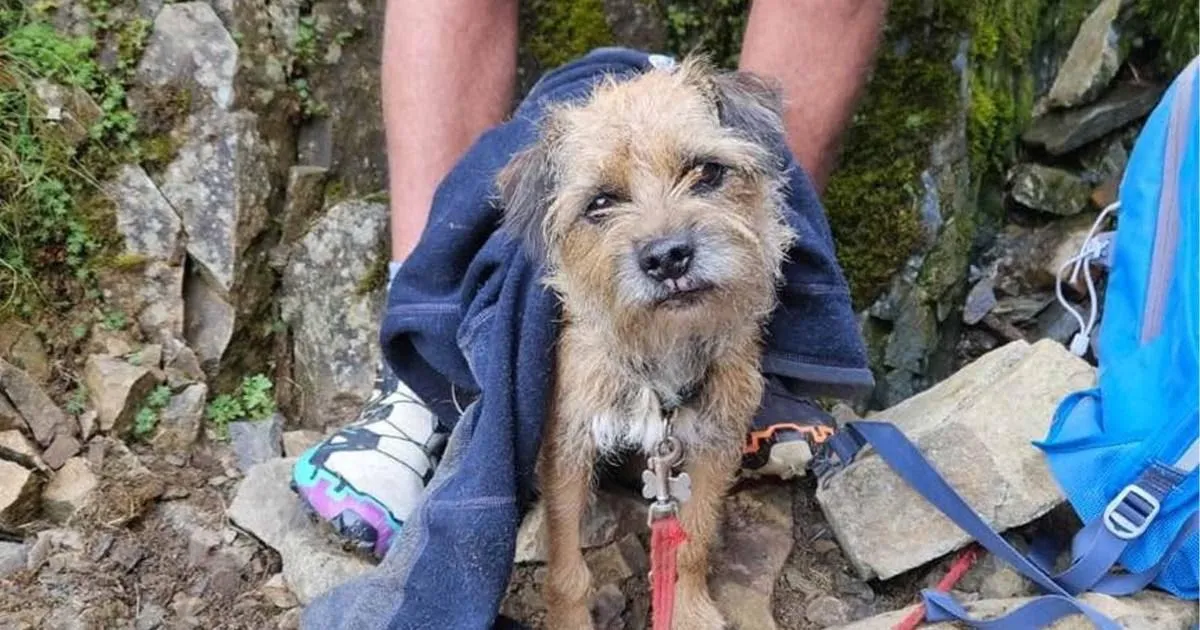
Teddy’s rescue was not an easy feat. The moment the volunteers saw the dog trauma he was in, they knew they couldn’d simply let him walk out; the sides of the ravine were too steep, the ground too unstable, and the shock of his ordeal had clearly taken its toll. That was when the Keswick Mountain Rescue Team was called in. Seven team members, the kind of people who spend their weekends and late nights learning how to save lives in impossible places, scrambled up to the spot. They brought ropes and a stretcher, but what they really needed was something else: a plan that would keep Teddy from being further harmed. The decision was typical of everything professional about mountain rescue — careful, patient, and calm. First, they gave Teddy a small amount of food. Not a full meal, because a dog this starved, and this neglected, could be overwhelmed by a sudden feast; just enough to let his body know that the nightmare was ending. Then, carefully, they lifted him into a rucksack, so that his legs would not have to struggle against the ground and his head could rest against the human shoulders that had come to carry him home. The rucksack acted as a cradle, and in that cradle, a very tired dog was carried step by step, slope by slope, away from the place that had almost taken everything from him.
The rescue took three and a half hours, short in some ways, but an eternity in the raw beating sun. The men worked in a rhythm: a rope in a fixed anchor, a slow descent on a steep ledge, a pause to check the dog’s breathing, another to speak to him in a low, kind voice. The team’s priority was not just to get Teddy down, but to get him down safely, without jarring, without causing further injury, and without frightening him further. Twice the ravine forced them to double back, but no one rushed. The path from Dry Gill to the main trail where Teddy’s journey would finally be finished was a full breath of the mountain, and the only heard the small sounds of boots and stones and the dog’s now quiet breathing. At the bottom, at Swirls car park, Teddy’s owner was waiting. The reunion was not a dramatic- enough. It was quiet, the one of a human being dropping to their knees, and of a dog pressing into familiar arms. The owner took Teddy into the arms, felt the thinness of him, and perhaps wept a little, because the last thing he had expected after almost three weeks of silence was a resurrection. From the rucksack to the car to the vet’s, the small dog was passed carefully, like something more precious than fine. The first veterinary were surprisingly clear: Teddy was thin, very thin, and weak, but he was not suffering from any obvious broken bones. He had not fallen deeply into a ditch or broken a leg. He had survived, in a way that, even knowing the hardest mountains, can only be described as remarkable.
It is hard to put into words an expedition like this. Teddy had not hiked up onto Helvellyn; he had simply been a dog, chasing a scent, following a sudden movement of wildlife, and before he knew it, the world was the different side of a ridge. He had somehow found a way, each nightfall, to lie down in a likely hidden place, licking the icy wind off an old stone, waiting for morning. He had found a stream to drink from, somewhere. He had eaten whatever berries, insects, or human scraps in a thankless to find. The body of a dog is not designed for long fasts, and by the time the rescuers reached him, he was lighter, thinner, and weaker. Yet the animal in him had not given up. He had even kept his voice; he had used it, sure, to bar when he could smell something distant — perhaps not the scent of his owner, but the scent of help. The fact that he had no injuries not only speaks to a little luck but to a hardwired instinct that all animals have when pushed across the edge: they protect themselves. They don’t throw themselves off blind edges, they don’t run into walls, they make a compact with the earth. Teddy made that compact, and the earth held him.
The Keswick Mountain Rescue Team, in a statement after the rescue, were overjoyed. They said, “The team are absolutely delighted to share this update, as the news of this missing dog had deeply affected so many people across our local community.” Those words reveal something important: this was not a random story from the news, a slick run with a happy ending. It was a community’s story, a story that had been carried through local homes, walks, shops, and friendships. Every time a car passed by the mountain path, someone looked up to the slopes, hoping. Every time someone walked a trail, they scanned the edges of sight. And everyone, all the volunteers, the call, the owner, and Teddy himself, were bound together in a quiet, common determination. The, “A remarkable outcome after nearly three weeks on Helvellyn, and a huge well done to everyone who kept searching and never gave up on Teddy,” should serve as a real, burning reminder of what kindness can be. No one knew if the dog would be alive. No one knew if the effort was worth it. But they tried anyway, and the result was not just a rescued dog heading to vets, but a rescued piece of the human spirit, too. Teddy went through the woods, down the valley, back into the ordinary life of car rides and dog bowls and warm laps, and he carried with him something that all of us, in our small ways, wished: in the large place where mountains, the small and silent are not forgotten.