

Here is a humanized and expanded retelling of the news report, structured into six paragraphs as requested.
—
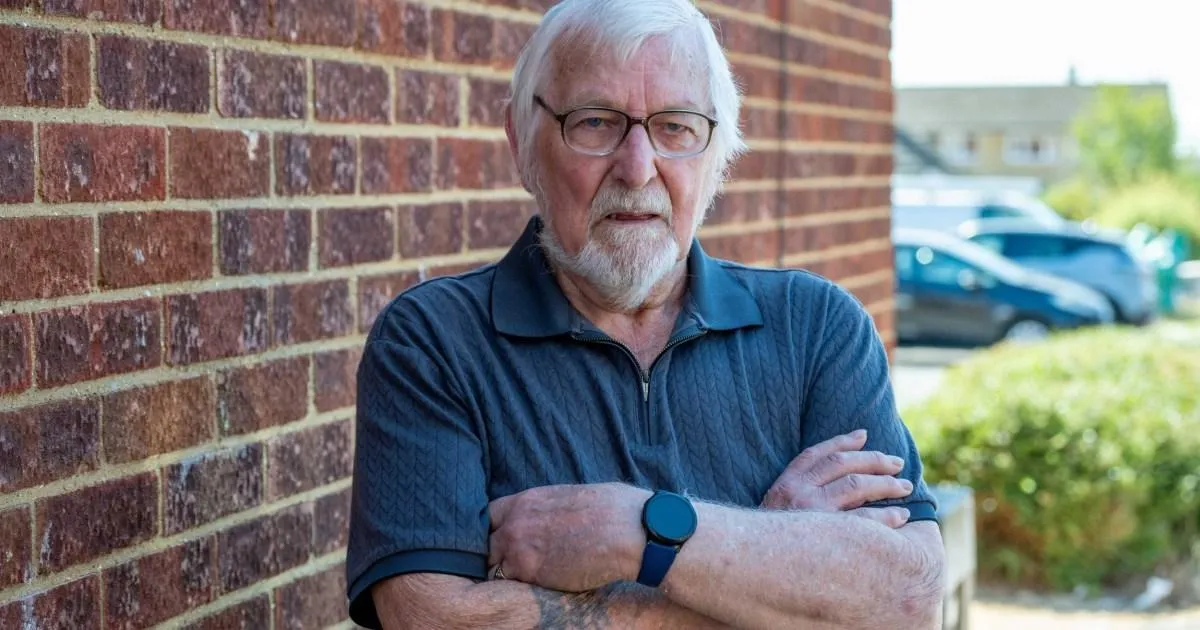
The quiet suburb of Rochford, Essex, seems an unlikely setting for a David-and-Goliath struggle, but for 85-year-old David Siggins, the very ground beneath his front window has become a source of immense personal turmoil. For over four decades, Mr. Siggins has called this home, a place where he raised his family and where he now hopes to live out his remaining years in peace. That peace has been shattered by a dispute over a patch of grass—once a mundane, often-overlooked strip of public land, now a paved driveway he built with his own funds and effort. The driveway, a neatly laid blue block-paved surface, was not borne of vanity or a desire to extend his property. It was a necessary adaptation, a lifeline for a man battling the chronic, debilitating effects of a severe respiratory disease, chronic obstructive pulmonary disease. Forced to contend with this condition, the former tiler now finds himself navigating the world on two crutches, each step a struggle, each slope a potential hurdle. The grassy verge outside his home was more than just a lawn; it was an obstacle, a barrier that made accessing his own front door a painful and precarious endeavor.
At the heart of Mr. Siggins’ pleading is a simple human need: the right to get out of a car and reach his own front door without a fraught struggle. He has lived in the close, a small, quiet enclave with thirteen houses, for most of his adult life. It’s a neighborhood where a man’s faded might well vouch for his character, a place where life moves at a slower, more predictable pace. But the disease, undeterred by the sedateness of his suburb, has increasingly limited his mobility. The simple act of exiting a vehicle and navigating to him home, once taken, now poses a considerable barrier. The initial dread of the journey ended never truly ends. The driveway, which he hoped would ease this burden, represents not just a construction project, but a release from a trap, a way to reclaim some independence in a body that no longer obeys him as it once did. He invested £2,200 of his pension, a significant portion of his fixed income, into transforming the verge, believing he had fully followed the labyrinthine regulatory process. The new driveway was paved, visually neat and, to him, far more useful than the strand of grassy verge it replaced. The sight of the finished work gave him a sense of accomplishment, a small victory in his daily battle simply to survive. But his victory was to be short-lived and politically complex in a way that he, in his analytical approach to his old age, could never have anticipated.
The conflict has its origins in bureaucratic categories and the friction two decades prior. Already in the past, he claims that he had entered a similar dialogue with the council about creating a dropped kerb outside his home. As he recalls it, he was given verbal consent, the work was done, and the comfort was quickly replaced by an inkling of doom. He was then told to have the kerb reinstated, and he was given compensation to cover the inconvenience, a bitter pill to swallow but one he accepted. His most recent attempt began in 2024, as his health concerns worsened, and he needed a more permanent solution. He attempted to do things through the proper channels. He reached out to Essex County Council, presumably to get clearance. He was told the land’s specifics didn’t fall under their control. He followed the advice, going to the Rochford Council’s planning department, and a planning officer, whom he describes as “very nice,” advised him to speak to Essex Highways. They said they had no jurisdiction. He then returned to Rochford Council and was given what he insists is a written assertion that they definitely did not own the land and that he should go ahead with his plans. With that reassurance, his trust was placed.
The saga is split by the coda in this falling out with the authorities. To Siggins, the author Don’t Judges the positive of a potential procedural denial is an odd, almost nonsensical complication. He was told separately by different government levels unofficial permissions to proceed, yet a formal, written planning application sunk further into the system. Planning, with its application process, doesn’t just have the air of for the common citizen. Siggins, who has likely spent a lifetime doing his job, not navigating the hostile terrain of bureaucratic law, thought his conversations and even prior verbal meetings were the proper course, not expecting that the council would have to submit a planning application for his own property. He was blindsided to find out that a formal permission was later applied and refused, the appeals dismissed. The system’s mixed messages had merely propelled him forward, only to be unsung by a completely contradictory order that this he had been told in writing wasn’t his land To do what he wanted, now was. This cyclical labyrinth of ownership, responsibility, and permission has left him trapped, a sheer litany were he can no longer trust, neither in the actions of his administration or the stability of his own life.
—
The pressure is taking its toll, transforming everyday life into a crushing weight. He fears a inner breakdown, a confession that speaks volumes about the burden placed on his age. A person who has lived a ringing and life, a former tiler, who’s not the one to be a department of jurisdiction, find himself ensnared by the very system he’s dependent upon. “This has made me quite ill,” he says. “I cannot walk, that’s the problem. I use two crutches. It just seems so unfair.” There is a world of frustration behind those words, a feeling of being targeted when all sought was a practical fix. The bristling is not just about pavers and dropped kerbs – it’s about the erosion of his stability and happiness, the sensation of being helpless against a faceless, large institution, and its own often-conflicting rules. He has lived here for more than a lifetime and this dance is turned savage. He’s not an anonymous cul-de-sac; he relays on the drive to make life tolerable, to allowing him to leave his house, and now the ultimate instrument to give him a sliver of independence is threatened with remedies. The longer the dispute spans, the more the edge deepens, the more heavy depression of a man who feels like he was a mol on a game he’s never seen the board of.
The dispute has become a hellish gentail; he throws alone each day with the shadow of legal action looming over him, and the house that was once simply his sanctuary, now also a adjacent crime scene. He has true faith that his actions were lawful and that there was no mistake; but the Council says ‘there grass verge is owned by them and forms part of a larger title under regulation as public open space. The council says she has received a “number of complaints.” The responses a contradiction to the perspective that his close, with its 13 houses or 31 vehicles, has been relieved to see one of their own get the conflicting cars off the road, freeing up space. He is right in an era of neighbours getting beaming, observing the daily struggle. David sees this authority as heavy lies, using audits, decisions already made, but disregarding the physical changes, the medical need, and the financial risk he took, believing their own words. He made the paving and the praised it, but the majority remains: the grass verge is very much authored, the council speaks in an abstract of regulations, and he is just a man watching his niche project get unruined. The council’s deadline is menacingly near—the entire end of August—a ticking clock that keeps him in the anxious state.
He cannot help but reflect on the aesthetics and the fairness, in a sort of final grumbling stand. He rests on the practicality: “It looks nice – it certainly looks better than the grass.” To him, the treeless, neatly packed pavers are a simple improvement to the mere strip of dead grass, a points, not damage. Yet, the idea of tackling the complexity of this transition, reverting it to “original state,” is crushable not just for his body—a physical impossibility—but his spirit. He has already begun to process of contacting a local solicitor, but the stress of a potential legal battle, ad absurdum, sucking financial resources and his dwindling energy, is enough to remind him of his powerlessness in the face of an overwhelming council. He feels the people against him, he says to him, over a harbor that was meant to bring him betterment. The 92-year-old’s last attempt is a guarantee that when he’s back to clear a long-running bureaucratic purgatory, in search of an oxygen that won’t come from the words of a planning officer, but from a modest, flat path that leads from the road to his blue front door. He is not asking for the sweeping grand solution; he just asking permission not to struggle so hard to be home.