


The Search for Leah Croucher: A Family’s Nightmare of Loss, Hope, and Injustice
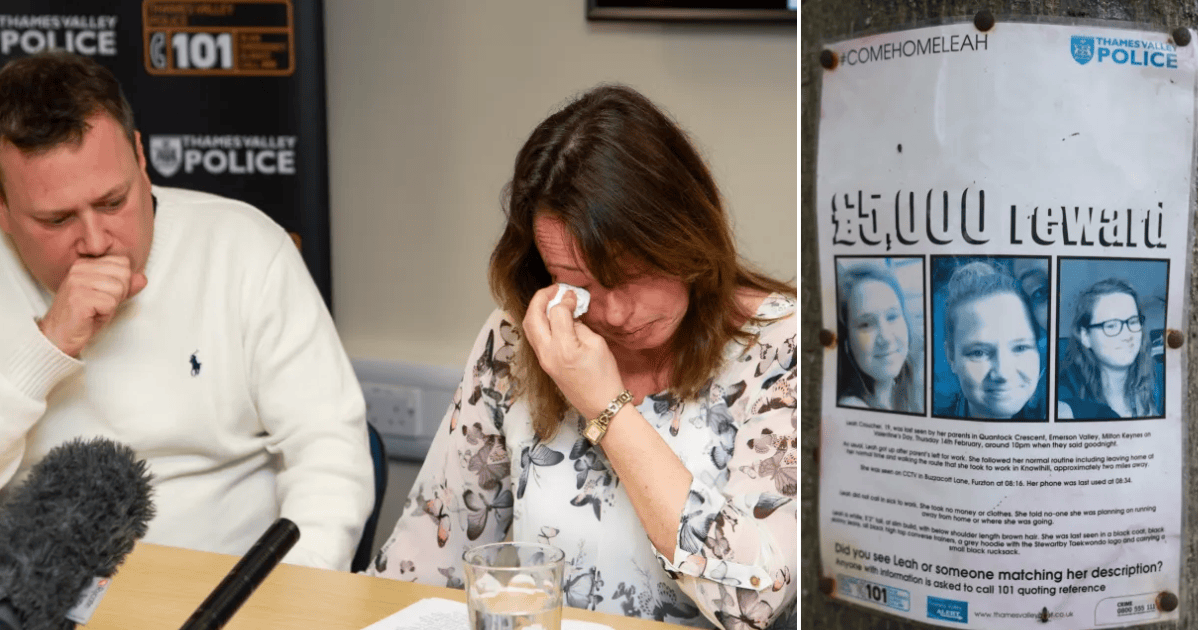
The moment that would shatter their world forever came on a cold February afternoon in 2019, when Claire and John Croucher received a phone call that would instantly change the course of their lives. Their nineteen-year-old daughter Leah had not shown up for her shift at work, and the couple knew with chilling certainty that something was terribly wrong. When John received the call from Leah’s colleague at 5:10pm, his blood ran cold. The teenager lived at home with her parents in the quiet Milton Keynes neighborhood of Emerson Valley, and they would have known if she was unwell that day. Neither parent could reach her on her phone, and when they rushed home from their jobs, they found her bedroom untouched, her bed neatly made, her passport still in the drawer, and foreign currency for their upcoming family holiday to Cape Verde safely stowed away. There were absolutely no signs that she had run away, and John remembers thinking, “We knew this wasn’t Leah. She hadn’t run away. She came from a loving home and we were going on holiday to Cape Verde 10 days later. We were all packing. She’d been out and bought some new holiday clothes.”
The family, including Leah’s older half-siblings Haydon and Jade, were beside themselves with grief and confusion as they reported her missing that same evening. What followed was a nightmare that would stretch on for more than three years, consuming their lives and ultimately claiming another family member. Weeks turned into months as Haydon, consumed by love for his missing sister, walked the streets of Milton Keynes wearing a high-visibility jacket emblazoned with “Have You Seen Leah” on the back, while he and Jade distributed leaflets and plastered posters and banners across the city in a desperate attempt to find her. But instead of bringing them closer to answers, their efforts seemed to invite a torrent of online speculation and cruel accusations. Strangers on the internet began to suspect Haydon and John themselves, spinning wild theories that the family had something to do with Leah’s disappearance. John recalls the gut-wrenching pain of watching his son be accused of throwing Leah down the stairs because she might have been pregnant, or of helping John hide her body. “I had to turn myself off from it because all I was interested in was finding my daughter. What disturbed me even more was when they started on my son. That really hurt,” John remembers. “They accused him of throwing her down the stairs because she might have been pregnant, and said I’d helped him hide her body. Just absolute fictitious rubbish.”
The toll of this relentless online harassment, combined with the anguish of his sister’s disappearance, proved too much for Haydon’s fragile mental state. Diagnosed with bipolar disorder, he had been struggling to cope even before Leah vanished, and the constant barrage of accusations and conspiracy theories only exacerbated his suffering. On November 14, 2019, just nine months after Leah had disappeared, Jade and Haydon’s mother Tracey found him in his flat. He had taken his own life. John firmly believes that the trolling contributed to his son’s death, explaining, “If you’re already suffering from mental illness anyway, it’s going to prey on you. It did contribute to his downfall.” The family was now trapped between two unimaginable losses—one unresolved, one permanent—and the pain of trying to hold both in their hearts was almost too much to bear. Claire describes the impossible balancing act of their grief: “The only way to cope was that you couldn’t think of both children at the same time. While we’re thinking of Leah, we feel guilty that we’re not thinking of Haydon. While we think of Haydon, we feel guilty about Leah. You couldn’t take them both at the same time because it was just physically too much for your brain to manage.”
For years, the family lived in a state of suspended animation, caught between hope and despair. Claire would go through the motions of daily life, making tea, lighting a cigarette, and stepping into the garden to call Leah’s phone, leaving tearful messages begging her daughter to come home—even though she knew deep down that the calls would never be answered. The media attention brought its own torments: hoax sightings, false leads, and cruel ransom messages from heartless individuals who preyed on their vulnerability. They chased a lead to Birmingham that turned out to be nothing, and they gave police names of friends and acquaintances, desperately grasping at any possibility. Claire admits she knew it was futile, saying, “I had no loyalty to anybody. I wanted to find her if she was out there, but it felt like an empty act giving the police ideas of where to look for her because deep down I knew they weren’t going to find her there.” Her mind cycled through the worst-case scenarios, imagining Leah had either been kidnapped and sex trafficked or murdered. Yet still, hope persisted, growing like a stubborn weed in the cracks of their shattered hearts. Claire reflects, “You hold on to that little grain of hope [that she is still alive], and it just festers. I didn’t realise how much hope we had until the night we were told she’d been murdered.”
The truth finally emerged on October 10, 2022, more than three and a half years after Leah had vanished. A contractor, hired by a landlord living abroad to investigate a foul odor at a property just minutes from the Crouchers’ home, discovered black bags in the loft surrounded by dried blood. As soon as family liaison officers appeared at their door, Claire, John, and Jade knew their nightmare had reached its end. Leah’s body and personal belongings were found at the address—less than half a mile from where she had been living—and outside, attached to a telephone pole, was one of the very missing posters bearing her face that the family had distributed so desperately. John says, “We were just in despair. Our world had already ended. This was a different hurt. I stood outside in the garden thinking to myself, I can’t believe how much hope I had, and I can’t believe how stupid I was to have that hope because I knew it was rubbish. Why did I let it grow over the past four years?” The killer was identified as Neil Maxwell, a man with previous convictions for sexual offenses against women and girls, who had been wanted for sexual assault in 2018. He had taken his own life on April 20, 2019—just two months after Leah disappeared. The realization that this monster had been living in their community, that he had killed their daughter and then escaped justice through suicide, added an entirely new dimension to their suffering. John says simply, “What he did to her is unspeakable. We have to live with that.”
Five months after her body was found, the Crouchers gave Leah the send-off she deserved, an elaborate and emotional funeral that drew hundreds of mourners lining the streets of Milton Keynes. Her coffin, draped in Harry Potter heraldry, was carried in an ornate carriage drawn by black horses—a farewell that honored her beloved books and her vibrant spirit, the celebration the family would never get to give her through birthdays or weddings. But even as they laid their daughter to rest, the devastating revelations were only beginning. An inquest in 2024 uncovered shocking failures in the monitoring of Maxwell, revealing that the probation service and police had failed to supervise this convicted sex offender adequately, and that these systemic failures “may have played a part” in Leah’s death. The coroner concluded that Leah was “unlawfully killed,” most likely the victim of an “unwarranted sex attack.” The family listened in horror as a probation representative admitted that the failings that had allowed Maxwell to slip through the net had not been repaired—meaning it could happen again. The public gasped audibly. Now, John and Claire are channeling their grief into advocacy, launching a petition for “Leah’s Law,” which would mandate a minimum prison sentence for anyone convicted of a third sexual offense, drawing parallels to existing minimums for domestic burglary and Class A drug trafficking. They are horrified by plans to release sex offenders back into communities through early release schemes, and they live in constant fear for their remaining child, Jade. As Claire says, “That monster took our daughter, and he took John’s son. He’s not getting us as well.” Their story, shared in the documentary “The Search for Leah Croucher: A Parent’s Nightmare,” stands as a testament to their resilience, their love for the children they’ve lost, and their determination to prevent other families from enduring the same unbearable pain.