

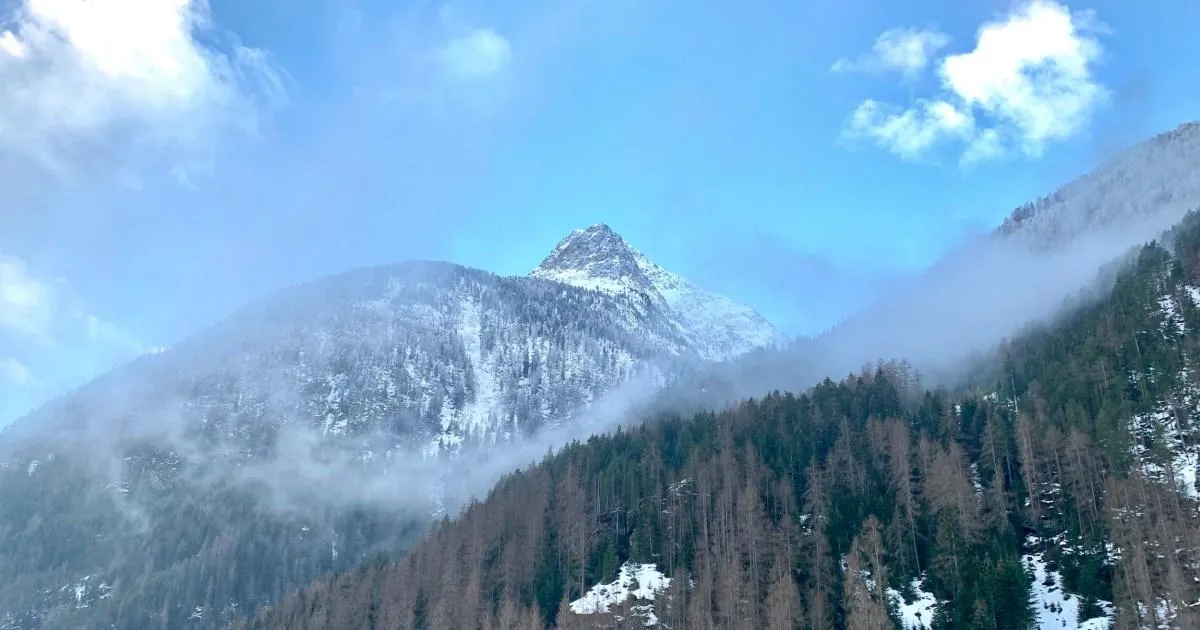
The Austrian Alps have a way of making human ambition feel small, and for one group of walkers above the resort town of Sölden, that grandeur turned from breathtaking to terrifying in a matter of minutes. It began as what should have been a gentle family outing, the kind of holiday adventure that promises fresh mountain air, laughter, and a few photographs against a postcard backdrop. A group of around thirty people, including nine British hikers, set off together on a walk above the snow-dusted peaks, with babies and toddlers tucked into prams and parents carrying the usual tangle of nappies, snacks, and spare clothes. They took the Wildspitz cable car to the top of an 8,694-foot mountain, planning to follow a scenic path back down into the valley below Sölden. There was nothing in the plan that suggested danger. But mountains do not care about plans. Somewhere along the way, the group took a wrong turn, and the gentle walk dissolved into a desperate struggle for survival on harsh, unforgiving terrain at an altitude of roughly 7,628 feet. What followed was a rescue operation that even hardened professionals described as touch and go, an airborne evacuation that plucked families from the edges of cliffs and lifted babies from places where one wrong step could have been fatal.
The group itself was a patchwork of nationalities and backgrounds, a small international community that had come together for a shared experience in the Alps. Alongside the nine British hikers were seventeen Belgians, seven Austrians, and three Americans, a mix of friends, relatives, and perhaps fellow travellers who had fallen into the rhythm of a group excursion. They were not mountaineers. They had no crampons, no ropes, no climbing helmets, and no technical gear designed for the kind of ground they found themselves on. According to rescuers, their equipment was described as equal to zero, a stark reminder that in the high mountains, even the simplest preparation can be the difference between a safe return and a tragedy. They were also, by their own admission, completely inexperienced in mountaineering, a fact that became painfully clear as the group began to fragment. Instead of staying together, the hikers spread out across the terrain, separated by as much as 200 metres in altitude in some cases. Parents were separated from children, relatives from one another, and the rescuers were faced with the challenge of finding and reaching people scattered across a steep, rocky slope where every step carried the risk of slipping into the void. The image of a group like this, ordinary families with prams, suddenly isolated across a mountainside, is a heartbreaking one.
The moment of crisis came when the group realised they could not find their way back. The path they had expected to follow either did not exist or had become invisible in the rocky landscape, and the terrain around them turned into a series of steep drops, loose stones, and slick rock slabs. Rescue official Jakob Kiegl, who coordinated the operation, later described how some members of the group were only about half a metre from a precipice and could barely hold on. There was even a stroller in the area where falls were imminent, a detail that sends a chill down the spine. Imagine standing on a mountainside, holding a child, watching the ground fall away into mist below you, and realising that the safety of your family depends entirely on the arrival of strangers you cannot yet see. That was the reality for the hikers as they clung to whatever hold they could find, waiting for help. The helicopters arrived eventually, but not before the group had spent agonising hours in the cold, exposed and frightened. For the rescuers, the operation was a logistical nightmare. The hikers were scattered, some high above others, some dangerously close to rock slabs, and the air was thin and unforgiving. Kiegl said he could not recall a rescue operation involving so many people, and he was clear that this story could have ended very differently. It was, in his words, touch and go.
Perhaps the most heartbreaking moment of the entire rescue came from the perspective of one father who could do nothing but watch. He stood higher up the mountain, clutching a toddler and standing with other relatives, while his sons were airlifted from an area described as dangerously close to a rock slab. The helplessness of that moment is almost impossible to put into words. As a parent, the instinct to protect your children is overwhelming, and to be forced to stand still, a safe distance away, while your children are lifted into the air by strangers, must have been a kind of quiet torture. He could see them, perhaps he could even hear them, but he could not reach them. His only choice was to trust that the rescue team knew what they were doing, that the cables would hold, that the weather would stay calm, and that his family would be brought back to him. The fact that this story ends with everyone safe is a testament to the skill and bravery of the Alpine rescue services, but it is also a reminder of how fragile life can be in the mountains. In a way, that father’s experience is the heart of the whole story: a family adventure, a wrong turn, and a sudden, terrifying reminder that the world does not bend to human wishes. All he could do was wait, watch, and hope.
When we step back from the details, this incident becomes about more than just a group of tourists who got lost. It is a story about human vulnerability and the unexpected ways we find ourselves tested. The hikers were not reckless adventurers seeking thrills; they were parents, grandparents, uncles, and aunts who wanted a day out in the mountains with the children. They made a simple mistake, a wrong turn, the kind of mistake that could happen to any of us on a walk in unfamiliar surroundings. But in the Alps, the consequences of a simple mistake can escalate with terrifying speed. The terrain cares nothing for good intentions, and a casual walk can become a survival situation in the space of a single path. The fact that babies and toddlers were among those rescued only heightens the sense of how close this came to tragedy. It also reminds us that the dividing line between safety and danger is not always clear to those who are about to cross it. The group likely did not notice the point at which their easy descent became a precarious climb, and by the time they did, it was too late to turn back. Their experience should not be dismissed as foolishness, but rather held up as a reminder that the mountains deserve respect, preparation, and humility.
In the end, the story of the Sölden rescue is one of relief, gratitude, and lessons learned. The group was brought down from the mountain alive, shaken but safe, and in the days since, they have had the chance to reflect on what happened. It would be easy to say that they were lucky, and no doubt they were, but luck alone does not explain why they survived. They were also helped by the professionalism of the rescue teams, the decision-making under pressure, and the human instinct to care for the most vulnerable among us. The Austrian rescuers did not ask about nationality or experience level; they simply went up into the danger and brought people home. That is worth remembering. For the rest of us, the story is a quiet call to prepare, to respect the wild places we visit, and to understand that even a sunny day in the Alps can hold hidden dangers. But it is also a story about human connection, about strangers coming together in a crisis, about a father watching over his sons, and about children who will one day grow up with an incredible story of survival. The mountains remain, beautiful and indifferent, but the people who walked away from them are carrying something they will never forget: the knowledge that on a Sunday in Sölden, with nothing but a wrong turn, they looked into the abyss and somehow found their way back.