


When the brutal winter storm of 2010 buried central Scotland under snow and ice, Brian Forbes found himself trudging a mile through the drifts to the local supermarket, his young children at home with little more than a half-empty fridge. The roads were gridlocked, schools were shut, and deliveries had stopped entirely. When he finally reached the store, the staff hadn’t even made it in, and the queues snaked through the aisles, with shoppers growing increasingly desperate and short-tempered. Milk, bread, and cereal were vanishing from the shelves before his eyes. As an engineer surveyor who spends his working days analyzing structural and safety risks, Brian felt a cold realization settle in his chest: his own family was completely unprepared for a crisis. His children, then small, had barely enough to eat for the next day, and that feeling of helplessness burned deeply. He trudged back home empty-handed, the wind howling around him, and made a quiet vow that he would never be caught off guard again. That single moment of parental panic, of feeling like he had failed his kids, transformed him into what he now calls “a master of doomsday prepping” – a man who has spent thousands of pounds building a fortress of supplies for his family, much to the amusement and bewilderment of his three children, now aged 15, 27, and 29.
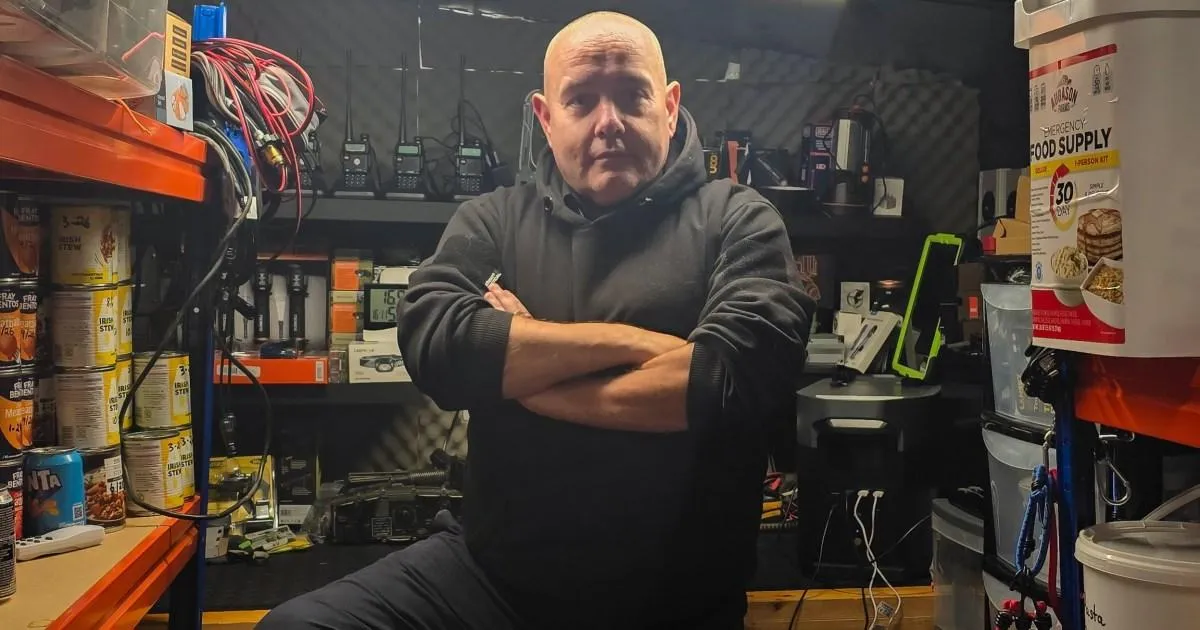
The transformation has been remarkable. Inside the Forbes family home, nestled between the cities of Glasgow and Stirling, two large sheds stand as monuments to Brian’s obsession. They are not simple garden storage units; they are meticulously organized survival hubs, equipped with their own solar panels, air conditioning, and auxiliary power supply. Shelves groan under the weight of hundreds of tins, freeze-dried meals, rice, pasta, and flour – enough non-perishable food to last a family of five for a staggering 25 years. There are army ration packs that provide a full 24-hour meal in a single bag, alongside power banks, battery-operated radios, headtorches, and walkie-talkies. A pair of night vision goggles hangs neatly on a hook, which Brian is quick to clarify are “not for hunting people” but simply so he can navigate in the dark without needing a torch. He also invested in a new generator this year, spending around £2,500 on freeze-dried foods, £2,000 on power banks, £500 on the generator, and a further £5,000 to build the sheds themselves. All told, his spending this year alone has reached a jaw-dropping £6,000. But for Brian, it’s not extravagance; it’s necessity. He perceives the risk of societal breakdown as higher than ever, pointing to a “crumbling power grid,” water shortages that left 40,000 people on bottled water for a month, and the increasing strain from electric cars, lorries, and heat pumps on an aging infrastructure. “These are things you can prep for,” he insists, his engineer’s mind constantly running through worst-case scenarios.
What makes Brian’s story deeply human is the family dynamic that surrounds his prepping. His wife, Donna, has come around to the lifestyle and now splits the bill with him, recognizing that his meticulous planning brings a sense of security to their home. But his children are less impressed. They think their dad is “nuts,” “crazy,” and has “lost his marbles,” as Brian put it with a wry smile. They go to great lengths to tell him why he’s wrong, why the chances of a catastrophic event are slim, why he’s wasting his money and his space. Brian listens, shrugs, and then says gently, “I may well be wrong, but it’s ultimately my money and time.” Behind that calm exterior, though, is a father who wants nothing more than to protect his family from the unforeseen. The memory of that 2010 storm still haunts him – the feeling of shame when his children asked for cereal and he had none to give. He began stockpiling less than a month later, adding “a little and often” to his supplies, building up slowly so the financial burden never felt overwhelming. When the Covid-19 pandemic hit in 2020, his family had enough food for three months, and they declined to panic-buy like the rest of the country. That quiet satisfaction – knowing they were safe while others scrambled – made all his preparation feel worthwhile. “The kids still roll their eyes,” he laughs, “but they also never went hungry.”
Brian’s prepping is not born of paranoia, but of a rational, professional assessment of the world around him. In his job as an engineer surveyor, he analyzes structural risk, and he has applied that same analytical eye to modern society. He worries about global conflicts that have raged every year throughout his life, noting that a distant war can “easily be our problem too.” He frets about extreme weather events damaging crops and driving up fuel prices, about cyberattacks crippling water systems, and about the fragility of a power grid that depends on just-in-time logistics. His two sheds are his answer to chaos – a sanctuary of self-reliance. He wishes he had “bunker money” to build a true underground shelter, but he proudly notes that his above-ground sheds are a practical compromise. They are not a doomsday fortress, but a lifeline. He is part of the UK Preppers Club movement, a community of like-minded individuals who share tips and encouragement. And he points out that his mindset is no longer fringe. Sweden and Finland have recently issued updated handbooks to their citizens on how to survive conflicts, disasters, and supply-chain disruptions, offering practical advice on resilience. The UK government has announced plans to revive the “War Book,” first used during the world wars and the Cold War, to guide officials through national emergencies. Brian sees this as validation: “It’s not just crazy people like me – governments are saying the same thing. We all need a plan.”
What ultimately makes Brian’s story so relatable is not the mountain of tins or the night vision goggles, but the universal parental urge to shield one’s family from harm. He acknowledges that his children think he’s eccentric, and he can laugh at himself, admitting that he might be over-preparing. Yet there is a quiet pride in his voice when he describes the two sheds as “peace of mind.” He knows that if the worst happens – a blackout, a flood, a war, a pandemic – his family will not be scrambling in panic. They will have light, food, heat, and communication. They will have a way to weather the storm, just as he weathered that frozen mile in 2010, but this time with a sled full of supplies and a heart full of certainty. Brian doesn’t consider himself a survivalist guru or a fearmonger; he’s simply a dad who learned a hard lesson about vulnerability and chose to do something about it. “My children think I’m nuts,” he says, smiling, “but they also know they’re safe. That’s all I ever wanted.” As the world grows increasingly unpredictable, his story reminds us that preparedness isn’t just about stockpiling goods – it’s about the quiet, stubborn love that drives us to look into the unknown and say, “No matter what comes, I’ll be ready for you.”
In the end, Brian’s 25-year food supply and arsenal of emergency gear are not just objects; they are a monument to his devotion as a father. He spends hours every month checking labels, rotating stock, testing batteries, and refining his systems. When his children roll their eyes and mock his “nuts” behavior, he doesn’t fight back. Instead, he reminds them of the 2010 storm, and of the fact that life is unpredictable – a car breaks down, a storm hits, a paycheck is delayed, a pandemic sweeps across the world. Prepping, he says, is just a way to say “I love you” to the future version of your family. It’s a way to turn anxiety into action, fear into fuel. He may never need to use a single freeze-dried meal or switch on a single power bank, and he will be glad for that. But if he does need them, he will be ready. And for a dad of three, there is no greater comfort than knowing that, whatever the future holds, he has done everything within his power to keep his children safe. That, more than the tins and torches, is the true heart of Brian Forbes’s story – a story of ordinary human resilience, wrapped in enormous resilience of an entirely different, and wonderfully Scottish, kind.