
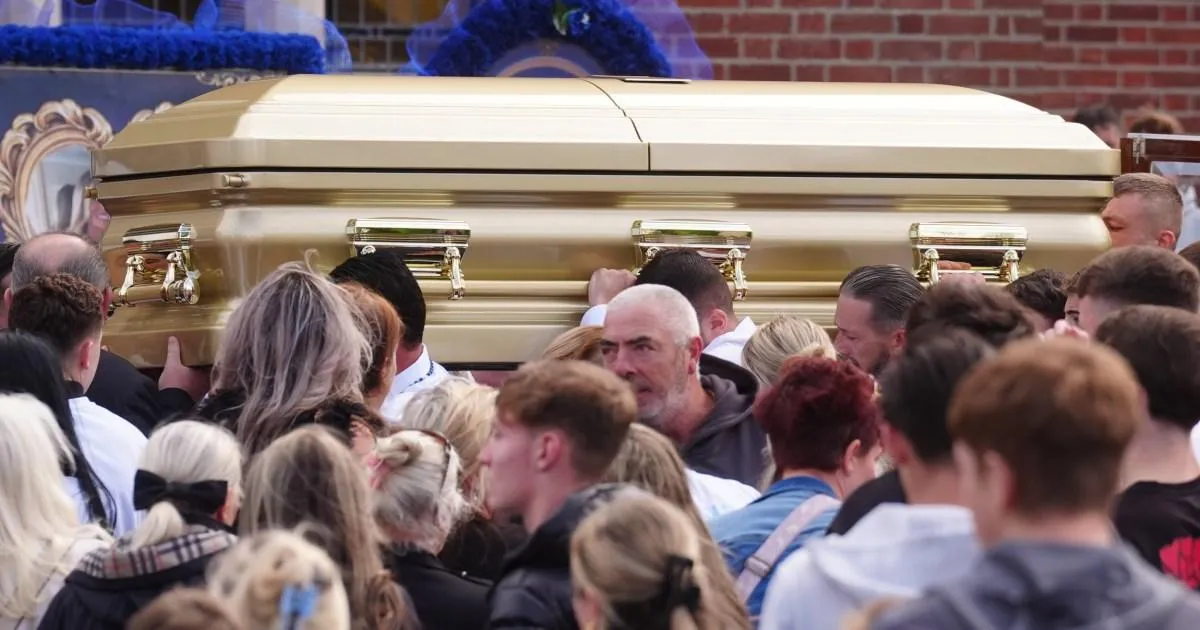
The small Irish town of Athy, nestled in County Kildare, became the epicenter of an overwhelming and heartbreaking spectacle this morning as the community gathered to bid a final farewell to one of its own. A gleaming gold coffin, a startling and poignant tribute to a life cut brutally short, arrived at St. Michael the Archangel Church not on a traditional hearse, but upon a white horse-drawn carriage, signaling a send-off of profound love and profound tragedy. The coffin carried the body of Joe Carthy, one of five teenagers whose lives were extinguished in a catastrophic head-on collision on the M9 motorway, a crash that has not only shattered families but has also ignited a nationwide conversation about youth, danger, and systemic failures. As the carriage clattered to a halt, the scene was one of striking, sorrowful pageantry. Mourners, many clad in stark white t-shirts emblazoned with Joe’s image, stood in silent unity, their individual grief merging into a single, palpable wave of communal mourning. Some raised framed photographs of the young man, their faces a mixture of disbelief, raw pain, and the hollow stillness that follows a sudden and devastating loss. The path to the church steps was laid with blue carpet, a regal yet somber pathway, flanked by delicate white flowers that seemed to whisper of innocence and lost youth, while a large screen displayed cherished pictures and videos of Joe, accompanied by music that filled the air, a soundtrack to a life remembered.
The devastating sequence of events that led to this somber procession began moments earlier on the M9, where the car carrying Joe Carthy and his friends—Jack Kennedy, Alex McCarthy, Jeremy O’Brien, and Kamil Pustkowski—was travelling the wrong way down the motorway. The teens’ vehicle was involved in a violent, head-on collision with a family travelling in another car, a wreck that would claim the lives of all five young men and leave a child and three women from the other vehicle fighting for their lives in hospitals, burdened with serious and likely life-altering injuries. While the community in Athy gathered to honor Joe, a parallel wave of grief and anxiety washed over another community in nearby Carlow. On Friday evening, a vigil was planned for the occupants of the other vehicle—three sisters, Ella Hendricken, Niamh and Alma Kinsella, along with a young boy, whose identities have become a focal point of public empathy. The sheer magnitude of the tragedy’s ripple effect is staggering, encapsulated by a crowdfunding effort launched to support the affected family, which had astonishingly raised over 640,000 euros by Friday morning. This generous outpouring is a profound testament to the public’s desperate need to offer tangible support in the face of unfathomable helplessness, a collective reaching out to individuals who are now navigating the terrifying limbo of hospital waiting rooms, uncertain of their loved ones’ futures, while simultaneously grappling with the knowledge that another family is burying their dead. The conflict of emotions—grief for the lost teens, fear for the injured, and anger at the circumstances—creates a complex emotional landscape that the entire nation is now traversing.
Beyond the stark statistics and political fallout, the funeral service for Joe Carthy served as a stark humanization of a headline. The details are intimate and harrowing: the sight of pallbearers straining under the weight of the gold casket, their faces etched with sorrow; the presence of Gardaí maintaining a respectful but watchful perimeter, a symbol of the ongoing investigation that now shadows this goodbye. Inside the church, the air was thick with incense and unshed tears as Fr. [Name] extended his “sincere sympathy to Joe’s family,” setting the tone for a service defined by shared sacrifice and communal resilience. He acknowledged the deep sorrow in everyone’s hearts, his words echoing against the quiet sobs of the congregation. This was not just a funeral; it was a testament to the profound impact a seventeen-year-old can have on his community. The choice of a gold coffin, the horse-drawn carriage, and the custom t-shirts are not simply macabre displays of wealth; they are desperate, symbolic acts of love, a way for a grieving family to elevate their son in death, to grant him a final spectacle of honor that he perhaps missed out on in life. It is a primal scream of affection unleashed in a world that suddenly feels meaningless. As the service concluded, the mourners filed out, their white t-shirts like a muster of ghosts, carrying the weight of their memories back into the daylight, aware that the next few days will bring more funerals, more vigils, and more gut-wrenching farewells.
In the aftermath of the funerals, the investigation into the M9 crash is peeling back layers of systemic vulnerability that point to a tragedy that may have been potentially preventable, or at least foreseen. Ireland’s child and family agency, Tusla, confirmed a deeply troubling fact: one of the deceased teenagers was in its care at the time of the crash, while two other boys were “known” to the agency. This revelation transforms the narrative from a simple tragic accident into a complex institutional failure. How did these young men, who had fallen through the cracks of the state’s protective net, end up in a car careening the wrong way down a motorway? The agency has committed to sharing information with the independent National Review Panel, which investigates deaths or serious incidents involving children known to Tusla or in State care. This promise of a review, while necessary, offers little comfort to the families who are now left to wonder if the cards were stacked against these boys from the start. It forces a painful societal introspection: what more could have been done to steer these youths away from danger, to provide them with the stability, guidance, or intervention that might have kept them from the road that night? The tragedy is no longer isolated to a single car crash; it is inextricably linked to the broader crisis of youth welfare, mental health, and the lack of adequate supervision and resources for vulnerable adolescents in Ireland.
As the funerals unfold, the political and legislative machinery in Ireland has lurched into emergency response mode, with justice officials scrambling to address the immediate threats exposed by the tragedy. Irish Justice Minister Jim O’Callaghan has committed to providing An Garda Síochána with “whatever resources they require” to combat dangerous driving, notably including the introduction of pursuit-specific training for the first time in the force’s history. This is a direct response to the controversial decision by local gardaí to instruct officers not to pursue the BMW occupied by the teenagers, after it had initially failed to stop for police. The decision, made in the interest of public safety to avoid a high-speed chase, ultimately culminated in the fatal head-on collision, leaving the public and politicians questioning the efficacy of such protocols. Mr. O’Callaghan is also exploring the creation of a specific criminal offence for deliberately driving against the flow of traffic, a legislative change that would treat this reckless act with the severe gravity it deserves. However, these knee-jerk policy commitments have been met with sharp criticism from opposition politicians, who argue that the root cause of the policing failures lies in a deep-seated recruitment and retention crisis. Sinn Féin justice spokesman Matt Carthy articulated this frustration perfectly, stating that a “failure to address” Garda numbers is “fuelling a community safety crisis” across the State. He insisted that a clear shortage of community gardaí means there are not enough officers to build the relationships and perform the interventions necessary to prevent crime and anti-social behavior before it spirals into fatal consequences.
The specter of social media and its role in glamorizing this tragedy has also come under intense scrutiny, adding another layer to this multifaceted crisis. Political leaders have sharply criticized tech giants for failing to swiftly restrict content that depicts dangerous driving or, in some cases, glorifies the illegal activities of the teenagers. In a move that has enraged lawmakers, TikTok declined a public invitation to appear before the Oireachtas Media Committee, where they were scheduled to address issues concerning content that “glorifies illegal activity.” Instead, the social media conglomerate offered a private briefing, a gesture viewed by many as a dismissive and cowardly attempt to avoid public accountability. This refusal is symbolic of a broader disconnect between the speed of digital influence and the sluggish pace of legislative oversight. The availability of videos showcasing reckless stunts or speed runs on public roads is being increasingly seen as a direct accelerant to dangerous behavior among impressionable youths. The boys involved in the M9 crash were not just victims of a moment of poor judgment; they were potentially part of a digital ecosystem that rewards notoriety and risk-taking. As the nation mourns, there is a palpable sense that the funerals of Joe, Jack, Alex, Jeremy, and Kamil are not just a farewell to five young men, but a poignant, devastating wake-up call for the entire nation—a call to fix the broken systems of child welfare, to adequately fund and support the police force, to hold social media companies accountable, and most crucially, to find a way to protect the next generation from the perils of the road and the blocks of their own vulnerable circumstances. The gold coffin may hold the remains of Joe Carthy, but the echoes of this tragedy will be felt in the halls of power, in living rooms, and on the motorway for years to come.