


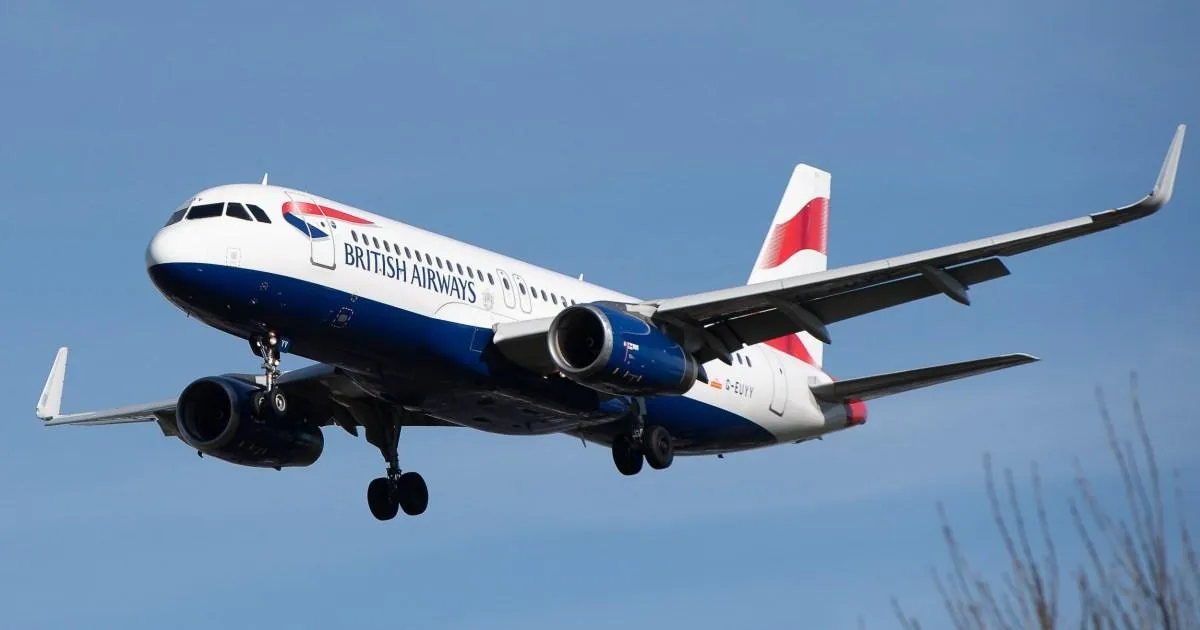
The incident involving British Airways flight BA919 serves as a stark reminder of the fragile balance between human intuition and complex automation in modern aviation. As the Airbus A320 approached London’s Heathrow Airport from Düsseldorf, what began as a routine descent quickly spiraled into a harrowing struggle for control. High above the bustling skyscrapers of Canary Wharf, the flight crew faced a cascade of technical failures that tested the limits of their training and composure. For the passengers on board, the serene final stage of the journey was suddenly shattered by the realization that their aircraft was struggling to maintain its equilibrium in the sky.
At the heart of the crisis was a critical failure of the aircraft’s air data systems, the complex network that provides pilots with essential information regarding speed, altitude, and orientation. When these sensors faltered at 4,000 feet, the aircraft’s automated systems issued a stall warning, signaling that the plane was losing the necessary lift to stay airborne safely. Navigating this danger at such a low altitude is a pilot’s worst nightmare, requiring immediate, calculated action. The crew correctly identified the urgency of the situation, declaring a “PAN PAN” emergency—a signal meant to alert air traffic control of a high-priority, though not immediately fatal, situation—and initiated a “go-around,” pulling the plane back up to climb again.
The tension in the cockpit compounded significantly during the second approach. As the aircraft neared the 3,000-foot mark, the stall warning sounded once more, indicating that the initial efforts to stabilize the plane had not fully resolved the underlying issues. Faced with the immediate risk of losing control, the crew was forced to perform an abrupt recovery maneuver that caused the aircraft to dip to an alarming altitude of 2,200 feet. The gravity of this moment cannot be overstated; at that height, the margin for error effectively vanishes. Recognizing the severity of the decline, the crew upgraded their emergency status to a “MAYDAY,” signaling that the aircraft was in imminent peril and required absolute priority for landing.
What makes this incident particularly chilling, according to reports, is the internal friction that unfolded within the cockpit during those critical minutes. While the first officer attempted to troubleshoot the malfunctioning data systems through standard protocols, the effort reportedly failed to stabilize the flight. The situation reached a breaking point when the captain found it necessary to physically intervene, taking direct control from the first officer to rectify the flight path. Such a move is exceptionally rare in commercial aviation—a final, drastic measure that highlights the extreme stress and ambiguity facing the crew as they fought to keep the heavy jet under control mere moments before touchdown.
In the aftermath, aviation experts have struggled to find a precedent for such a localized emergency over a dense urban center. Internal assessments have even classified the incident as a “loss of control in flight,” with investigators noting that the events were partially “pilot-induced.” This does not necessarily assign blame in a legal sense, but rather acknowledges the complex interplay between the machine’s malfunctioning systems and the human reaction to those faults. The captain, clearly shaken by the intensity of the struggle and the technical breakdown, was subsequently placed on stress leave—a human response to a situation that pushed professional training to its absolute breaking point.
As the Air Accidents Investigation Branch (AAIB) continues its deep-dive analysis, the aviation community watches closely to understand how a modern, highly automated aircraft could come so close to a “hull loss”—the industry’s bleak term for the total destruction of a plane. While the incident concludes with the relief of a safe landing, the story of BA919 remains a chilling narrative of courage and chaos. It underscores a fundamental truth about flying: despite all the sophisticated technology shielding passengers from danger, the safety of flight ultimately relies on the split-second decisions made by the humans sitting in the cockpit when the computers stop telling the truth.