

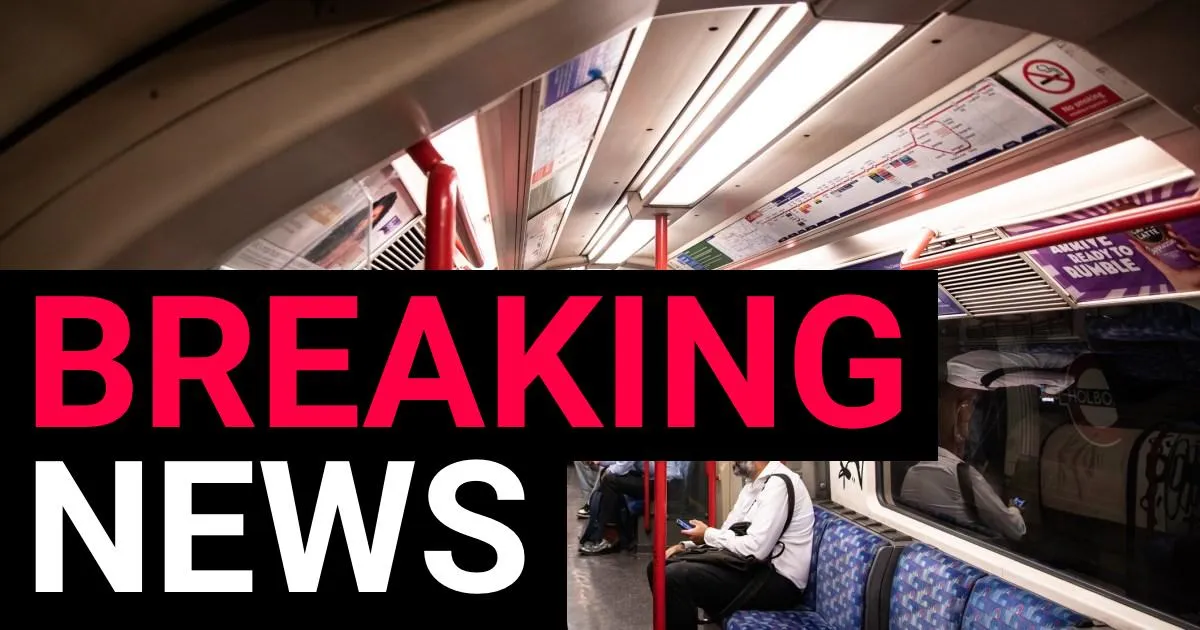
It began like any other rush-hour morning on the Central line. Commuters packed into carriages, headphones in, coffee cups balanced, minds already fixed on the day ahead. The train rumbled toward Stratford station in east London, one of the busiest interchange hubs on the network, carrying its usual cargo of exhausted sleepers, anxious job seekers, students, nurses and office workers. Then, without warning, everything changed. The train ground to a halt. Doors opened onto a platform suddenly alive with uniforms, flashing lights and the unmistakable presence of armed police. Commuters, bleary-eyed and disoriented, were told to leave their carriages immediately. A man who had been quietly scrolling through his phone on the way to work found himself standing on the platform, surrounded by strangers, all sharing the same confused, frightened expression. The air was thick with uncertainty. Some passengers later said they had seen officers moving through the train, searching every corner, every seat, every bag. Social media began to buzz with messages of alarm and disbelief. One passenger posted: “My central line train at TfL has just been evacuated with all these armed police looking for someone with a weapon…. Great.” Another tweeted about the sight of armed officers patrolling the platforms, calling it unsettling and worrying. What should have been an ordinary commute had suddenly become a scene of high tension, and for many, the line between everyday routine and real fear had blurred.
The incident, which unfolded shortly before 8 a.m. on 12 August, was triggered by a report that a man was carrying a firearm aboard a Central line train. At 7.44 a.m., British Transport Police received the call, and the response was swift and forceful. Armed officers were immediately dispatched to intercept the train at Stratford station, one of the busiest and most strategically important stations in east London. The train was met by these officers as it arrived, and the decision was made to evacuate all passengers. The carriages were then thoroughly searched, with officers moving through the train in a methodical, cautious manner, checking for anything that could confirm or dispel the report. The scene must have been overwhelming for those caught in the middle of it: the low hum of nervous conversation, the sharp crackle of police radios, the quiet commands to keep back and stay calm. For what felt like an eternity, nobody knew what was happening or whether the threat was real. Eventually, the search came to an end. Officers found no firearms, and no one matching the description of the reported man was located. But relief was tempered by lingering unease. British Transport Police later confirmed that they were continuing enquiries into the report, meaning that for many passengers, the question of what had really happened remained unresolved. The investigation was ongoing, and the anxiety of that morning would not simply disappear with the all-clear.
For the thousands of Londoners who rely on the Central line every day, the disruption was more than just an inconvenience. It was a disruption of trust in the routine of travel, in the safety of the familiar. Those caught up in the evacuation had to find alternative routes, some waiting on platforms for updates, others squeezing into buses and overground trains, all carrying with them the visceral memory of armed police swarming their commute. The ripple effects spread quickly. Transport for London’s travel status update reported minor delays on the Central line, with particular disruption on the westbound section of the entire line, as well as between North Acton and Ealing Broadway or West Ruislip, and between Leytonstone and Epping or Hainault. The reason given was blunt and unsettling: a police investigation. That phrase, appearing on station screens and smartphone notifications, was enough to remind every commuter that the system they depend on can be thrown into chaos in an instant. On the platforms at Stratford, officers were seen walking the length of the station, their presence a visual reminder of the heightened threat that now exists in every public space. People tried to carry on, to be patient and reasonable, but the tension was unmistakable. There was no panic, but there was a quiet, collective holding of breath, the kind that follows a near miss or an unexplained alarm.
The police response was measured and professional, and in the aftermath, British Transport Police moved quickly to reassure the public. A spokesperson confirmed the report of a man with a firearm on board a Central line train, described the response, and stressed that no weapons were found and no suspect was located. That statement, while necessary, did little to soothe the deeper anxiety that such incidents provoke. Reports of weapons on public transport are always treated with the utmost seriousness, because the potential consequences are so catastrophic. The decision to send armed officers into a crowded station is not made lightly, but it reflects the reality of the times we live in, where a single phone call can trigger a massive security operation. For the passengers who experienced it, the morning was a reminder of how fragile our sense of safety can be. We travel together in these confined metal tubes, strangers sharing a few minutes of proximity, and we often take for granted that nothing will ever interrupt the monotony of the journey. But when that monotony is shattered by the presence of guns and the command to evacuate, the imagination runs wild. Every face becomes a possible threat, every backpack a potential danger. Even after the all-clear, the mind lingers on the what-ifs, the maybe-nots, the shadows that remain in the corners of the story.
As if the drama on the Central line were not enough, the day carried another burden for Londoners: extreme heat. The capital was bracing for the fifth heatwave of the season, with temperatures expected to soar as high as 38°C the following day. The combination of a police emergency and sweltering conditions made for a uniquely miserable commute. Passengers emerging from the stale, potentially dangerous atmosphere of the evacuated train were met not with relief but with waves of heat radiating from the concrete and tarmac. London’s infrastructure, built for cooler climates, groans under such temperatures. Trains run slower, delays mount, and tempers fray. For those forced to stand outside waiting for updates on the Central line, the sun was an additional torment. The heat made every moment more exhausting, every wait more unbearable. National Rail also warned of possible disruption across the wider network, with several train operators running amended schedules, including Great Western Railway, c2c, Northern, CrossCountry and Chiltern Railway. It was one of those mornings when the entire city seemed to be conspiring against the commuter, when public transport, weather and emergency incidents all converged into a single, grinding, oppressive experience. The sweat, the stress, the fear and the frustration all mixed together on the platforms of Stratford, leaving everyone a little more worn down than usual.
In the end, the incident ended without violence, without injury, without any confirmation that a weapon had ever existed. But the emotional impact lingered long after the trains began moving again. We often talk about london’s resilience, its ability to absorb shocks and keep going, and there is truth in that. The buses still run, the stations still open, the city still moves forward. But resilience is not the same as immunity. Every event like this leaves a small mark, a memory that resurfaces the next time a train stops unexpectedly or an officer walks through a carriage. The passengers who were evacuated at Stratford may not know one another, but they share something now, a story of a morning when the ordinary became extraordinary. They will remember the armed officers, the silence before the announcement, the rush to get off the train. They will also remember the heat, the delays, the strange mix of fear and relief. The British Transport Police continue their enquiries, and perhaps in time the truth of what happened will emerge. But for the people caught in that moment, the truth is already clear: they were reminded that safety is never guaranteed, that our daily routines are held together by a fragile web of trust and vigilance. And yet, they got home, they got to work, they carried on. That is what londoners do. They carry on, through the heat, through the delays, through the fear, because the city has a rhythm that refuses to stop. And somewhere along the Central line, the trains continue to run.