


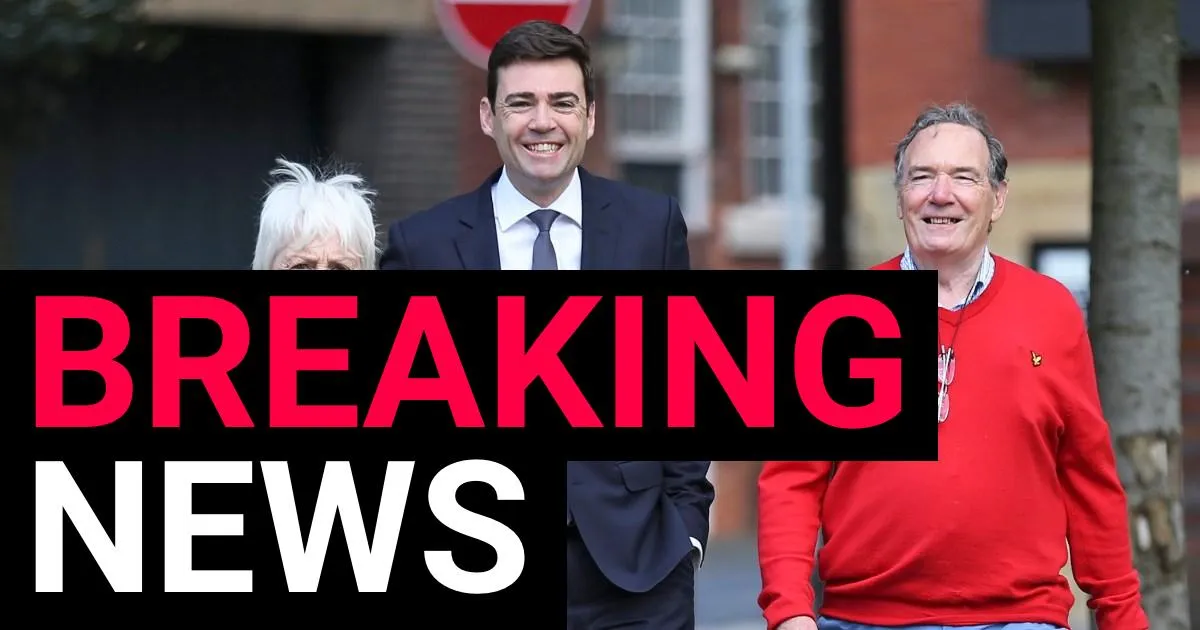
Andy Burnham’s father, Roy, has died. The news is both a family loss and a public event, because in death Roy Burnham is being remembered as the quiet foundation of a son who went on to become one of the most prominent figures in British public life. Official engagements for the next two days were cancelled, including a reception for business leaders at Downing Street, the weekly cabinet meeting, and a planned address to the Trade Union Congress in Brighton. Such cancellations are standard in the choreography of public mourning, but they also reflect the fundamental truth that grief does not consult a diary. Roy was not famous, and he never tried to be. For years, he worked as a telephone engineer at BT, while his wife Eileen worked as a GP receptionist. They were a Labour-supporting household, rooted in the working-class values of hard work, mutual responsibility, and care for others. Those values would later become the moral scaffolding of Burnham’s political life. Roy had been living with Alzheimer’s disease and had been in a care home, a painful reality that Burnham had spoken about openly. The disease had stolen parts of him, but it had not erased the love his family felt for him. The confirmation of his death came with the weight of a long farewell. For Burnham, his father was more than a parent; he was a symbol of everything fair and decent about ordinary British life. The formal statement may have used the language of schedules and cancellations, but the emotional meaning was far deeper: a son had lost his father, and the world, for a moment, was a little quieter.
At the centre of Burnham’s identity is family. He has often spoken of the way his parents shaped his political values, and those acknowledgements have never felt like box-ticking. They felt like gratitude. Roy and Eileen were both lifelong Labour supporters, and they gave their son something more durable than money: a moral clarity. Growing up, Burnham witnessed the relationship between work and dignity, the importance of community, and the idea that individuals are not alone in their struggles. Roy’s profession as a telephone engineer connected him to the practical world of public infrastructure, while Eileen’s work at a GP surgery surrounded her with the everyday health of ordinary families. Together, they taught their son to look at the world through the eyes of people who were just about managing, people who did not expect the state to solve everything but expected it to be on their side. Burnham has carried that lesson into every area of policy, but nowhere is it more visible than in his approach to care. His parents were not powerful people in the conventional sense, but they were powerful moral witnesses. Roy, in particular, was the kind of man who believed in quiet service. He did not need to be seen to matter. He demonstrated that a good life is built from small, repeated acts of kindness and responsibility. These are not the things that make headlines, but they are the things that make children into adults who can be trusted with difficult decisions. Burnham has said that his achievement was his father’s achievement too, and those words should be read not as modesty but as an accurate description of how lives are passed down. We often imagine success as a solitary ascent, but for Burnham it was a family project. Every step he took was supported by the values and sacrifices of the people who raised him. Roy may not have known his son had climbed to the top of the political world, but he had helped build the very qualities that made that climb possible.
Perhaps the most poignant insight into their relationship came from a moment Burnham shared in an interview with Elizabeth Day. He described visiting his father on the Sunday after he had been sworn into office. He was tearful as he recalled the scene, and it is not difficult to see why. The care home staff, knowing that Burnham would be appearing on television, had prepared carefully. They moved Roy’s chair into position, put the television directly in front of him, and gathered around him. Then, with gentle encouragement, they said, again and again, “Look, Roy! Look, look!” For a brief, flickering moment, staff thought Roy truly recognised his son. Burnham called it “wonderful,” and admitted that the memory made him “quite emotional.” What makes this story so affecting is the effort of the carers. They understood that Roy could no longer grasp the full meaning of the moment, but they wanted to give him a chance to experience it in whatever form was still possible. They wanted him to see his son, even if he could not fully understand who his son had become. There is something deeply humane in that scene, and Burnham’s willingness to tell it with tears in his eyes says something about his character too. He did not hide his vulnerability. He did not smooth over the awkwardness of a father with Alzheimer’s staring at a screen. Instead, he honoured the moment for what it was: an act of collective love. The staff were not just caring for Roy’s body; they were caring for his spirit, and by extension for his son’s heart. It was a small testament to the difference care workers make, and it is no wonder Burnham has made their cause central to his political mission. In that moment, the pain of the disease became intertwined with the beauty of human compassion.
The sadness of Roy’s illness was that it often prevented him from knowing the things that would have made him happiest. As Burnham prepared to take on his most significant role, he revealed the extent of his father’s decline in an interview with The Times. The man who had once been a proud parent no longer knew that his son was poised to enter the highest ranks of leadership. Burnham described the feeling with an honesty that was almost unbearable. “That’s a sadness because he would be (proud),” he said. The pause before the word “proud” is heavy with meaning. Roy did not know that his son had reached such a height, but Burnham refused to turn that sadness into bitterness. Instead, he folded it into gratitude. “The way I look at it, it’s his achievement as well. A whole family achievement, although he doesn’t know it.” There is something powerful about that framing. It could be easy to think that the tragedy of Alzheimer’s is that someone loses the ability to witness a family triumph. But Burnham’s perspective shifts the focus away from recognition and towards contribution. Roy may not have known about the achievement, but he was part of making it possible. His work, his values, his sacrifices, and his love were woven into the person his son had become. The achievement was not a single moment on a stage; it was the accumulated result of years of quiet support. Burnham’s public acknowledgement of this is a reminder that success does not belong only to the person whose name is remembered. It belongs to everyone who helped shape them, even if those people never hear their own name mentioned. In that sense, Roy’s pride did not need to be expressed. It could be implied by the life he lived and the son he raised. The disease may have stolen his knowledge, but it could not steal the reality of what he had created.
Roy’s health journey had a profound impact on Burnham’s politics. Towards the end of the pandemic, Roy was diagnosed with prostate cancer and received what Burnham described as “intense” treatment. Later, the family was told he had advanced Alzheimer’s disease. This double diagnosis was devastating, but it also gave Burnham a personal lens into a broken care system. He spoke about the unfairness facing “my dad and the millions like him.” He described the millions of family carers, people like his mother, who try to hold everything together when the formal system cannot help them. “We discovered as a family, my mum was sinking under the pressure of trying to make it work when the care system couldn’t make it work for her,” he said. Those words are not the language of a politician delivering a talking point; they are the language of a son who had watched someone he loved struggle. Burnham’s commitment to social care reform was not abstract. It came from witnessing his father’s own decline and his mother’s exhaustion. It came from the knowledge that no family should have to sell their home to pay for care. He described an ideal world where people would not be destroyed financially by the cost of looking after someone they love. His speech over the summer connected a personal story to a national scandal. The care system in Britain was already fragile, and the pandemic had exposed how deep its fractures went. Burnham was not asking for sympathy; he was asking for change. He wanted to transform the system so that no one would have to face what his family faced. And yet, his voice was never angry in a way that lacked compassion. He was angry at the injustice, but he was also grateful for the carers who supported his father, the staff who arranged the television, the people who tried to make Roy’s final years as dignified as possible. His father’s story became a symbol of a larger failure and a greater hope.
In the end, what can be said about a man whose greatest monument is the life of his son? Roy Burnham was a telephone engineer, a husband, a father, and a quiet believer in a fairer society. He lived his life without wanting applause. He was not on a platform, and he was not in a headline. But he did something more important. He passed on to his son a set of values that would shape the way a whole country might think about care, family, and community. Burnham has often said that his parents shaped his political values, and now that his father has died, that acknowledgement feels like an epitaph. Roy’s life was not defined by the disease that ended it, but by the years of meaning he built before it took hold. The Alzheimer’s diagnosis was cruel, and the loss of recognition may have been one of the hardest parts of the journey. But the memory of the care home staff, who gathered around him and pointed to the television, reminds us that even in the fog of illness, there are moments of grace. Burnham’s grief is private, but he has chosen to share pieces of it in his public life. That sharing is not weakness. It is a way of saying that grief does not have to be hidden, and that caring for people with dementia is not a shameful secret but a shared responsibility. The nation’s condolences may be offered to a public figure, but they are really offered to a son who lost his father. As Burnham returns to his duties after the funeral and the private sorrow, he will carry his father with him. Roy Burnham may never have known that his son had reached the highest office in the land, but he knew something more important: he knew what it meant to be loved, and he left behind a son determined to build a country that would love its citizens too. That is not a small legacy. It is the only legacy that matters.