

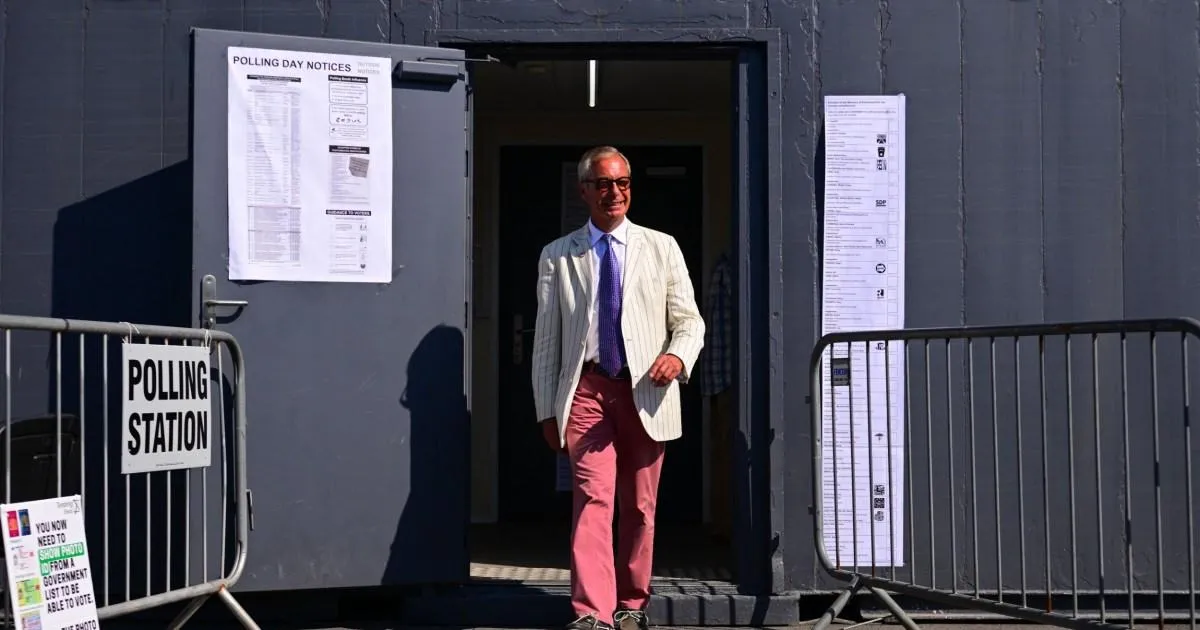
Polling day has finally arrived in Clacton-on-Sea, and the people who live here will be glad when it is over. There is something strange about a by-election that has turned a small seaside town into the centre of a national circus, and residents are not pretending to enjoy it. The contest to decide who will represent them in Westminster features 34 candidates, but in reality the battle has narrowed to a sitcom-like showdown between Reform UK’s Nigel Farage and Count Binface, a surrealist political character who has become the unexpected face of the opposition. Many locals told Metro they are simply “fed up” with the whole affair. This is not a normal election, and nobody seems to think it is. The vote was triggered after Farage resigned, following allegations that he received a £5 million “unconditional gift” from cryptocurrency mogul Christopher Harbourne. Farage, characteristically, has attempted to frame his resignation as a noble move, calling it a “people versus the establishment” fight and inviting voters in Clacton to “be the judge of my actions.” But on the ground, that grand narrative is landing badly. People want a representative who will show up, listen, and understand their lives. Instead, they have watched their town become a punchline and their electoral process become a reality show. The exhaustion is not about apathy; it is the sound of people who have been let down so often that they no longer believe the circus will deliver anything real. Polling day should be a moment of democratic renewal, but in Clacton it feels more like the final act of a long, noisy farce that the residents never asked to be in.
To understand why this election feels so strange, you have to understand Clacton’s recent history. This was the first place in England to elect a UKIP Member of Parliament, when Douglas Carswell defected and won a by-election in 2014, setting the stage for the Brexit revolution. It has since become a symbol of working-class frustration with a political system that, in the eyes of many voters, cares more about London and the wealthy than about struggling coastal communities. When Nigel Farage eventually won the seat for Reform in the 2024 general election, it seemed like the culmination of a long journey for both the man and the town. Yet here they are, not long after, back at the ballot box. The fact that Count Binface—the comic creation who has run against politicians before, promising things like mandatory questions about alien life and bringing back proper bins—has emerged as Farage’s closest challenger says something uncomfortable about the state of British politics. It suggests that, for a significant number of voters, the main parties have failed to offer a credible alternative, and even the serious candidates have become hard to distinguish from the joke ones. The long list of 34 names includes local activists, party loyalists, independent voices, and professional provocateurs, but in the minds of many residents they blur into one loud, confusing noise. What began as a protest over a donation scandal has morphed into something much broader: a test of whether a constituency can still be heard above the spectacle of its own election. And the people of Clacton are watching, many with folded arms, wondering whether any of these names will actually make their lives better once the cameras have gone.
Among those who have made up their minds is Julia Gibson-Cranch, a 60-year-old retired NHS worker. She is not a natural follower of novelty candidates, but she has come out in favour of Count Binface, and her reasoning shows exactly why Farage is in trouble with some voters. “The whole reason we pay politicians a reasonable salary is so that they don’t take money from anywhere else,” she said. “So that they don’t feel the need to take bribes or backhanders from dodgy billionaires. It seems he has no respect for that.” For Julia, the issue is not just the alleged donation itself, but what it says about Farage’s attitude to public service. She worked for years as a manager in the NHS and charities, and she knows what it means to be accountable for your time and your duties. “Nigel Farage has represented us in parliament something like 33% of the time,” she pointed out. “He is completely unable to be an MP. He’s got something like 13 other jobs! I’ve been a manager in the NHS and other charities all my career. If someone turned up 33% of the time then left, I would not be impressed!” Her words capture a broader anger among people who feel let down by the performance of elected officials. It is not that they disagree with everything Farage says; many of them probably agree with him on culture, immigration, and Britain’s place in the world. But they are tired of having a representative who appears to treat Parliament as an afterthought. They want someone who will attend debates, answer constituents, fight for local services, and be present in the community. The fact that a satirical candidate has become the vehicle for that anger is a sign of how desperate people have become for a way to show what they think of the system without holding their noses and voting for the status quo. In a way, voting for Binface is a protest, but it is a protest with a serious message: we are not prepared to be ignored, and if you will not take us seriously, we will find another way to make our point.
But not everyone in the constituency sees it that way. There is still a deep well of affection for Nigel Farage, and for many local residents he remains the only mainstream figure who ever seemed to speak for them. June and Alan Seward, aged 79 and 83, and their son Nick, 57, live in Holland-on-Sea, close to Clacton, and they have no time for the idea that Farage should be replaced by a satirist. Alan made his feelings clear, saying: “I think his support has been diluted by all these joke candidates like Binface. They’re wasting our time and making a mockery of the election. We just want the election to be over to be honest.” For the Sewards, the parade of novelty candidates is not delightful political theatre; it is a distraction from the serious business of choosing a Member of Parliament. They feel that Farage has been denied a fair hearing because the media has given so much attention to Count Binface and other stunts. In their eyes, the by-election should be about policies and representation, not about which candidate can produce the funniest photo opportunity. They want the vote to be over because the whole experience has made them feel as though their community is being treated as a joke. It is easy to dismiss that as blind loyalty, but it is also a reminder that Farage retains genuine support among older voters who remember a time when politics felt more straightforward and who believe he is one of the few politicians willing to challenge the establishment. They do not necessarily condone the alleged donation, but they do not think it should undo everything he has stood for. For them, the real problem is not Farage’s behaviour but the way his opponents have turned a serious election into a pantomime. At some point, they say, we need to stop laughing and start governing.
Further along the coast, in Jaywick, officially rated as the most deprived neighbourhood in England, the mood is even more complicated. Jaywick is a place that has been left behind for decades. It has some of the highest unemployment, poorest health, and least reliable infrastructure in the country. It is the kind of place politicians visit for a photo opportunity and then forget. Darren, 51, sums up the frustration many people feel: “I don’t like any of them really. Nobody would care about us down here if it wasn’t for Nigel being famous, but he’s hardly ever here anyway. So now all these joke candidates are coming down. It’s ridiculous.” There is a bitter irony in his words. Farage’s celebrity has brought the media to Jaywick, but his actual presence in the constituency has been limited. For locals, that is the oldest political trick in the book: use a struggling community as a backdrop, offer grand words, then disappear until the next election. The arrival of Count Binface and other joke candidates only deepens the insult. Here are people struggling to pay bills, living in areas the state has neglected for generations, and the national conversation is about a man in a space suit and a billionaire’s donation. It is difficult to imagine a clearer example of the disconnect between Westminster and working-class Britain. Darren does not pretend to have an easy answer. He is not convinced that any of the serious candidates would change anything, and he is definitely not convinced that the joke candidates deserve his vote. But his frustration is a reminder that by-elections are not just games for political obsessives. They are moments when real people are asked to place their trust in a system that has given them very little reason to trust. And when that trust is broken, it does not matter how many famous names appear on the ballot. What matters is whether anyone is actually listening.
At its heart, the Clacton by-election has become a referendum on the idea of representation itself. Nigel Farage wants voters to see this as a battle between the people and the establishment, and perhaps there is some truth in that framing. But for many people in Clacton, Holland-on-Sea, and Jaywick, the establishment is not just a distant elite in London. It is also the political class that includes Farage himself—the spectacle, the celebrity, the constant campaign mode, the fundraising controversies, and the sense that their community is less a home than a stage. Count Binface may be a joke, but he has become a vessel for a very serious emotion: the desire to punish a system that has failed them. The 34 candidates on the ballot are a symbol of a fragmented, chaotic politics in which nobody seems able to speak directly to ordinary people without turning everything into entertainment. What the residents want is remarkably simple and yet profoundly difficult to deliver. They want a Member of Parliament who shows up. They want someone who will not use their town as a platform for national ambitions. They want a politician who understands that a salary in public office is a matter of trust, not an invitation to collect donations from billionaires. They want to be able to walk down the street and see their elected representative, not just read about them in the papers. They want an end to the circus. Whether Farage wins, loses, or is humiliated by a man with a blue bin on his head, the deeper story in Clacton is about democracy’s failure to feel meaningful to the people it is supposed to serve. The result will be counted, a winner will be declared, and the cameras will eventually leave. But the frustration will remain until someone proves that they have truly heard what the towns of the Essex coast are saying. On polling day, residents are not just voting for a candidate. They are voting for the hope that the next Member of Parliament will finally be one of them—or at least, will finally show up.