
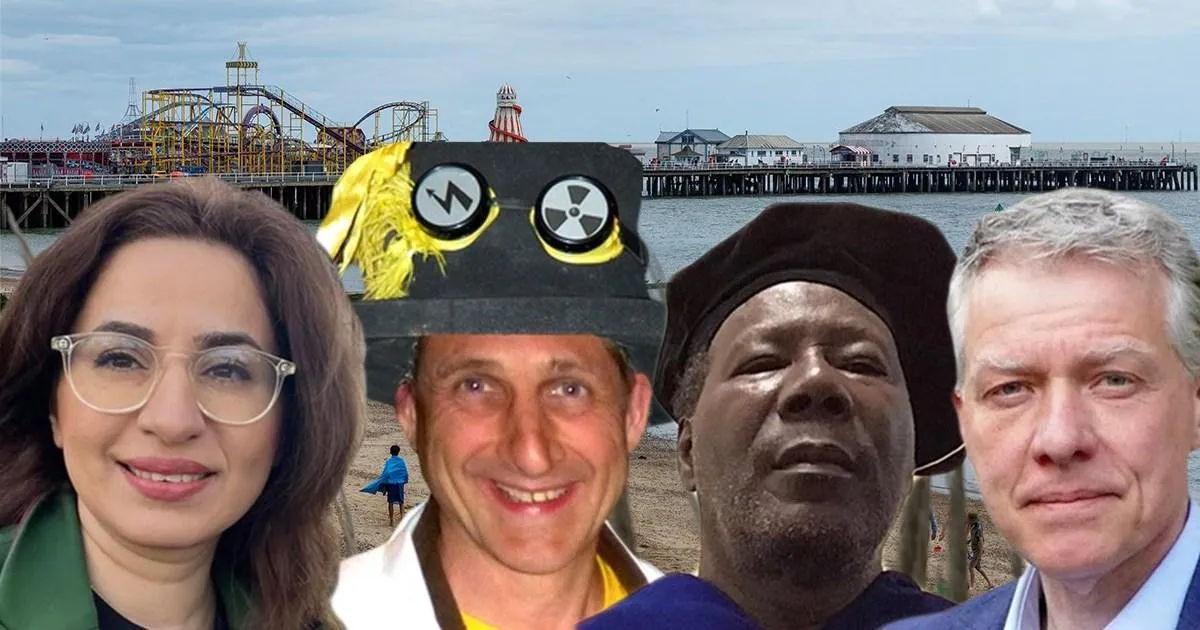
Tomorrow, the seaside town of Clacton-on-Sea will be thrust into the heart of British politics for a by-election that feels less like a normal democratic exercise and more like a curious mash-up of a protest march, a village fete, and a comedy festival. It exists because Nigel Farage, the leader of Reform UK, did something almost unprecedented: he resigned the seat he had won only recently, forcing a contest he did not need to fight, and then watched as every major party decided they would rather sit this one out than give him the satisfaction of a straight fight. Instead, Farage will face a sprawling field of 33 candidates, made up of independents, novelty act veterans, and micro-party true believers, from Count Binface to Nick the Incredible Flying Brick. In an attempt to make sense of it all, reporters reached out to every single candidate with the same ten questions about their plans for Clacton and the country, and fifteen of them bothered to answer. What emerges is a vivid, chaotic, occasionally touching and frequently absurd snapshot of modern Britain: a place where genuine deprivation, neglected infrastructure, and fractured community life sit side by side with a rich tradition of political eccentricity and slapstick protest. It is, in other words, a by-election that says an awful lot about how many people in this country feel ignored, entertained, furious, and faintly hopeful all at once.
Nigel Farage, for his part, offered only four answers out of the ten, which is its own kind of statement. He framed his return not as an act of political ambition but as a reluctant sacrifice, insisting that he did not want to resign and that the “political establishment” forced the contest upon him. His pitch to Clacton is simple and emotive: he will always be accountable, he will always take on Westminster, and he will always fight to fix “broken Britain.” His policies are the familiar Reform repertoire: deploying the Royal Navy to stop illegal migration, detaining and deporting those already here, cutting taxes on workers, scrapping green policies that push up energy bills, and taking a hard line on “dodgy barbers, vape shops, and candy stores” which he claims are ruining high streets. There is little in the way of the local, place-based detail that Clacton’s more serious candidates offer, but that is not really the point. Farage is running as the irresistible force against an establishment he says has failed, and in a constituency that has historically rewarded that message, his victory feels inevitable. The most substantive challenge to him comes not from the official opposition but from William Clouston, the leader of the Social Democratic Party, who gives the longest and most ideologically developed answers. Clouston argues that the press caricature of Clacton is wrong, pointing out that the constituency is not one monolith but a collection of distinct towns including Frinton, Walton, and the notoriously disadvantaged Jaywick. He talks about underinvestment in the public realm, poor road and rail connectivity, and a shocking shortage of dentists, doctors, nurses, and carers, all of which he has heard about directly on the doorstep. His proposed National Care Service, funded and structured nationally, would be a genuine lifeline for an aging constituency, and his critique of Andy Burnham’s Labour Party is sharp, accusing it of empty platitudes, incompetence with debt, and a refusal to confront mass migration. Clouston is serious, measured, and driven by a coherent vision of a patriotic state, and he stands out precisely because he treats Clacton voters as citizens with real problems rather than punchlines in a national drama.
Then there is Count Binface, who is having the time of his life. The intergalactic space villain and perennial political prankster offers exactly the kind of joy that the circus needs, promising to turn up, to listen, to make Clacton famous across the planet, and to campaign for affordable 99 Flakes and fairer arcade grabber machines. His manifesto includes gems like building at least one affordable house, nationalising Adele, making oil and gas companies pay for solar panels, and spending more time in Clacton than Washington DC. He has even had a summit with Andy Burnham, who apparently promised to think about renaming HS2 to FFS1. Binface is funny, self-aware, and genuinely warm, insisting that he is not horrendously right-wing and that only a vote for him can “take out the trash and clean up Clacton.” He is joined in the novelty corner by Nick the Incredible Flying Brick of the Monster Raving Looney Party, whose best campaign pledge is to become the Clacton Football Club mascot, and whose main proposed policies involve moving Parliament to St Osyth Naturist Beach and introducing piranhas into Holland Brook so that fishing and wild swimming become spectator sports. Baron Von Thunderclap, another Looney veteran, has decided that the town should be renamed Eric and that Clacton Pier should take up a seat in the House of Lords. On his seventh attempt to win a seat, he cheerfully admits he is not expecting victory but is enjoying the ride, and his night out in Clacton involved drinking several pints in the name of ridding the world of real ale. These candidates are easy to dismiss as jokes, but they are also performing an old and valuable function in British political culture: they remind everyone that power should not be taken too seriously, that politics belongs to the people, and that even the most cynical election can be disrupted by a man with a brick on his head and a dream.
Beneath the gags, however, there is a far more grounded and quite moving strand of independent candidacy from people who genuinely know Clacton and want to fix it. Attieh Fard, an independent with a background in law and a Christian faith she says calls her to serve, is determined to be an accessible, visible, accountable MP. Her diagnosis of the constituency is forensic: dangerous potholes that are costing drivers serious money, poor bus services, no university, high unemployment, a struggling high street, and Jaywick’s deeply complex problems, including the private ownership of its beaches. She has already written to the Prime Minister and proposed new legislation to change the road funding formula, and she wants to tackle immigration, security, social housing, and the dignity of care workers. Derrick Morris, an independent who claims a grand political history and describes himself as the “Modern Father of America,” has his own bold vision, calling for two million jobs for young people, huge new hospitals in every county, better ambulance response times, an end to wars, and a rebranding of benefits as “assistance.” His campaign slogan is the gloriously unfiltered “Prettify & Richify Clacton.” Tony Francis, a former police sergeant and community worker, offers a quieter but no less passionate message: listen, understand, act. He is deeply worried about health access, homelessness, addiction, hopelessness among young people, and the silo mentality that passes people from one service to another, and he points to Clacton’s two vibrant theatres, his favourite café Seabreeze, and the burgers at The Cherry Tree as proof that this is a place worth fighting for. Nick Pelas, who has lived in the area for over twelve years, wants to open up empty shops, make Clacton a year-round destination, and boost arts and local business. Martyn O’Brien, another independent, cares about elderly care, unemployment, transport, and access to Colchester Hospital, and he does not trust Andy Burnham’s rebrand. Robin Green, with an unusually detailed policy programme, wants to tackle GP waiting times and take AI seriously. Joseph 77 wants to build a “Clacton Culture Campus” to revive the town’s holiday camp spirit. These candidates do not have the money, the machine, or the media profile of Farage, and almost none of them will win, but they represent something essential: real people who looked at the mess and decided to stand up, ask uncomfortable questions, and try to make a difference in their own community.
The final group of respondents adds yet more texture to a remarkable field. Daniel Pocock, an Australian engineer and independent, has thrown himself into the contest with extraordinary intensity, citing his diplomatic mission to Clacton’s sister city, his legal battle against Centrica over a £40,000 estimated billing error, his fight with IBM Red Hat over children’s online safety, his diagnosis of mobile network blackspots, and his warnings about cryptocurrency scams. He wants a tramway between Clacton, Jaywick, and other districts, warmer homes for energy sovereignty, positive alternatives to social media for young people, and very careful scrutiny of assisted suicide legislation so vulnerable people are not put at risk. His belief that he is a better “Trump Whisperer” than Farage is just one of many extraordinary claims. James Ransley, standing for the micro-party Consensus, is the only candidate with direct council leadership experience, having run a local authority of 12,000 residents without raising council tax. He thinks the key to Clacton is taking a seat on the town board and helping Tendring Council spend the £60 million of regeneration money wisely, and he modestly suggests he might send Donald Trump some gold-coloured sticks of rock. John Stevens, standing for Rejoin EU, is refreshingly honest about his chances, admitting he expects Farage to win easily. His purpose is symbolic: to give Clacton voters a chance to send a national message that Brexit was a mistake, noting that polling suggests a growing minority of residents now agree. His dream role would be negotiating Britain’s return to the European Union, and his three-word campaign warning is “Hot. Surreal. Fun.” Even the most serious candidates seem aware that they are taking part in something strange, but everyone, in their own way, is convinced that Clacton deserves better than the caricature of it that dominates national headlines.
Taken together, this extraordinary by-election offers a weirdly hopeful and deeply human picture of politics. On the surface, it looks like a joke, a circus with too many clowns and no ringmaster, but the reality is more complicated. The novelty candidates are there because democracy should be playful and irreverent, and because sometimes the best way to puncture the arrogance of power is with absurdity. The serious independents are there because they love their town and cannot bear to watch it decline while party loyalists and career politicians argue about nothing. The micro-party true believers are there because they think the mainstream has failed and they have an answer, no matter how unlikely it is to win. And Farage is there because he has tapped into a deep well of public anger and frustration that the old parties have not known how to answer. What unites almost all of them is a sense that British politics is broken, distant, and self-serving, and that ordinary people have been left to patch together their own remedies, whether that means standing for Parliament in a silly hat or writing a detailed plan for social care reform. Clacton will probably re-elect Farage, because that is the easiest and angriest option, but the sheer variety of voices in this campaign proves that the town is not as simple as the headlines suggest. It is a place of elderly people worried about care, young people who need jobs and hope, potholed roads, empty shops, beautiful beaches, proud communities, and a stubborn refusal to be ignored. Whatever happens when the votes are counted, this by-election has already done something valuable: it has reminded everyone that politics is not just about Westminster, but about kitchens, streets, churches, seaside cafes, and the strange, stubborn, irreverent, and resilient people who call a place like Clacton home.