


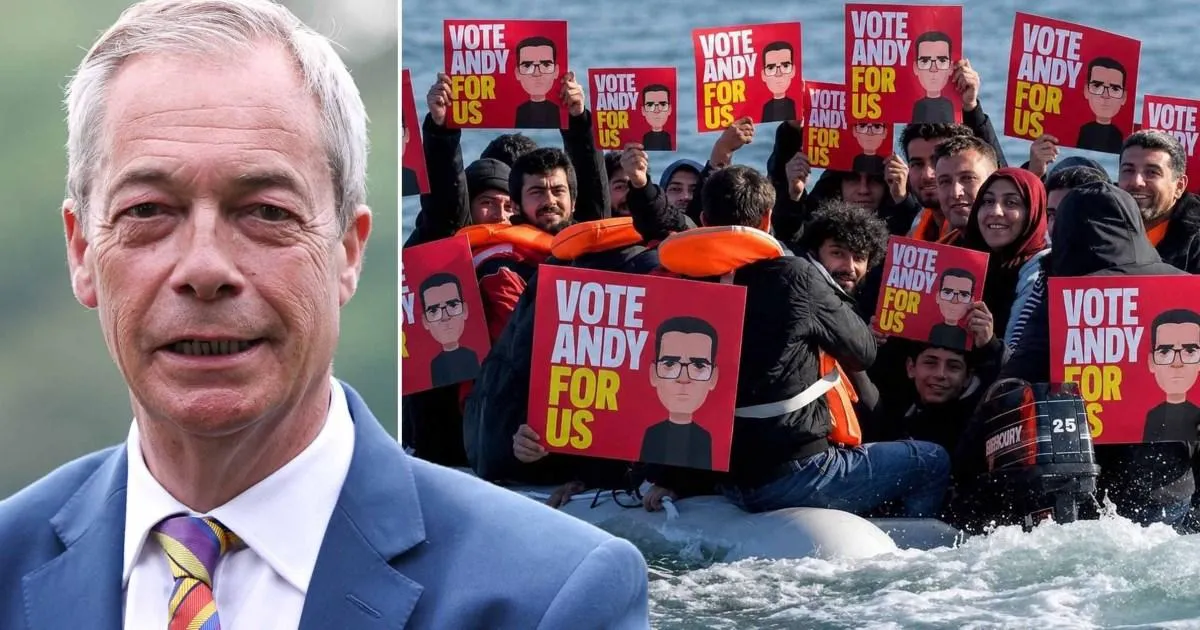
The political landscape in Makerfield has become increasingly combative as the June 18 by-election approaches, with Nigel Farage and Andy Burnham engaging in a high-stakes war of words. The latest provocation arrived when Farage, the leader of Reform UK, shared an AI-generated image on social media. The graphic depicted a group of migrants in a small boat, beaming with joy while holding up banners that read “Vote Andy For Us,” complete with a cartoonish illustration of the Greater Manchester mayor. Farage framed his post with a sharp jab at the Labour politician’s past rhetoric, telling voters that Burnham serves the interests of migrants rather than those of ordinary citizens. It was a calculated attempt to stir up debate on immigration, a sensitive and defining issue for the voters of this specific constituency.
Andy Burnham, famously known for his quick wit and refusal to be intimidated, didn’t leave the attack unanswered for long. He responded to Farage by dismissing the stunt as evidence of “desperation,” cheekily suggesting that the Reform leader would be better off utilizing his substantial financial resources—specifically referencing the controversy surrounding the £5 million donation Farage received from a crypto billionaire—on something more useful than amateurish smear campaigns. This retort highlighted the growing friction between the two men, as both navigate the intense pressures of a by-election campaign that has transformed into a proxy battle for the future direction of British politics.
The back-and-forth quickly transitioned from personal barbs to policy clashes as Farage attempted to pivot the conversation back to Burnham’s record. The Reform leader shared screenshots of reports detailing that the Greater Manchester Combined Authority, under Burnham’s leadership, had committed roughly £700,000 toward helping refugees integrate by overcoming hurdles related to housing and local services. Farage used this to fuel his narrative that local resources are being squandered on people rather than prioritizing the resident British population. However, the reality of the policy—which largely concerns individuals who have already been granted legal asylum—was somewhat lost in the heated rhetoric of the exchange.
At the heart of this conflict lies the demographic and political complexity of Makerfield, a seat within Wigan that voted heavily to leave the European Union back in 2016. Because of this, immigration has become the ultimate “wedge issue,” capable of swaying the electorate in a territory that is historically Labour but increasingly receptive to Reform’s populist messaging. Burnham has found himself walking a delicate tightrope, having recently shifted his position on restricting benefits for immigrants after a period of intense public scrutiny. Simultaneously, he has signaled a move toward a more restrictive stance on net migration, acknowledging that the public demands a significant reduction in the numbers moving to the UK.
Despite the noise and the dramatic digital theater, the electoral reality remains incredibly tight. Recent polling data from Survation indicates that while Burnham currently holds a lead at 43%, he is only three percentage points ahead of Reform’s candidate, Robert Kenyon. With the Conservative, Liberal Democrat, and Green parties pulling in smaller shares of the vote, the contest has effectively narrowed into a fierce head-to-head between the Labour stalwart and the Reform challenger. This thin margin underscores why both sides are so eager to seize control of the narrative, knowing that a few thousand votes could determine the outcome, and by extension, send a powerful message about the national political climate.
Ultimately, this skirmish is about far more than local governance; it is a battle for the soul of the working-class voter. For Farage, the goal is to leverage the frustration surrounding immigration to erode Labour’s traditional support base. For Burnham, the challenge is to defend his track record while pivoting to address the concerns of a base that feels left behind. As the clock ticks down to June 18, the voters of Makerfield are being inundated with headlines, social media theatrics, and sharp policy debates. Regardless of the outcome, the bitterness of this contest serves as a stark reminder of how deeply divided the country remains on the issues of identity, borders, and what it truly means to represent the people.