


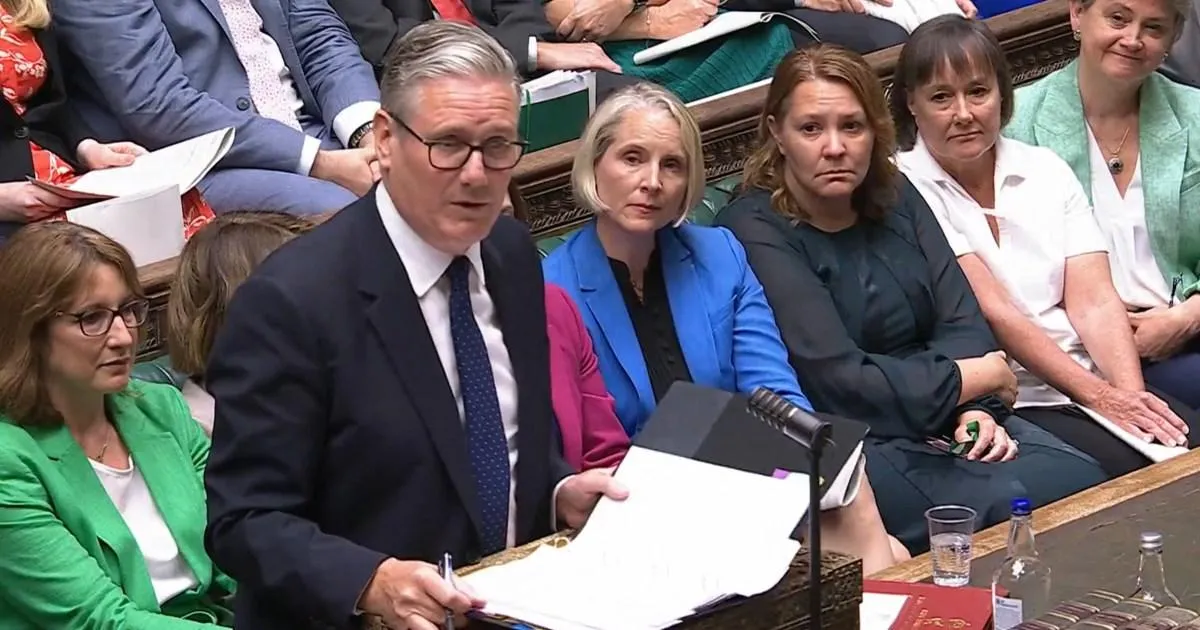
The recent scenes during Prime Minister’s Questions in the House of Commons offered a rare, humanizing glimpse into the high-pressure world of British politics. In an era where a prominent politician breaking down in tears would typically signal a catastrophic shift in the markets or a destabilized government, the atmosphere yesterday felt remarkably different. Reflecting on the tumultuous tenure of Liz Truss, whose short-lived premiership was defined by economic volatility, the public has become accustomed to the idea that tears in Parliament usually precede a collapse. Yet, as Labour MPs Johanna Baxter and Carolyn Harris grew visibly emotional while paying tribute to Sir Keir Starmer during his final weekly session, the emotional heavy lifting felt more like a sincere farewell than a political omen.
The intimacy of the moment was palpable, extending well beyond the front benches. As Sir Keir delivered his final response, he took a moment to honor his family, his voice wavering with an intensity that suggested he was dangerously close to losing his composure entirely. Watching from the galleries, Labour staff and devoted campaigners were seen wiping away tears, replaced by a shared sense of collective vulnerability. It was a stark departure from the typical, performative hostility that characterizes Westminster. For a brief hour, the chamber felt less like an arena for gladiatorial combat and more like a space where the human toll of public service was finally acknowledged, transcending the usual partisan friction.
One could not help but contrast this display with the jarring theatrics of the past. When Boris Johnson bowed out from the despatch box, he did so with a flourish of “Hasta la vista, baby,” leaning into a style of braggadocio that felt designed to command headlines rather than foster connection. That famous exit was sharp, combative, and intentionally alienating. In contrast, yesterday’s proceedings were defined by an unaccustomed restraint. Leaders and backbenchers from across the political spectrum arrived with a mutual intention to lower the temperature, choosing to offer genuine well-wishes to a man who had navigated two of the most grueling years in modern political memory.
Despite the gravity, the session was not without its moments of levity, proving that politics need not always be a joyless slog. There were playful exchanges, lighthearted ribbing about football allegiances, and even a nod to the eccentric absurdity of the “Binface” by-election campaign. When asked about his viral moments—the “6-7 dance” that had previously lit up social media—Starmer leaned into the humor, meeting the question with a self-awareness that brought genuine, roaring laughter from every corner of the Commons. Even staunch political opponents, such as the Conservative MP Jesse Norman, seemed to set aside their ideological iron bars to simply enjoy the communal humor of the moment.
Ultimately, the session served as a powerful reminder that beneath the policy debates, the fiscal crises, and the endless viral soundbites, these figures are individuals tasked with carrying an immense weight. By tempering the typically vicious atmosphere of PMQs, the House of Commons managed to carve out a pocket of sincerity that is often missed in the churn of breaking news. It was a quiet acknowledgement that while policies may divide a nation, the stresses and personal sacrifices required to lead it are universal constants. The emotional weight of the room wasn’t about a looming crisis, but about the profound realization of what it costs to walk away from one of the hardest jobs in the country.
As we look toward the future of British politics, characterized lately by the resignation of high-profile figures and the constant noise of the Westminster bubble, yesterday’s session stands as a testament to the power of decorum. It suggested a path forward where political disagreement does not automatically equate to personal malice. Whether one supports the outgoing leadership or stands in fierce opposition, there was something undeniably restorative about seeing a legislative body pause long enough to recognize the humanity of its participants. In stripping away the snark and the performative aggression, the House found a way to end a chapter on a note of grace, proving that even in the mad world of British politics, empathy still has a seat at the table.