


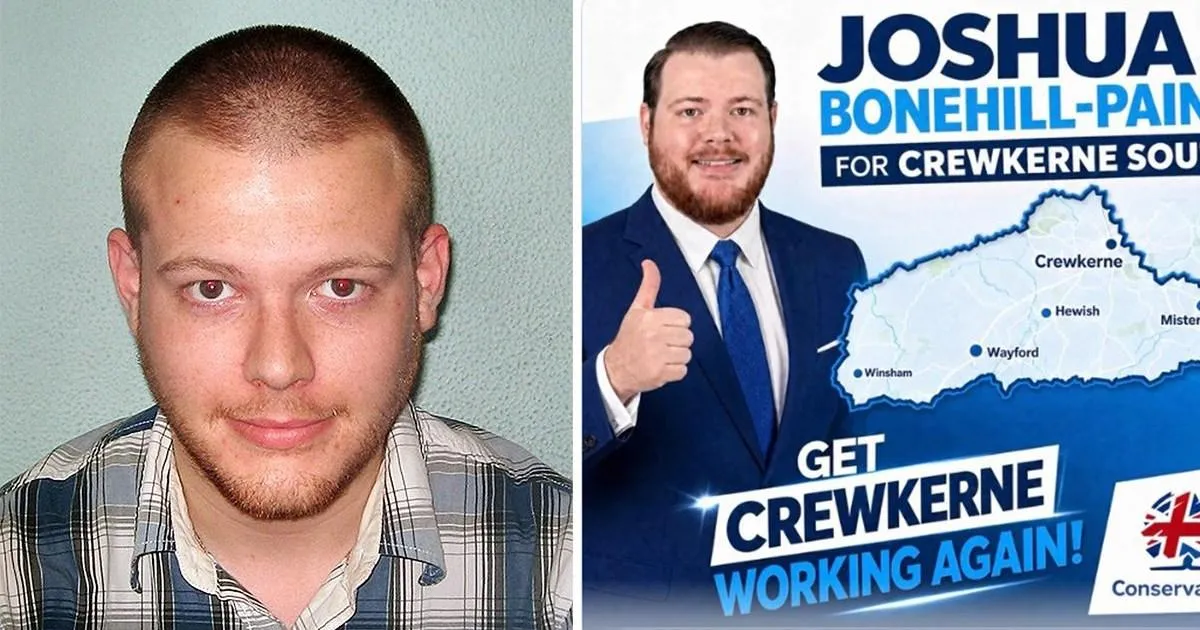
The recent selection of Joshua Bonehill-Paine as a Conservative council candidate in Somerset has ignited a firestorm of controversy, throwing a spotlight on the complexities of political redemption and the standards we set for public office. Bonehill-Paine is a figure defined by a turbulent and often dark history; once a prominent neo-Nazi activist, he gained infamy for orchestrating campaigns of hate, including an anti-Semitic rally targeting a Jewish community and the severe harassment of Labour MP Luciana Berger. His rap sheet is extensive, ranging from inciting racial hatred to bizarre and violent outbursts that included impersonating a police officer after breaking into a station. For many, the sight of his name on a ballot paper for the Conservative Party feels less like a step toward progress and more like an affront to the values of public service.
However, the narrative surrounding Bonehill-Paine is not a simple one of villainy, as he and his supporters argue that he is a reformed man. Following his time in prison, he has undergone a documented shift in ideology, claiming that soul-searching during his incarceration led him to renounce his past hatred. He now speaks openly about his transformation, pointing to his Home Office certification as a counter-extremism consultant—a role in which he trains police, schools, and universities on how to combat the very ideologies he once championed. For those who believe in the power of rehabilitation, Bonehill-Paine stands as a testament to the idea that people can fundamentally change their trajectory if they are given the space to learn from their mistakes.
Conservative leader Kemi Badenoch has emerged as a staunch defender of his candidacy, framing his selection as an exercise in the party’s commitment to second chances. She rejects the characterization of his recruitment as a lapse in judgment, instead emphasizing his ongoing contributions to society and his efforts to undo the harm he previously caused. By highlighting his professional work in the Home Office’s counter-extremism programs, the leadership is betting that his lived experience makes him an asset rather than a liability. To the party hierarchy, Bonehill-Paine represents a man who has faced his demons and emerged as a productive, remorseful member of society who is now working to improve his local community.
The reality, however, remains deeply polarized. While he attempts to pivot toward local governance, his online persona tells a different story. As the architect of the “Crewkerne Gazette” social media channels, he has become a viral force, utilizing sophisticated AI-generated videos to mock political opponents and champion Conservative figures. These accounts, which boast hundreds of thousands of followers, serve as a modern digital battleground, blending satire with sharp-edged political propaganda. While some see this as clever, modern campaigning, critics view it as a continuation of his history of aggressive, troll-like behavior, questioning whether a man who built an audience through polarization is truly fit for the measured, constructive work of local council representation.
The reaction from the broader political spectrum has been scathing. Reform UK leader Nigel Farage has publicly questioned the “new generation” of Conservative candidates, utilizing Bonehill-Paine’s past as a bludgeon against the party’s vetting processes. For many, the sting of his previous conviction for stalking and harassing a Jewish politician remains too fresh to be washed away by a few years of training seminars. The tension lies in a fundamental disagreement over what constitutes “rehabilitation.” Is someone with a history of extreme bigotry ever truly “cured” of those impulses, or does the stain of their past actions serve as a permanent disqualification from the privilege of representing the public?
Ultimately, this saga serves as a microcosm of the current state of British politics, where the lines between digital influence, personal redemption, and institutional vetting are increasingly blurred. Whether Bonehill-Paine’s candidacy is viewed as a brave act of inclusivity or a reckless disregard for ethical standards depends largely on one’s personal threshold for forgiveness. As he moves forward with his campaign in Crewkerne South, the voters will now have the final say on whether his past is a closed chapter or a warning sign that cannot be ignored. The case remains a challenging reminder that, in the court of public opinion, the path to redemption is rarely as straightforward as a certificate or a change in political allegiance.