

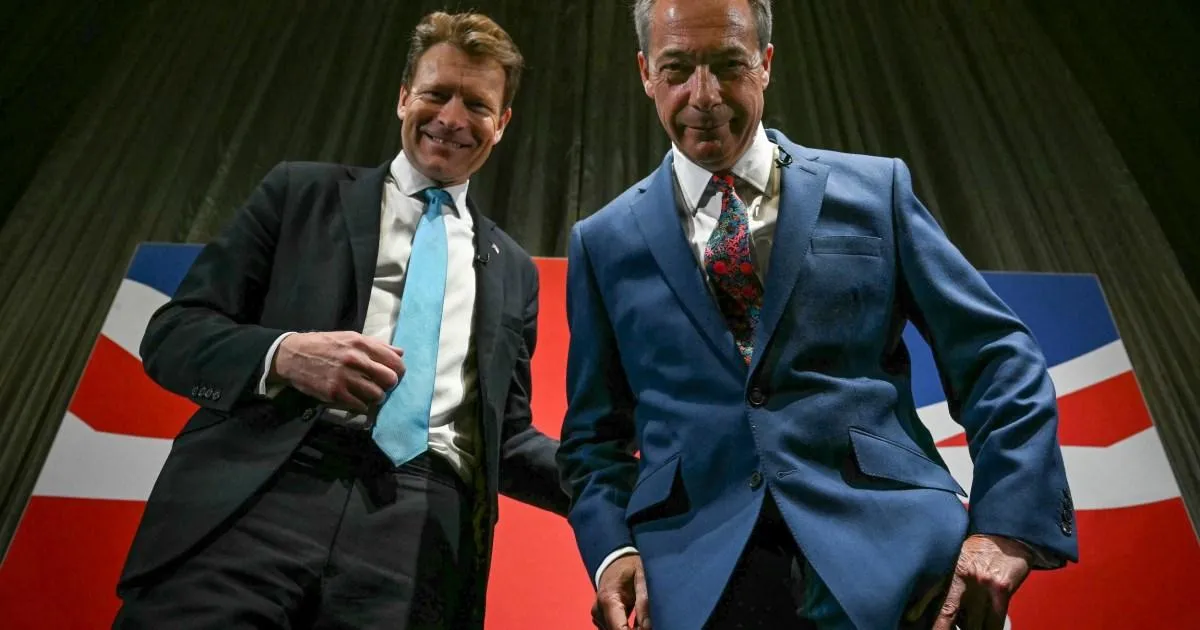
The narrative surrounding Nigel Farage’s return to the helm of Reform UK has long been framed as a spontaneous “lightbulb moment”—a last-minute decision spurred by an urgent sense of duty to the country. However, recent investigative reporting from the Sunday Times suggests a far more calculated reality. Far from being a sudden impulse, Farage’s takeover appears to have been the result of months of backroom negotiations involving then-leader Richard Tice and political operative George Cottrell. By mapping out a strategy as early as March 2024, Farage and his inner circle were not merely reacting to the political climate; they were architecting a power transition that was firmly in place well before the public saw the Reform leader take the stage in June.
At the heart of this controversy lies a significant financial question regarding a £5 million “gift” from billionaire Christopher Harborne. Farage has consistently maintained that he was essentially a private citizen until his dramatic announcement on June 3rd, a distinction that has allowed him to sidestep formal parliamentary disclosure rules regarding political donations. Under current regulations, MPs are required to declare any gifts or hospitality linked to political activity received within a year of their election. By clinging to the narrative that he wasn’t “in politics” during the spring, Farage has shielded himself from having to account for how those millions were utilized, famously brushing off public scrutiny with the flippant remark that he could spend the money on “Ferraris if I want.”
The timeline uncovered by journalists creates a glaring friction with Farage’s public claims. Sources indicate that by March 2024, Farage was already discussing his compensation requirements with senior Reform figures, reportedly citing a need for “a million a year” to offset his lost earnings should he commit to a five-year parliamentary term. This conversation took place just weeks before the massive injection of funds from Harborne. It paints a picture of a man ensuring his financial security and the party’s structural stability were fully aligned before he ever officially set foot on the campaign trail. It transforms the image of a selfless crusader into that of a high-stakes negotiator ensuring his transition into office was as lucrative as it was influential.
Furthermore, the mechanics of the takeover involved complex internal maneuvering, including the settling of existing debts. The Sunday Times reports that part of the arrangement between Farage, Tice, and Cottrell included the repayment or write-off of substantial loans previously provided to the party by Tice’s own business interests. This internal restructuring suggests that the leadership change wasn’t just about a change in the face of the party, but a comprehensive financial reset. While a Reform spokesperson has attempted to frame these discussions as mere exploratory talks—insisting that Farage was simply “keeping his options open”—the depth of these financial arrangements suggests a level of commitment that makes the “spontaneous” narrative feel increasingly thin.
The implications of these revelations go beyond mere administrative oversights; they strike at the heart of voter trust. When a politician frames their return to public service as an unprompted, heroic sacrifice, the discovery of a pre-planned, multi-million-pound arrangement feels like a breach of that narrative contract. Farage’s decision to resign his seat and force a by-election in Clacton—a move he branded as a “people versus the establishment” struggle—is now being scrutinized under a different light. Far from being a champion of the common person fighting an entrenched system, critics argue this move was a vanity-driven stunt, an attempt to bypass accountability while maintaining a firm grip on the narrative.
Ultimately, we are left with a story of two different realities: the polished, populist persona Farage projects on the stump and the pragmatic, high-finance reality revealed by investigative digging. Whether he violated specific parliamentary standards or simply navigated them with calculated precision remains a point of legal debate. However, in the court of public opinion, the discrepancy between his stated motivations and his private negotiations highlights the opacity that often defines modern political movements. As the dust settles on the election, Farage finds himself not just fighting for his seat in Clacton, but defending the integrity of his political comeback against a growing trail of financial questions that he seems increasingly eager to leave in the shadows.