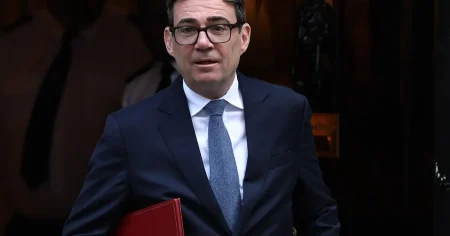



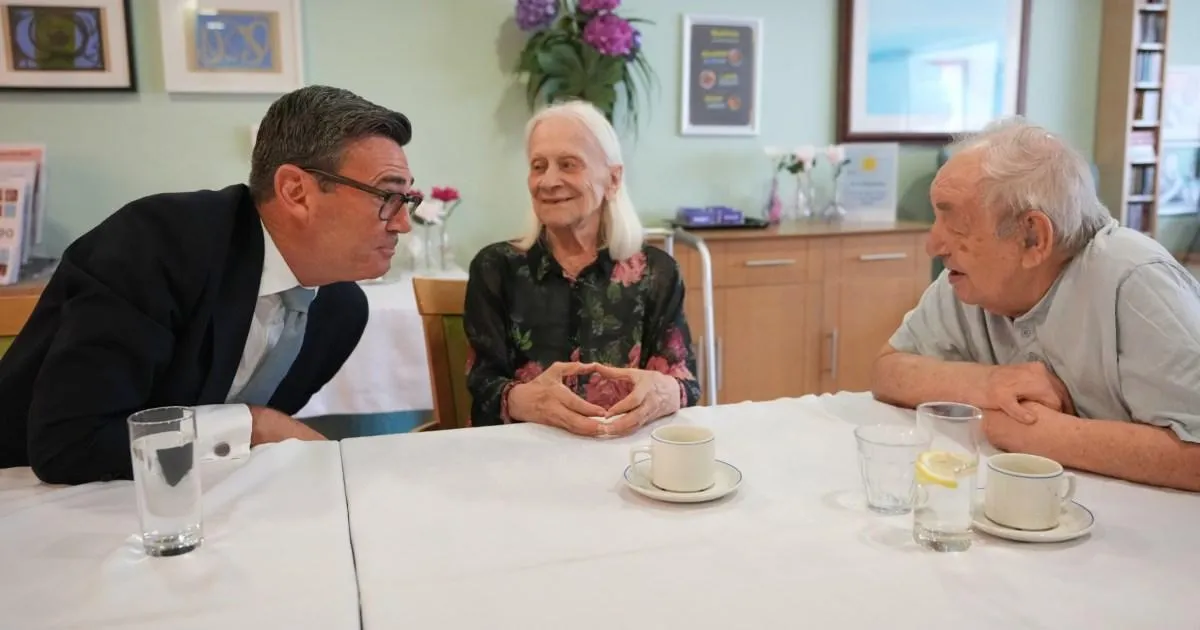
There is something undeniably poignant, and perhaps a touch humorous, about the state of British politics when even the Prime Minister himself becomes an enigma to the public he serves. In a recent visit to a Jewish Care home in North West London, Prime Minister Andy Burnham encountered a reality check that went well beyond official briefings or press releases. While touring the facility to promote his ambitious new social care manifesto, Burnham was pulled aside by a resident who—unfazed by the Prime Minister’s security detail or the cameras—simply didn’t recognize him. It was a candid reminder of how dizzying the “revolving door” of leadership has become in Whitehall, where the face at the head of the table seems to transition with as much frequency as the changing seasons.
The exchange that followed was a masterclass in unintentional comedy. When the resident asked if Burnham was merely a local political candidate, the Prime Minister gently corrected him, mentioning his recent by-election win. Upon learning he was speaking to the nation’s leader, the resident’s reaction was one of pure, unvarnished skepticism: “What, a new one?” When the resident pointed out that the Prime Minister “keeps changing every five minutes,” Burnham couldn’t help but laugh and agree. It was a rare, humanizing moment in high-stakes politics—a brief pause where the office of the Prime Minister felt less like a seat of untouchable power and more like a role in a restless, fast-paced drama that the British public is frankly exhausted by.
This climate of instability is hardly surprising, given that the United Kingdom has seen seven different Prime Ministers in the decade since the 2016 Brexit referendum. With Keir Starmer stepping down in June and Burnham ascending to the top job shortly thereafter, the electorate has been forced to constantly recalibrate its expectations. The resident’s bewildered comment wasn’t just a joke; it was the voice of a nation that has struggled to find a sense of continuity. For Burnham, who has inherited this volatile political landscape, the challenge is to move past the superficiality of “who is in charge” and actually deliver the steady, reliable hand that the public has been craving for years.
During the visit, the tone shifted from lighthearted banter to serious policy. Burnham used the platform to highlight what he unflinchingly called a “major dereliction of public duty” regarding the previous administration’s long-standing neglect of social care. It is a sector that has been ignored, underfunded, and left to fracture while politicians swapped titles in Westminster. By choosing a care home as the setting for one of his first major policy addresses, the Prime Minister sent a clear message: the bubble of government must finally pop to serve the people who have been left furthest behind. His presence there was an attempt to tether his newfound authority to the actual, physical needs of the elderly and the workforce that supports them.
The substance of Burnham’s plan reflects a genuine attempt to turn the tide. He has proposed the creation of a national care service designed not just to pad the budget, but to fundamentally honor the dignity of the profession. This includes a commitment to better pay and more rigorous training for care workers, the people who act as the backbone of the system. In a promising move to accelerate progress, he has fast-tracked a landmark review by Baroness Casey, aiming for a summer release date instead of the distant 2028 timeline originally set by his predecessors. It is an ambitious pivot, signaling that he intends to define his premiership by tangibles rather than rhetoric.
However, Burnham is also a realist. He acknowledged that these fixes will not come without pain, noting that “difficult decisions” lie ahead—decisions he intends to be transparent about by seeking the public’s consent. In an era of deep polarization, his effort to reach across the aisle and secure cross-party backing from the Liberal Democrats and the Conservative Party suggests a desire to build a consensus that transcends tribal politics. Whether or not he succeeds, that brief, honest interaction at the care home serves as an ongoing challenge to his government: in a nation that keeps changing its leaders, the only way to earn trust is to stop the music and finally provide the stability that everyone is waiting for.