



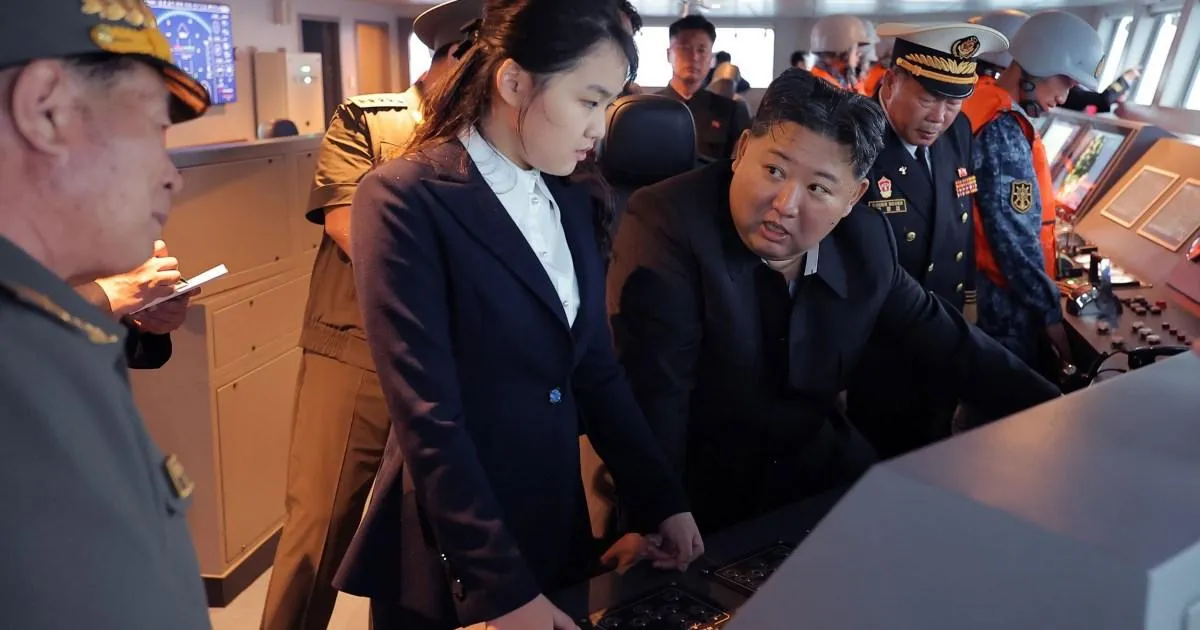
North Korean leader Kim Jong Un has recently signaled a significant shift in his military strategy, publicly committing to the rapid expansion of a nuclear-armed navy. During a high-profile inspection of a new 5,000-ton destroyer, the Kang Kon, Kim articulated a vision where his naval forces form the bedrock of the country’s nuclear deterrent. He spoke of equipping these vessels not just with conventional anti-aircraft or anti-ship weaponry, but with the capacity to launch nuclear-capable ballistic and cruise missiles. His stated goal is to ensure that his naval fleet can deliver a “deadly blow” to any perceived enemy, whether that strike originates from above or below the surface of the water.
Accompanying the leader during this display of maritime ambition was his teenage daughter, believed to be Kim Ju Ae. Her presence throughout the tour highlights an increasingly common trend in North Korean state media, where the younger generation is carefully positioned alongside the leadership to project an image of continuity and future-readiness. This domestic display of unity arrives at a delicate geopolitical juncture, occurring just as diplomatic channels remain largely frozen between Pyongyang, Washington, and Seoul. By showcasing his daughter against the backdrop of warships and nuclear aspirations, Kim is carefully crafting a narrative of absolute resolve that transcends current diplomatic stagnation.
Central to Kim’s updated five-year defense plan is a push toward modernization that includes the construction of massive 10,000-tonne-class destroyers and the development of mysterious, unspecified “underwater secret weapons.” While the specifics of this technology remain hidden from public view, the rhetoric is clear: Pyongyang intends to move beyond mere terrestrial nuclear tests and integrate its firepower deeply into its maritime architecture. Even as some international analysts remain skeptical about the operational viability of these ships—especially given the damaged state of the Kang Kon following a failed launch last year—Kim’s insistence on their importance suggests that, for his regime, the mere possession of these platforms is as much a political statement as a military one.
The timing of this naval push is anything but accidental, unfolding right on the heels of major geopolitical moves in the region. Most notably, the announcement coincides with upcoming diplomatic visits from Chinese President Xi Jinping. By flexing his nuclear muscle just before these high-level summits, Kim is effectively staking his claim to being treated as an undeniable nuclear-armed state. Furthermore, this display follows the recent unveiling of what South Korean authorities believe to be a new uranium-enrichment facility for nuclear bomb fuel, signaling that Pyongyang is aggressively scaling up its production capabilities alongside its naval deployment ambitions.
It is worth noting that while North Korea maintains a focus on these regional displays, the regime has also been strengthening its ties with Russia. This includes the controversial provision of military equipment and support for Moscow’s ongoing conflict in Ukraine. This evolving alliance, combined with the reaffirmation of strong bonds with Beijing, suggests that North Korea is working hard to solidify its position within a bloc of countries that view the existing international order with hostility. Kim is navigating a complex web of alliances, seemingly aimed at insulating his country from global pressure while simultaneously demanding recognition for his technological advancements.
Ultimately, these developments paint a portrait of a regime that is undeterred by international sanctions and diplomatic isolation. By prioritizing a nuclear-capable navy and continuing to test the functional limits of its military hardware, Kim is attempting to rewrite the security landscape of the Korean Peninsula. Whether these ships are truly ready for active duty or are merely symbolic manifestations of state power is an ongoing question for global intelligence agencies. What is certain, however, is that as Kim Ju Ae steps further into the spotlight, the North Korean leadership is looking toward a future where their naval presence stands as a permanent, intimidating fixture of the Pacific.