


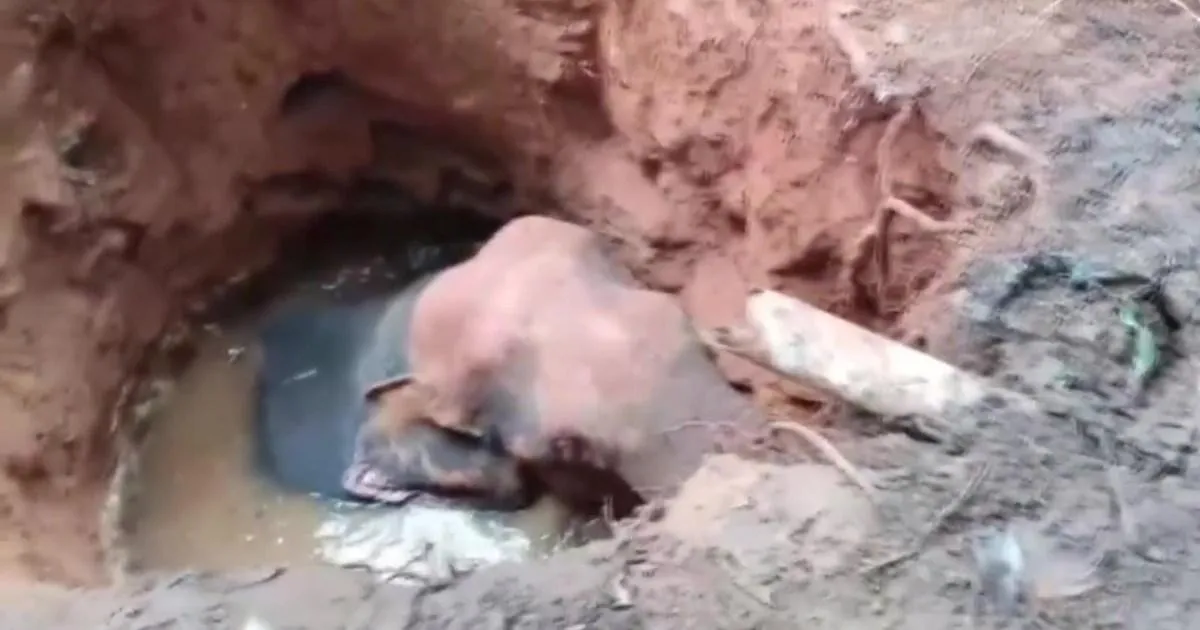
The natural world often reminds us of its unpredictable nature, sometimes in the most startling of ways. In the early hours of Tuesday morning, in the quiet village of Ernakulam, Kerala, a 15-year-old elephant’s desperate search for water took a harrowing turn. While wandering near the home of Dr. Thattayath Aliyar, the young animal accidentally tumbled into an abandoned well. Without a protective wall to serve as a warning, the deep, muddy pit became an unexpected prison. For ten long, grueling hours, the elephant remained trapped, splashing helplessly in the dark water as the sun began to rise over the forest’s edge.
The scene at the well soon became a stage for a tense standoff between humanity and nature. As the light of day revealed the elephant’s plight, the local community found their empathy for the distressed animal warring with a deep-seated frustration regarding their own safety. Residents, worried about the ongoing encroachment of wildlife into their living spaces, staged a protest, blocking the initial rescue efforts. They weren’t just onlookers; they were people living on the edge of the wilderness, demanding that officials guarantee their security before they would allow the rescue to move forward. It was a sobering reminder of the complex, often fragile friction that exists when humans and megafauna occupy the same geography.
The deadlock was finally broken through a series of negotiations between the villagers and the divisional forest officer, P. Karthik. Recognizing the community’s genuine fear, officials made a series of concrete promises: 24/7 drone surveillance, dedicated forest patrol teams to monitor the elephant’s location, and the construction of an electric fence to create a permanent buffer between the village and the forest. Furthermore, the authorities committed to compensating Dr. Aliyar for the damage caused to his property. It was a compromise born of necessity—a path forward that prioritized the welfare of the elephant while validating the anxiety of the people living under its shadow.
Only once these guarantees were firmly in place did the actual work of mercy begin. By noon, forest department officials moved in, utilizing an excavator to bridge the gap between captivity and freedom. It was a delicate, high-stakes operation; the team focused on carving a stable mud ramp into the side of the well, giving the elephant a lifeline to climb out. Observers watched with bated breath as the animal, exhausted and disoriented, grappled with the steep slope. The elephant’s struggle was profound, a raw display of strength against the soft, crumbling sides of the pit, but eventually, the earth held firm enough to support its weight.
With a final, powerful effort, the elephant hauled itself from the mud and back onto solid ground. The transition from the terrifying confines of the well to the open air of the forest must have been overwhelming, yet once liberated, the elephant wasted no time in retreating to the safety of the trees. It was a poignant moment of relief, a successful conclusion to an ordeal that could have easily ended in tragedy. The forest, which just hours before had been home to a trapped and suffering creature, once again reclaimed its own, leaving behind only the churned-up mud of the well and a village forever touched by the encounter.
Behind this dramatic story lies a more nuanced, saddening reality: the elephant’s presence near the village was not a result of malice, but of necessity. Officials later revealed that the animal was suffering from an old injury to its trunk, which hindered its ability to forage for food and water in the deep forest. This physical limitation had forced the elephant to become a regular visitor to human settlements, where resources were easier to find. The incident serves as a quiet call to reflect on our responsibility toward these intelligent, suffering giants. As we continue to develop land and expand our surroundings, the intersection of our lives and theirs becomes increasingly frequent, necessitating empathy, better management, and a willingness to protect these animals even when they find themselves in the most inconvenient of places.