
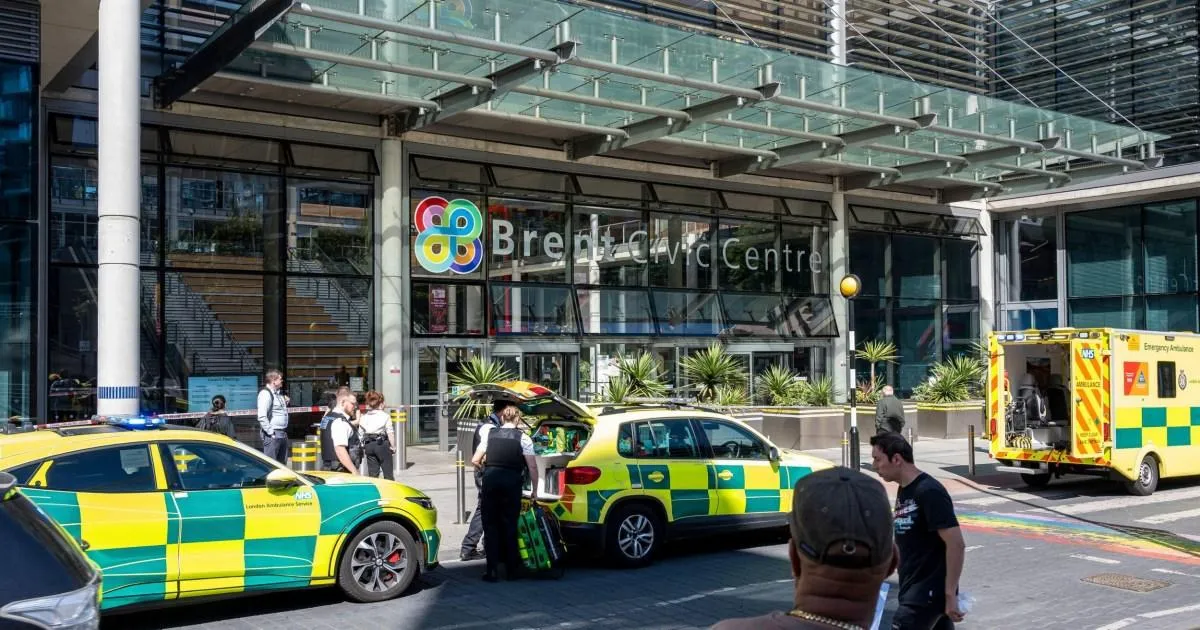
On an ordinary Tuesday afternoon, when the world usually hums with the mundane rhythms of work, study, and errands, the Brent Civic Centre near Wembley Stadium became the scene of a sudden and devastating tragedy. At 2:25pm, in the library of the building that serves as the heart of the borough, a young man—thought to be a teenager or in his early twenties—was stabbed to death. The Civic Centre is not just a council headquarters; it is a place where people come to sort out their lives, to borrow books, to attend meetings, to participate in the democratic process. It houses Wembley Library and The Drum at Wembley, and it is where the borough’s most important decisions are made. It is a symbol of civic life, of community, of people coming together in a shared space. On this day, that symbol was shattered. The first sign that something was terribly wrong came when staff members began urgently telling people to evacuate. One witness, who had been on the first floor just ten minutes before the attack, described the surreal horror of being told to leave because someone had been stabbed. “What I witnessed on the way down was unreal,” they wrote on social media. Outside, the pavement was marked with spatterings of blood, a stark and shocking reminder of the violence that had just occurred. Emergency services arrived quickly, but despite their best efforts, the young man could not be saved. He was pronounced dead at the scene. For those who were there, the image of that blood on the pavement, the sudden disruption of a normal day, and the knowledge that a life had ended in such a brutal way will not easily fade. The victim was someone’s son, someone’s friend, someone with a future. And in a matter of moments, that future was taken away.
The emergency response was swift, but it was also heartbreaking. The call came in at 2:25pm, and within minutes, the area was flooded with police officers, paramedics, and medical responders. A London Ambulance spokesperson said: “We were called at 2:25pm to reports of a stabbing at Brent Civic Centre, Wembley, HA9. We sent an ambulance crew, paramedics in fast response cars and an incident response officer. We also dispatched London’s Air Ambulance. Sadly, despite the best efforts of our crews, a patient was pronounced dead at the scene.” Those words—“despite the best efforts of our crews”—carry a weight that is difficult to fully comprehend. Paramedics train for years to save lives, and they are called to scenes like this with the hope that they will be able to make a difference. But sometimes, the injuries are too severe, the damage too deep, and all they can do is try, and fail, and then have to live with that failure. The air ambulance thundered overhead, a sound that usually brings hope, but this time it was too late. The young man’s life slipped away on the floor of a library, surrounded by strangers and medical equipment, in a place that should have been safe. The police quickly established a cordon, yellow tape cutting across the pavement, officers standing guard with serious faces. The building was evacuated, and people spilled out into the streets, some in tears, some in shock, all trying to make sense of what had happened. The library, a place of quiet learning and peaceful reflection, had become a crime scene. The juxtaposition of books and blood, of knowledge and violence, was almost too much to bear. The emergency services did everything they could, but some wounds are too deep, and some lives are lost before anyone can reach them.
The evacuation itself was a scene of confusion and fear. People who had been going about their day, perhaps browsing the shelves or working on a laptop, were suddenly told to leave. A staff member walked into a meeting room and delivered the news with a pale face: someone had been stabbed, and everyone needed to evacuate. The witness who shared their experience on social media said they had been in the exact same place where the stabbing happened, and had gone up to the first floor about ten minutes earlier. The randomness of it all was terrifying. Ten minutes earlier, and they could have been in the middle of the attack. Ten minutes later, and they might have seen it happen. The walk down the stairs was surreal, a mix of dread and disbelief. “What I witnessed on the way down was unreal,” they said. The word “unreal” is telling. When violence happens in a place that is supposed to be ordinary, the mind struggles to accept it. It feels like a scene from a movie, not something that happens in your own community, in your own library, on a Tuesday afternoon. Outside, the reality of the situation hit: blood on the pavement, police cars, ambulances, the air ambulance overhead. People gathered in clusters, whispering, trying to piece together what had happened. Some were crying, others were on their phones, letting loved ones know they were safe. The library, which had been filled with the quiet rustle of pages and the soft murmur of study, was now a place of sirens and shouts. The victim, a young man, lay inside, beyond help. For the witnesses, the trauma would linger. They would replay the moment they were told to evacuate, the sight of the blood, the faces of the emergency workers. They would wonder if they could have done something, though there was nothing they could have done. The sense of safety that comes with being in a public building, in the middle of the day, was shattered. The Civic Centre, a place of bureaucracy and community, had been transformed into a site of tragedy. And the young man, whose name had not yet been released, was at the center of it all, a life cut short in a place that should have been safe.
The police investigation began immediately, and it was a race against time to find answers. Supt Chris Clarke described the incident as “awful,” and said: “This is an awful incident, in which someone has tragically lost their life. We are working to urgently identify the victim and inform his next-of-kin as soon as possible. An investigation is underway to establish exactly what has taken place and trace those responsible. We recognise the concern this incident will cause within the local community and are committed to keeping residents informed as our enquiries progress.” These words, while carefully chosen, cannot fully convey the pain of the moment. Identifying the victim and informing his family is one of the most difficult tasks any police officer can face. Somewhere, a mother and father were about to receive the news that would change their lives forever. The police would have to knock on a door, and a family would answer, and their world would collapse. No amount of training can prepare an officer for that moment. But it had to be done. The victim deserved that much. His family deserved the truth, no matter how painful. The investigation would involve examining CCTV footage, speaking to witnesses, and trying to trace those responsible. The attack is not believed to be terror-related, which in some ways makes it even more senseless. It was an act of violence that took a life, and the motive was still unclear. The community would want answers. Why did this happen? Who was the young man? Was he targeted, or was this a random act of violence? The police asked for patience, and for anyone with information to come forward. They also asked people not to speculate, as rumors can cause further pain. In the meantime, the area around the Civic Centre remained cordoned off, a visible reminder of the tragedy. The yellow tape fluttered in the wind, and officers stood guard, their faces serious. The building, which had been evacuated, would remain closed until further notice. The library, the council offices, The Drum at Wembley, all were dark and empty. The heart of the borough had stopped beating.
The response from civic leaders was one of shock, grief, and a determination to support the community. Muhammed Butt, the leader of Brent Council, said: “Today, Brent has been shaken by an appalling and deeply tragic incident at the Civic Centre, in which a person has lost their life. Our thoughts are first and foremost with the victim, their family and loved ones, as well as the staff, residents and visitors who witnessed what happened. The Civic Centre has been evacuated and will remain closed until further notice. I would urge people to avoid the area and allow the police and emergency services to carry out their work.” He also urged people not to speculate, and expressed his sincere thanks to the police, paramedics, and emergency services for their swift response, and to his staff for the professionalism, compassion, and calm they had shown in the most difficult of circumstances. These are the words of a leader trying to hold a community together in the face of unimaginable tragedy. The notice on the Brent council website was stark and simple: “The Brent Civic Centre and Wembley Library are currently closed due to an ongoing incident. Please avoid visiting the building at this time. We’ll share updates as soon as we can.” For a council leader, this was a nightmare scenario. The building that was supposed to be a hub of community life had become a crime scene. The library, where children came to read and students came to study, was now a place of grief. The council’s thoughts were with the victim, his family, and all those who witnessed the attack. But words can only do so much. The community would need time to heal, and the healing would not begin until the shock had worn off. In the days to come, there would be vigils, flowers, and tributes. People would gather to remember the young man, even if they had never known him. They would light candles and leave messages, trying to make sense of the senseless. The council would have to support its staff, many of whom were traumatized by what they had seen. They would have to reopen the library, restore the sense of safety, and try to move forward. But that would not be easy. The memory of that Tuesday afternoon would linger in the corridors, in the library, on the pavement outside. The blood would be washed away, but the stain on the community’s heart would remain.
This stabbing is part of a larger, troubling pattern of knife violence in London. Every life lost is a tragedy, but the loss of a young person, someone with their whole life ahead of them, is particularly devastating. The victim was a teenager or in his early twenties, an age when life should be full of possibility. Instead, he became a statistic, a name on a police report, a headline in the news. But he was more than that. He was a human being, with dreams, with people who loved him, with a story that will never be fully told. The attack at the Brent Civic Centre is a reminder that violence can happen anywhere, even in the most ordinary of places. It is a reminder that we must do more to address the root causes of knife crime, to reach young people before they pick up a weapon, to create a society where such tragedies are unthinkable. It is also a reminder of the importance of community, of looking out for one another, of not taking our safety for granted. In the aftermath of the attack, the people of Brent came together. They shared their shock, their grief, their anger. They demanded justice for the victim and his family. They refused to let fear define them. The Civic Centre would reopen, the library would once again be filled with the sound of children reading and students studying. But the memory of the young man who died there would not be forgotten. His life, though cut short, mattered. And in the end, that is all we can hold onto: the hope that justice will be done, that the community will heal, and that we will find a way to prevent such senseless violence in the future. The young man who died in the library was someone’s world. And the world lost him too.