


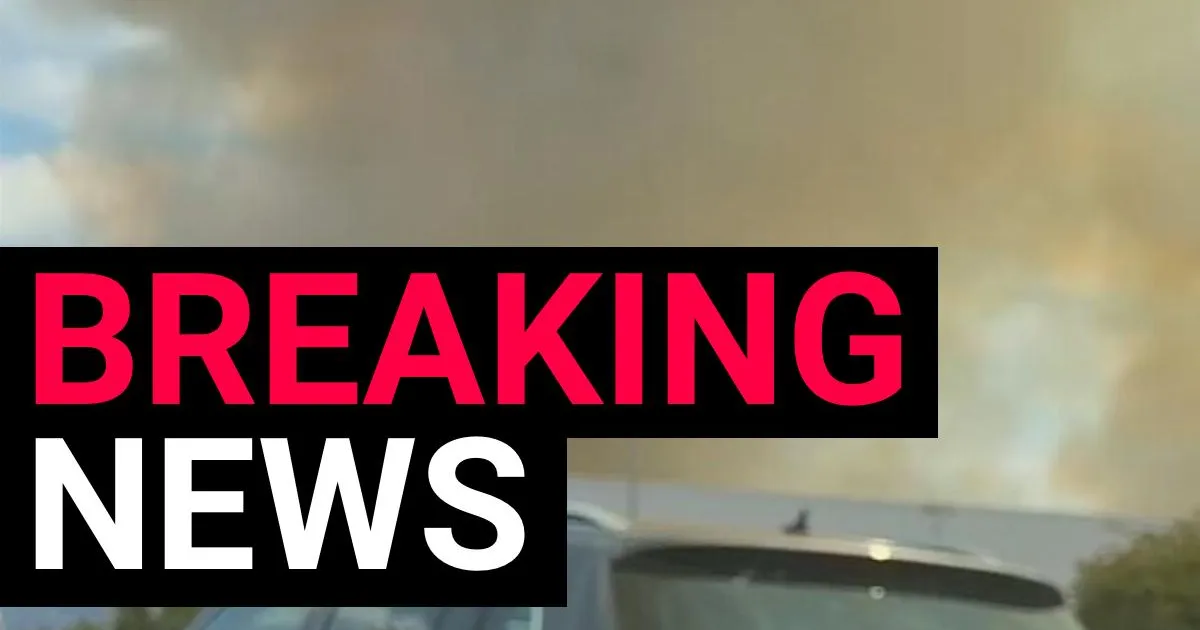
A chaotic scene unfolded this past Sunday in North London as a series of massive wildfires broke out directly alongside a major railway line, bringing travel to a standstill. Thick, ominous plumes of black smoke billowed high into the sky, visible for miles across the countryside and creating a stark, unsettling backdrop to an otherwise quiet afternoon. By mid-afternoon, the severity of the flames had reached a point where local authorities made the difficult decision to halt all rail traffic, effectively cutting off one of the primary arteries leading to Stansted Airport. Passengers who were expecting a smooth journey found themselves stranded as trains ground to an abrupt halt, forcing people to disembark in the middle of their commute, unsure of when or if they would reach their destination.
The scale of the incident was made clear by the sheer volume of emergency calls, with at least 50 concerned residents reporting the fire near Waltham Abbey, Essex, around 2:00 p.m. Recognizing the potential for the fire to spread rapidly across the dry, open land, the London Fire Brigade (LFB) launched a major response. To combat the blaze, they deployed specialized terrain support vehicles capable of navigating the rough, off-road landscape that standard fire engines simply cannot reach. These vehicles are marvels of tactical firefighting, equipped with 475-liter water tanks, misting lances, and high-tech blowers that allow crews to stay mobile and aggressive while pushing back the advancing flames.
For the commuters trapped in the middle of the disruption, the experience was understandably stressful. The Stansted Express, a lifeline for travelers heading to the airport, became a focal point of the chaos. A spokesperson for the service explained that the decision to stop all movement was purely precautionary, made at the explicit instruction of the fire brigade to ensure that no passenger trains were caught in the path of the encroaching fire. As a result, routes to and from London’s Liverpool Street station were diverted through Seven Sisters, turning what should have been a standard weekend trip into a complex logistical puzzle for thousands of passengers.
Behind the scenes, the atmosphere was one of intense, calculated urgency as Network Rail teams joined forces with emergency responders. While the smoke dominated the horizon, the ground crews were working in grueling conditions to establish firebreaks and extinguish the scattered hotspots that threatened to bridge the gap toward the tracks. Every minute counted, as the combination of dry terrain and proximity to critical infrastructure made this a high-stakes operation. The aim was not just to put out the fire, but to ensure the tracks were safe enough to carry thousands of passengers once again, an objective that required careful inspection after the heat had finally subsided.
This incident serves as a poignant reminder of how vulnerable our transit infrastructure can be when faced with the unpredictability of nature. Whether caused by human error, the summer heat, or dry conditions, fires near transit lines have an immediate and punishing ripple effect on the city. For those caught on the trains, the day was defined by the uncertainty of the situation, the sight of smoke drifting past their carriage windows, and the sudden realization that their travel plans were no longer in their own hands. It was a day where the rhythms of city life were abruptly interrupted by the raw, untamed power of a wildfire.
As the situation slowly stabilized and cleanup operations began, the broader conversation turned to the resilience of our travel systems. While travel disruptions are often met with frustration, the swift response from the London Fire Brigade likely prevented a much more dangerous scenario from unfolding. By the time the dust settled and the smoke began to dissipate, the focus shifted back to the long process of rerouting passengers and attempting to resume a semblance of normalcy. It was a stark wake-up call for the city—a reminder that despite our modern infrastructure, we remain deeply tied to the environment, and sometimes, the best-laid plans must give way to the demands of an emergency.