

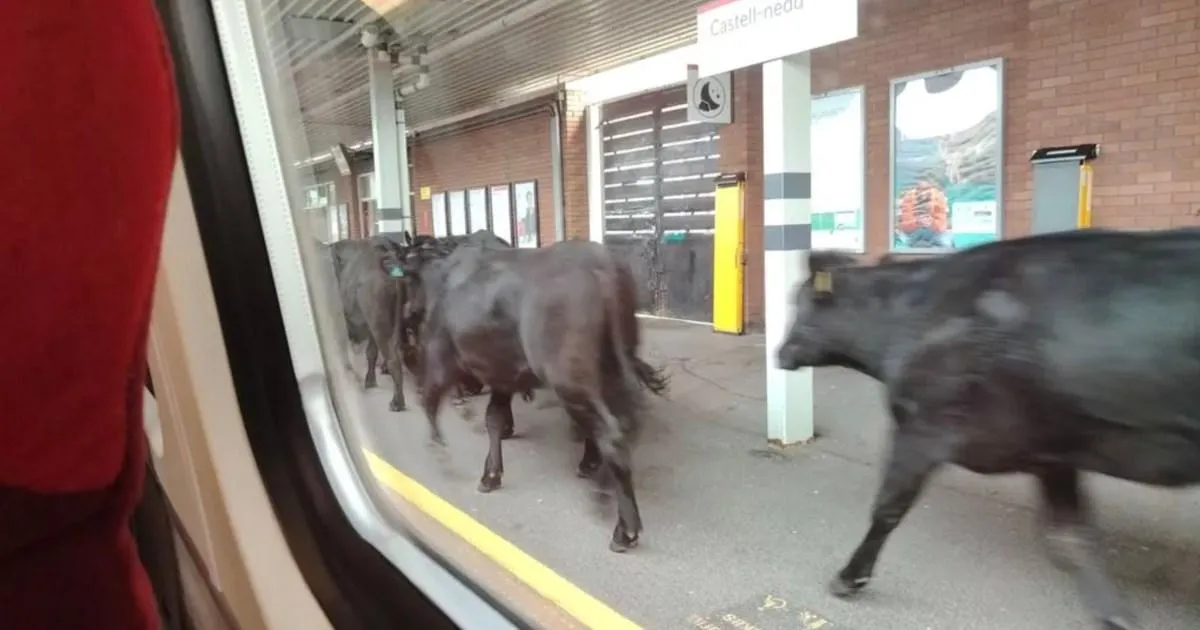
We have all become accustomed to the typical litany of excuses for train delays: leaves on the line, unexpected flooding, or even the rails becoming dangerously overheated during a summer heatwave. These incidents have become so routine that they are often met with a shrug and a sigh from weary commuters. However, this morning, passengers on the West Coast Main Line were faced with an obstacle that was far more unusual—and arguably much more stubborn—than a fallen tree or a signal failure. Instead of mechanical issues or weather complications, the entire network was ground to a halt by a group of wandering cows, turning a standard Tuesday morning commute into an unpredictable logistical challenge for thousands of travelers.
The disruption began shortly before 9:00 am in Staffordshire, when a herd of cows managed to escape their pasture and find their way directly onto the railway tracks. While the image of cattle grazing near train lines might seem idyllic in a rural setting, it represents a significant safety hazard that forces railway operators to stop all traffic immediately. Because trains are incredibly heavy and require a vast distance to come to a complete emergency stop, the presence of large livestock on the route creates an unacceptable level of risk. Consequently, Network Rail had no choice but to implement a mandatory hold on all movement along that section of the track, effectively freezing one of the busiest rail arteries in the country.
One of the biggest hurdles in resolving this bizarre incident was the delayed arrival of the person responsible for the herd. Finding the farmer and securing their help to safely guide the animals away from the danger zone took several hours, leading to a four-hour paralysis of the line. For the passengers trapped on board or waiting at stations, the lack of immediate progress was incredibly frustrating. As the clock ticked past noon, the frustration mounted. One stranded passenger took to social media platform X, formerly known as Twitter, to vent their irritation, bluntly asking, “How long does it take to move cows off the line?” The comment reflected the collective sentiment of a public that was essentially being held hostage by a group of disinterested bovines.
The impact of the rogue herd was far-reaching, rippling across several major rail operators. Major services including Avanti West Coast and Lumo, which carry passengers between London Euston and Scotland, were severely affected by the blockage. Furthermore, the disruption cascaded into regional services, causing significant delays and cancellations for London Northwestern Railway and West Midlands Railway customers. Because of the interconnected nature of the UK’s rail network, a single incident in Staffordshire quickly transformed into a nationwide headache, highlighting how fragile the system can be when faced with unexpected and unconventional obstacles.
By the time the situation was finally brought under control around 1:00 pm, the morning had been completely derailed for thousands of people. A spokesperson for Network Rail confirmed that their teams had spent the morning working alongside the farmers to safely clear the line. Once the herd was successfully corralled and escorted back to a secure field, the network was given the all-clear to resume normal operations. In the aftermath, Network Rail issued a formal apology to the thousands of travelers whose plans were disrupted, acknowledging the inconvenience caused by the four-hour standoff. While the scene may have provided a moment of dark humor for some, for the commuters caught in the chaos, it was a long, taxing day of uncertainty.
Incidents like this serve as a strange reminder of how modern infrastructure and the natural world constantly intersect in unpredictable ways. While we often view the railway as a triumph of industrial precision, it remains physically grounded in the countryside, susceptible to the whims of wandering livestock and local geography. While the cows are now safely grazing far from the tracks, the event will likely remain a memorable anecdote for the passengers, if not a cautionary tale for landowners living near busy lines. As the rail network works to stabilize, passengers are left to wonder what strange sight might interrupt their journey next—though most would prefer it to be absolutely anything other than an unexpected group of cows.