


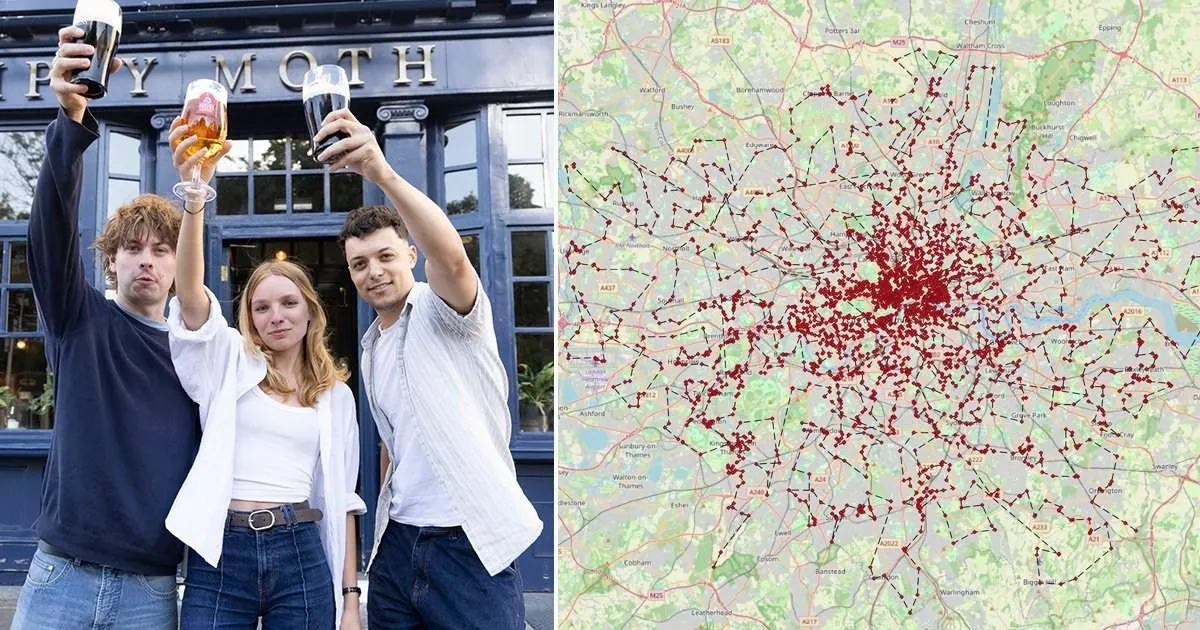
The late-afternoon sun catches the masts of the Cutty Sark and turns the River Thames into a ribbon of gold. In a pub garden in Greenwich, three young men raise their glasses, the lager settling into perfect heads, and announce to no one in particular: “17 down, 3518 to go.” It sounds like a joke, a line delivered with a self-aware grin, but Danny, Spike and Nikol are entirely serious. They are attempting to visit every single pub in London. Every one. All 3,535 of them. Not as a sponsored stunt, not for a Guinness World Record, not as a marketing gimmick for a brand. They are doing it because they love pubs, because they love each other’s company, and because they believe, stubbornly and maybe beautifully, that the great British pub is worth the effort. The three friends met at university, but their friendship was sealed in the kind of places they now spend their weekends: worn carpets, sticky tables, the low hum of conversation and the clink of glasses. They are from the Isle of Dogs, which explains why their intricate, colour-coded map begins and ends there. It is a homecoming, a loop, a promise. When Metro joins them, they are partway through an east London crawl, having chosen four pubs overlooking the river. There is no camera crew, no sponsor, no merchandise. Just three mates, a map, a spreadsheet of half-remembered pints, and the quiet determination to do something impossible at a human pace. In a city where pubs close almost every week, where footfall dwindles and landlords struggle, this trio wants to make one thing clear: young people still yearn for sticky carpets and perfectly poured pints. The quest is absurd. That is precisely the point.
The map is Spike’s invention. It is not just a list; it is a carefully woven web in which each of London’s 3,535 pubs connects to another, borough by borough, from the gleaming gastro pubs of central London to the Wetherspoons tucked into suburban corners. The plan is detailed but not rigid. If a detour feels right, they take it, as long as they stay in the general area. Spike explains that the journey starts and ends in the Isle of Dogs, “a bit of a homecoming for us as it’s where we are from.” That sense of origin anchors the whole project. The rules are simple, but they have teeth. Friends who want to join for just an afternoon are gently turned away. “If you are going to do it, you need to join us for every single one,” Spike says. It sounds strict, but it protects the integrity of the thing. This is not a casual pub crawl; it is a long-term commitment, a shared language, a private religion with a very specific liturgy: order a drink, note the atmosphere, rate the Guinness, move on. The group has already walked into working men’s clubs where the older regulars stare at them in silence. Danny, 23, a musician, admits it can be awkward at first. “Pubs are an important part of British culture. We have gone into a few working men-type venues and the old men can just kind of stare at us,” he says. But the staring never lasts. “Once we actually get chatting to people they see we are a good bunch.” That is the human magic of the project: it turns strangers into regulars, outsiders into welcomed guests, and a seemingly impossible list into a string of small, warm connections. Each pub is marked for its atmosphere, its prices, and its ability to pour a proper Guinness. One day, they hope, people will use their account as a guide. For now, the map is enough.
The financial reality of visiting 3,535 London pubs is enough to make anyone’s wallet weep. The average pint in the capital has crept toward £8. Travel costs keep rising. The trio are not wealthy; they are ordinary young people with jobs, rent and responsibilities. And yet they have thought this through. “Because we are doing this over almost 15 years, we don’t think this will financially destroy us,” Spike says with a calm that borders on heroic. The plan is to spread the cost across a decade and a half, to treat the quest as a slow, steady rhythm rather than a frantic sprint. They aim for at least five pubs per week, meeting after work and on weekends, ticking off venues in a methodical way. Some places are easier than others. Romford, on the border with Essex, and Biggin Hill, buried deep in Bromley, are inconvenient. Danny admits, “We have been putting them off.” But the strategy is to do all the pubs in those far-flung areas in one go, turning a logistical nightmare into a day-long adventure. The early days of their social media accounts have already drawn a small but enthusiastic crowd. Strangers leave comments cheering them on. Pubs have begun to reach out, offering free pints. Nikol, who looks like he is still in his early twenties, seems genuinely surprised by the kindness. “We have had pubs get in contact with us saying they’ll give us a free pint,” he says. Every little helps. The offers are not just about free beer; they are a sign that the hospitality industry sees something hopeful in these three young men. In an era when pubs are closing and young people are accused of drinking less, Danny, Spike and Nikol are walking proof that the culture is not dead. It is just waiting for someone to care enough to show up.
Why do they do it? The obvious answer is that they like pubs. But the deeper answer is more tender. They all met at a pub, so the quest is not really about beer. It is about the version of themselves that exists when they are together. “We all met at a pub, so it really feels like a nice thing to be doing together and keeps us meeting after work,” Danny says. “And we are making more friends as we go.” That is the quiet heartbeat of the whole project. In a city that can feel cold and transient, where people move in and out and friendships are often reduced to Instagram likes, this pub crawl is an act of stubborn connection. It forces them to show up, week after week, for each other and for a tradition that is slowly slipping away. London’s nightlife has taken a battering. Iconic venues have closed in the face of dwindling footfall. The pandemic did not help. Rent and energy costs have piled pressure on landlords. Yet here are three young men, raising a glass to the very institutions that are struggling. They want the world to know that young people still value the sticky carpets, the smell of spilled ale, the comfort of a dimly lit corner, the bartender who knows your order. They are not nostalgic old men in flat caps; they are twentysomethings with phones and social media pages, using the tools of their generation to celebrate a very old idea. The pub, they argue, is more than a place to drink. It is a community living room, a place where strangers become acquaintances and acquaintances become friends. It is where you go to celebrate, mourn, argue, laugh, sit in comfortable silence, and feel less alone. In a world that is increasingly digital and isolating, the pub is a reminder that real life happens face to face. This trio is doing their small part to keep that flame alive, one pint at a time.
The scale of the task is almost laughable. Three thousand five hundred and thirty-five pubs. At their current pace, they expect to finish in around 13.5 years. That is not a project; it is a life stage. In that time, careers will change, relationships will begin and end, maybe marriages and children will appear. The map will travel with them, folded and refolded, stained with beer, marked with notes in their own handwriting. There will be hungover mornings, terrible pints, overpriced lager, and the occasional transcendent Guinness. There will be pubs so soulless that they blur together and pubs so full of character that they become reference points for the rest of their lives. The beauty of a 13.5-year project is that it cannot be rushed. It demands patience, humility, and a willingness to enjoy the journey rather than fixate on the destination. They are not ticking off pubs like items on a shopping list; they are building a relationship with London, one street, one borough, one landlord at a time. The city will change beneath their feet. Pubs on the list will close before they reach them. New ones will open. The map may need updating. But that is okay. The quest is not about completion in any pure sense. It is about showing up, again and again, with the same friends and the same open hearts. When they finally reach the end, back on the Isle of Dogs, they will have spent more than a decade in each other’s company. They will have aged, matured, maybe grown apart and then back together. And the final pint will taste like all the ones before it: shared, earned, and exactly right. The impossible, they are learning, is just a series of possible moments strung together by friendship.
There is something deeply human about a pointless, beautiful quest. Danny, Spike and Nikol are not saving the world. They are not raising money for charity or breaking records. They are simply drinking their way through London, rating Guinness and atmosphere and price, and refusing to let a beloved institution fade away without a fight. In a society obsessed with productivity and outcomes, their project is gloriously useless. And that is what makes it meaningful. The pubs that offer them free pints, the strangers who cheer them on, the old men in working men’s clubs who eventually warm to them — all of this is evidence that the quest resonates far beyond the three of them. It speaks to a longing for connection, for ritual, for the simple pleasure of sitting down with someone and saying, “Cheers.” As the sun sets over the Thames and the glasses empty, they look at the map and pick the next pub. There are thousands to go. The journey ahead is long, expensive, and at times absurd. But they are not discouraged. They have each other. They have the map. They have the certainty that somewhere in this vast, sprawling, ever-changing city, there is a pub with a seat waiting for them. And after that, another. And another. In a world that often feels fragmented and rushed, they are choosing to go slowly, together, through the most human ritual we have: sharing a drink with friends. The final numbers will come later. For now, 17 down, 3518 to go. It is not a joke. It is a promise. And they intend to keep it, one perfect pint at a time.