
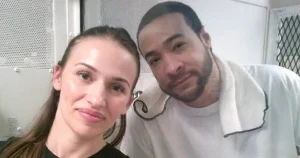

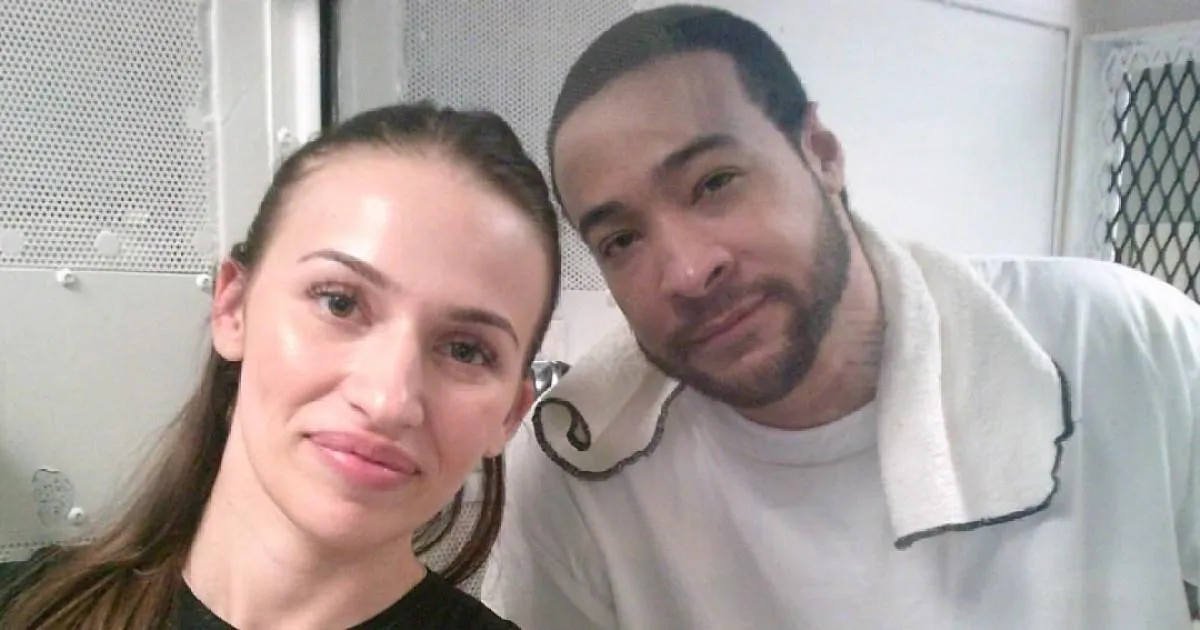
The faint hum of fluorescent lights, the cold sterility of a Texas death chamber, and the unbearable distance between two people who loved each other—this was the final reality for Tiana Broadnax, a London mother who watched her husband, James, be put to death more than 5,000 miles away from their home. On April 30, James Broadnax was strapped to a gurney in Huntsville, Texas, and given a lethal injection. Forty agonizing minutes later, he was gone. For Tiana, the experience was not merely heartbreaking; it was, in her own words, “utterly traumatising.” She described a profound emotional collapse so severe that she entered a “psychotic state,” hallucinating that her husband was standing outside the prison walls, as if the boundaries between life and death, presence and absence, had dissolved into a nightmare she could not wake from. Perhaps the most devastating detail she shared was this: “The first time I ever touched him was when he lay dead in front of me.” It is a sentence that encapsulates the brutal inhumanity of the system that took him—a system that permitted her to witness his final breath but denied them the simplest human comfort of a last embrace. For Tiana, the trauma was not just in the watching; it was in the profound isolation of being a British woman caught in the machinery of American capital punishment, utterly alone in her grief.
James Broadnax was only 37 years old when he was executed, but his fate had been sealed nearly two decades earlier, following a robbery that ended in tragedy. In a parking lot, James and his cousin, Demarius Cummings, attacked Stephen Swan and Matthew Butler, both of whom died from their injuries. At the time of his arrest, James claimed to be the shooter—a confession he later recanted, insisting he had not fired the fatal shots. Years later, Cummings, who was sentenced to life without parole, came forward and confessed that he, not James, had been the one to pull the trigger. The case was further tainted by the dismissal of all Black jurors during the trial, raising painful questions about racial bias and the fairness of the judicial process. Tiana, who had married James and devoted herself to him, became his fiercest advocate. She spent years fighting to have his sentence overturned, navigating legal avenues that seemed to stretch endlessly into the future, always hoping that somewhere, somehow, a court would listen. But the legal system offered no mercy. After exhausting every appeal, James’s execution date was confirmed. For Tiana, the fight was never abstract—it was a daily, consuming mission. She was his wife, his support system, his voice. And when the state finally moved forward with its ultimate punishment, she was left with nothing but the shattering knowledge that her efforts had not been enough. Her grief is compounded by the injustice she still believes occurred, and she now carries the weight of a system she watched fail the man she loved.
The day of the execution was a study in dehumanizing procedure. Tiana was led into a viewing room, separated from her husband by a wall and a pane of glass. James was already strapped down, his body immobilized, his final lucid moments spent in a stark room surrounded by strangers. They were not allowed to be together, not allowed to touch, not allowed any private goodbye. Tiana could only watch as the process unfolded—the injection, the stillness, the declaration of death. She described the experience as utterly traumatizing, and the aftermath was devastating. A week later, she was back in London, but the city that had once been her home felt alien and hollow. She found herself unable to return to work or to her full-time studies, her mind too fractured by grief to focus on anything other than survival. Her world, which had revolved around James, had collapsed. Tiana explained that she had been James’s personal assistant, his advocate, and his therapist, all rolled into one. She was caring for him and their daughter full-time, often running on just four hours of sleep a night. Her life was a relentless balancing act of love and duty, and now, with James gone, that life has been torn apart. “Now he is gone, the world feels a lot emptier,” she said. The loneliness she feels is not just the absence of a partner; it is the absence of a purpose that defined her days. And the manner of his death—so clinical, so distant, so devoid of human warmth—has left her with wounds that may never fully heal. She speaks of the isolation of her experience, noting that no one in the UK can truly relate to what she has been through. She is a widow in a foreign land, grieving a man whose death was determined by a justice system that felt utterly alien and unforgiving.
While Tiana’s story is one of a family shattered by a completed execution, the case of Christa Pike in Tennessee underscores the cruel unpredictability of the death penalty itself. Pike, a woman sentenced to death in 1996 for the brutal murder of 19-year-old Colleen Slemmer, was scheduled to be executed, and the event quickly descended into apparent chaos. Witnesses reported that Pike survived not one but two lethal injections. Her heart was still beating after the first dose, and she was heard snoring by onlookers before officials abruptly drew the curtains and cut off the microphone, sealing the gruesome scene from public view. It was a moment that raised urgent questions about the humanity—and the efficacy—of the procedures designed to end a human life. Pike’s attorneys confirmed that she was taken to a hospital, though her condition remained unclear. The botched execution drew immediate attention, not only because of the shocking details but because Pike would have been the first woman executed in Tennessee in at least 200 years. The state’s governor, Bill Lee, ordered a review to determine exactly what occurred, and he announced that the remaining scheduled execution would not be carried out that year. The spectacle of a condemned woman struggling against the very chemicals meant to kill her served as a grim reminder that capital punishment is not a sterile, controlled act—it is a human process, prone to error and fraught with suffering, both for the condemned and for those forced to witness.
The official response to Pike’s ordeal has been careful and measured, but the implications are profound. For years, states have struggled with lethal injection protocols, facing legal challenges and shortages of the drugs used to carry out executions. Critics argue that the process is inherently flawed, a medical procedure designed to kill, which often goes wrong in ways that cause excruciating pain and prolonged suffering. In Pike’s case, the failure was not just a technical glitch; it was a deeply disturbing public display of a state attempting to take a life and failing, leaving the woman alive and gasping for breath in front of witnesses. The governor’s decision to pause further executions suggests a recognition, however reluctant, that something is deeply wrong. But for families like Tiana’s, the technicalities of the process offer little comfort. Whether an execution is “botched” or goes according to plan, the result is the same: a family loses someone they love, and the trauma of witnessing that loss is compounded by the cold, clinical nature of the death chamber. Tiana’s experience—watching her husband die, unable to touch him, unable to hold his hand—is a stark contrast to the image of a peaceful passing. There is nothing serene about being strapped to a gurney, surrounded by strangers, as the state administers a lethal cocktail. The anguish is not limited to the prisoner; it radiates outward, scarring everyone who cares for them.
Ultimately, these two stories—Tiana’s grief and Christa Pike’s survival—are inseparable threads in the larger tapestry of America’s death penalty debate. They force us to confront uncomfortable truths about justice, revenge, and the sanctity of life. For Tiana, her husband’s execution was not justice; it was a profound loss, deepened by the belief that the wrong man may have been put to death. For Pike, the state’s failure to kill her has reignited conversations about the morality and practicality of capital punishment, and about what it means to witness a human being struggle to survive on a deathbed designed to end her. Both cases highlight the human cost of these proceedings—not only for the condemned but for the families on both sides of the glass. Tiana is now left to pick up the pieces of her life in London, caring for her daughter, trying to find meaning in a world that feels empty. She carries with her the image of her husband’s final moments and the memory of a touch that came only after his heart had stopped beating. Her story is not just a tale of systemic injustice; it is a deeply personal testimony to the power of love and the devastating consequences of state-sanctioned death. As Tennessee investigates what went wrong with Pike’s execution, and as Tiana continues to mourn, we are reminded that the death penalty does not exist in a vacuum. It affects real people, shatters real families, and leaves behind wounds that no amount of legal reasoning or procedural review can ever heal. Tiana’s voice, raw and honest, calls out from a place of unspeakable pain—a voice that asks us to look beyond the politics and to see the humanity at the center of it all. In the end, she is not just a campaigner or a widow; she is a woman who loved deeply and lost everything, and her story challenges us to imagine a different way.