

The quiet rhythms of an ordinary Thursday morning were shattered when a single social media post by Sarah Helm, a respected author and journalist, began rippling through the corridors of British power. Helm, who is married to Jonathan Powell, the Prime Minister’s national security adviser and a long-time Labour strategist, had waded into a literary and political storm by publicly backing Irish novelist Sally Rooney. Rooney, the celebrated author of Normal People, had announced that her publisher, Faber, would no longer sell her books in the UK because of her outspoken support for Palestine Action, a group that the British government proscribed as a terrorist organisation in July 2025. The controversy was already charged with high emotion and legal gravity, but Helm’s intervention added a deeply personal and startlingly intimate dimension. By the time she posted her second message, referencing an 83-year-old survivor of the Nakba and a friend in Rafah who had been “obliterated,” the situation had transformed from a literary dispute into a potential police matter. The Metropolitan Police confirmed they were assessing her comments to determine whether they warranted criminal investigation, while the government scrambled to distance itself from her words, insisting that she was speaking purely in an individual capacity. It was a moment that captured the collision between private conscience, public office, and the unforgiving machinery of counter-terrorism law.
To understand the gravity of Helm’s comments, one must first trace the chain of events that led her to type those words. Sally Rooney, whose literary fame has made her a cultural beacon for progressive causes, had long been vocal in her condemnation of Israel’s military actions in Gaza. As part of her activism, she committed to donating proceeds from her work to Palestine Action, a group that gained notoriety for its direct-action campaigns against British companies and institutions with ties to Israel. Once the UK government proscribed the organisation in July 2025, support for it became a criminal offence, carrying a potential prison sentence of up to fourteen years. Faber, facing legal risk and reputational pressure, made the decision to cease distribution of Rooney’s books in Britain. Rooney responded publicly, framing her publisher’s decision as an act of censorship that punished solidarity with a people she believed were suffering genocide. Helm, reading these exchanges, felt compelled to respond. Her first post, “God help us authors who support Palestine and Palestine Action,” was a cry of exasperation, a lament for authors and artists who found themselves trapped between moral conviction and the threat of prosecution. But it was her second post that resonated more deeply. She spoke of an elderly survivor of the Nakba—the mass displacement of Palestinians in 1948—and quoted a friend from Rafah, a city later destroyed, who had urged her: “Keep writing Sarah, we need all the pencils we can get.” The image was haunting, a reminder that behind the legal debates and political rhetoric were real human beings, their lives unraveled by conflict, clinging to the written word as a form of resistance.
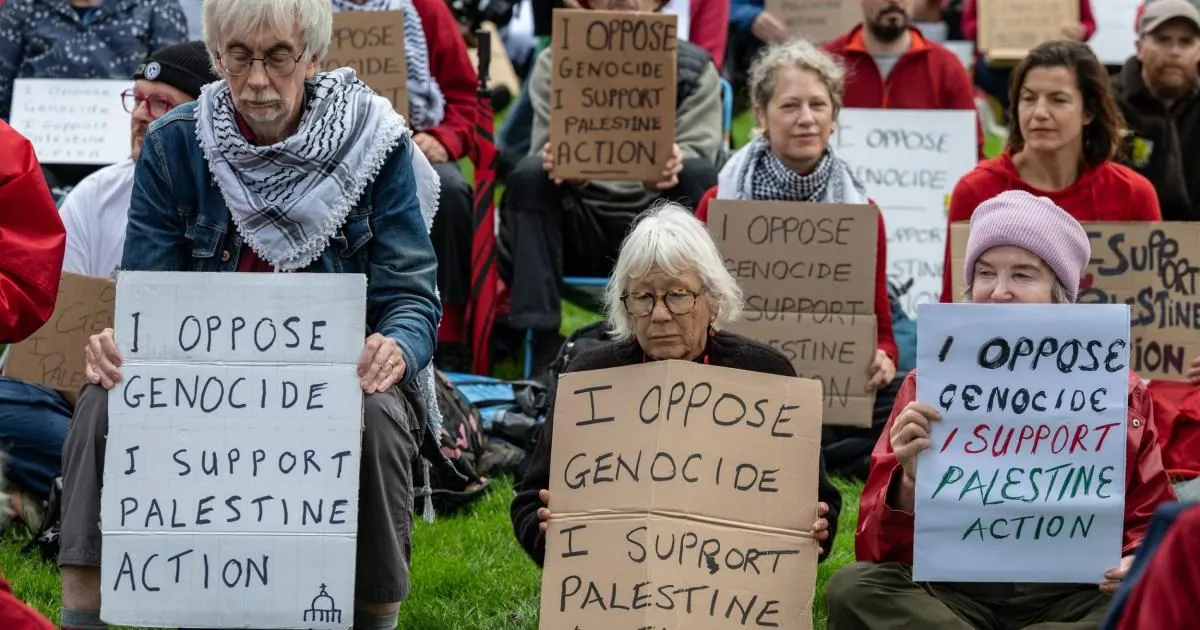
The legal landscape surrounding Palestine Action is as combustible as the group’s own tactics. Proscribed under anti-terrorism legislation, Palestine Action has been accused of using criminal damage as a means of political expression. Members and supporters have defaced RAF aircraft, vandalised weapons factories with alleged links to Israel, and staged dramatic occupations of industrial sites, often wearing shirts and holding placards that read: “I oppose genocide, I support Palestine Action.” Since the ban, the repressive machinery of the state has swung into action with extraordinary speed and force. Thousands of protesters have been arrested at demonstrations, their numbers swelling in cities across Britain. The statistics are staggering: more than 90 percent of the 3,867 arrests made under anti-terrorism legislation up to June of that year were linked to support for Palestine Action. For Helm, who is not an activist but a writer, the question of whether her words constitute “support” in the legal sense is now at the centre of a police assessment. The law is unforgiving: even expressing approval of the group’s aims, if interpreted as encouraging support, could expose an individual to charges. The Met Police’s decision to assess her comments highlights the fraught relationship between freedom of expression and national security. It also raises uncomfortable questions about how a spouse of a senior government official, someone embedded in the heart of the establishment, can navigate personal beliefs in an era of pervasive surveillance and prosecutorial discretion.
The political fallout was immediate and predictable. A government spokesperson rushed to clarify that Helm’s remarks did not represent the views or policies of the administration, stressing that she was commenting in a private capacity. But such disclaimers did little to quell the outrage. Campaign Against Antisemitism, a prominent advocacy group, seized on the situation, calling for a formal investigation into Helm given her “close links to No 10.” In a statement, the organisation declared: “Clearly, the police need to investigate and Sarah Helm must face the full force of the law, just like others who appear to express support for any proscribed terrorist organisation.” The demand was a sharp reminder that in the eyes of many, the law makes no exception for spouses of national security advisers, for award-winning journalists, or for those who frame their support in humanitarian terms. For Helm, already an 83-year-old woman—wait, no, that was the Nakba survivor she quoted—the ordeal has become a personal crucible. She is herself an author, not a young firebrand, and her decision to align herself with Rooney suggests a deep-seated belief that some principles transcend legal boundaries. Yet the very closeness of her connection to Jonathan Powell complicates matters. How can Britain’s national security adviser credibly oversee counter-terrorism policy when his own wife appears to endorse an organisation designated as a terrorist threat? The question hangs in the air, unanswered, a reminder that public life in the modern age leaves no room for private ambiguity.
To fully appreciate the stakes, one must also consider the broader context in which Palestine Action operates. The group emerged in response to what it describes as Israeli apartheid and the ongoing occupation of Palestinian territories. Its methods, however, have proven polarising even among those sympathetic to its aims. Critics accuse the organisation of glorifying violence and destruction, while supporters argue that peaceful protest has failed to achieve meaningful change. In the United States, Palestine Action has also been designated as a terrorist organisation, a move that further isolates its advocates on the global stage. The human toll of the conflict in Gaza, which has seen entire neighbourhoods reduced to rubble and tens of thousands killed, has driven many people to extreme positions. For every person who recoils at the group’s vandalism, there is another who sees it as a desperate measure to stop the flow of weapons that perpetuate suffering. The arrests of thousands of protesters, many of whom are ordinary citizens with no previous criminal record, have sparked an intense debate about the limits of dissent. The image of activists being handcuffed for simply wearing a T-shirt with a slogan has become a symbol for those who believe the state has overreached. Yet for the families of victims of terrorism, such demonstrations are not noble acts of conscience but dangerous flirtations with violence. In this charged atmosphere, Helm’s comments have become a lightning rod, attracting both condemnation and solidarity, and forcing a nation to confront its own discomfort with moral complexity.
As the Met Police weigh their next move, the broader implications for freedom of expression loom large. Helm’s invocation of the Nakba survivor, with its poignant plea for “pencils,” is more than just a literary device; it is a reminder that writing, and the freedom to write, carries a profound weight in times of conflict. For authors like Sally Rooney, whose books are now effectively banned in Britain, the question is whether art can ever be separated from politics. For Sarah Helm, the question is whether her words, however sincerely meant, cross a line that the state has drawn in blood. The world watches with bated breath, not only because of the personal consequences for Helm and her family, but because the outcome could set a precedent for how Britain treats dissent in an increasingly volatile geopolitical climate. There are no easy answers here. The law, with its blunt definitions and harsh penalties, struggles to capture the nuance of human emotion, the layers of historical trauma, and the desperate desire for a better world. What is certain is that Helm’s story has touched a nerve, revealing deep fractures in British society about the legitimacy of protest, the boundaries of loyalty, and the meaning of justice. Whether she is investigated, exonerated, or prosecuted, her words have already achieved what all powerful writing intends: they have forced us to stop, to look, and to think. And in doing so, they have reminded us that sometimes a single human voice, speaking from the heart, can spark a conversation that no law can silence.