

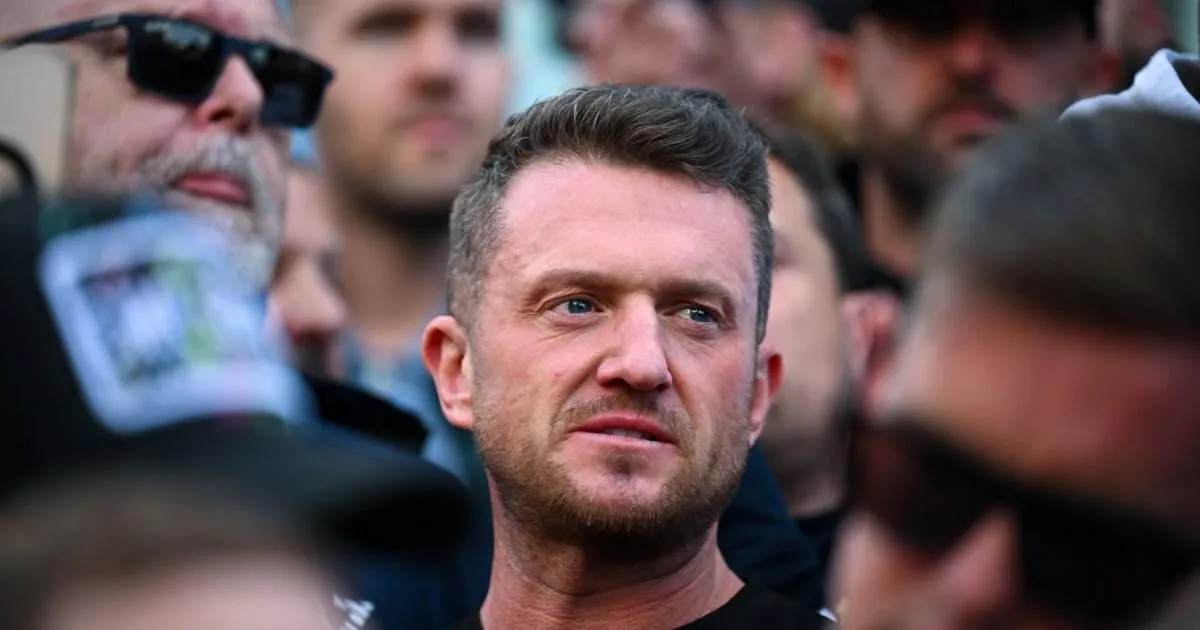
Stephen Yaxley-Lennon, widely recognized by his pseudonym Tommy Robinson, has once again found himself at the center of a high-profile legal controversy. Known for his aggressive anti-immigrant activism and a penchant for fueling public unrest, Robinson recently took to social media to announce that he had been detained by authorities at London’s Heathrow Airport. His post, characterized by his signature combative tone and titled “I’M A TERRORIST AGAIN,” detailed his encounter under Section 3 of the Counter-Terrorism and Border Security Act 2019. During this detention, officials seized his mobile phone, a move he described as a direct encroachment on his activities. Unsurprisingly, Robinson immediately utilized the incident as a rallying cry, sharing a link to his legal defense fund and lamenting the mounting expenses his lifestyle and legal battles continue to generate.
This incident follows a turbulent period that saw Robinson deeply involved in inciting unrest across the UK. Over the past few weeks, he has been accused of orchestrating or heavily encouraging violent demonstrations in both Southampton and Belfast. The fallout from these protests has been severe; in Southampton, a police confrontation resulted in injuries to a dozen officers and a police dog, while the situation in Belfast escalated into chaotic scenes of arson and the targeting of private residences. Rather than distancing himself from the chaos, Robinson’s digital team has framed the police action as an “attack on free speech” and an attempt to silence what they label as “investigative journalism.” They have claimed that the seizure of his phone was an attempt by the state to uncover his confidential sources, though critics point out that Robinson’s own history of spreading misinformation undermines his self-styled reputation as a legitimate reporter.
Despite Robinson’s repeated insistence that he is a persecuted journalist working in the public interest, his track record tells a different story. He has previously spent time behind bars for contempt of court, having notoriously repeated false, defamatory claims about a Syrian refugee. Currently, he faces yet another legal hurdle in an upcoming trial scheduled for October, where he will defend himself against two charges of harassment and causing fear of violence directed at staff members from the MailOnline. This pattern of behavior—moving from one courtroom to the next while simultaneously cultivating a brand centered on outrage—has become his hallmark. His supporters often view him as a martyr fighting against the establishment, while his detractors see a divisive agitator whose rhetoric consistently leads to real-world harm.
The financial aspect of Robinson’s activism remains a point of intense curiosity and contention. With constant calls for donations to cover his legal fees, one has to wonder about the sustainability of his operations. Last year, Robinson famously attributed the funding of his legal costs to none other than Elon Musk, the billionaire tech magnate who recently reached the status of the world’s first trillionaire. This connection to the upper echelons of global wealth, while Robinson portrays himself as a man of the people, highlights the strange and often polarizing nature of modern digital activism. Whether or not these financial streams remain open following his latest detention, Robinson shows no signs of slowing down or re-evaluating his confrontational path.
The reach of Robinson’s influence also extends into the increasingly complicated world of international geopolitics and optics. Recently, he made headlines again for a trip to Moscow, where he was photographed meeting with Errol Musk, the father of Elon Musk. During this excursion, Robinson offered a staunch defense of Russia, claiming that the notion of Russia being an enemy to Britain is a narrative that has effectively expired. His visit and subsequent commentary seem to align him with global figures who seek to challenge the established diplomatic status quo. By positioning himself at the intersection of such controversial figures and international relations, Robinson continues to maximize his visibility, ensuring that he remains a prominent fixture in media cycles regardless of the fallout left in his wake.
Ultimately, the saga of Tommy Robinson remains a startling reflection of current societal tensions. Whether one perceives him as an investigative journalist fighting for the truth or a reckless provocateur inciting violence, his ability to command attention is undeniable. His latest detention at Heathrow is merely the most recent chapter in a long-standing pattern of friction between an individual bent on challenging the state and a legal system attempting to maintain order. As his October trial approaches, the public is left to watch a man who thrives on instability continue to navigate the thin line between protected expression and criminal conduct. The core of his story isn’t just about the man himself, but about how a single individual can leverage social media and legal chaos to command both public fury and significant financial backing in an increasingly fractured political landscape.