

The Titanic Slide Controversy: When Tragedy Meets Children’s Entertainment
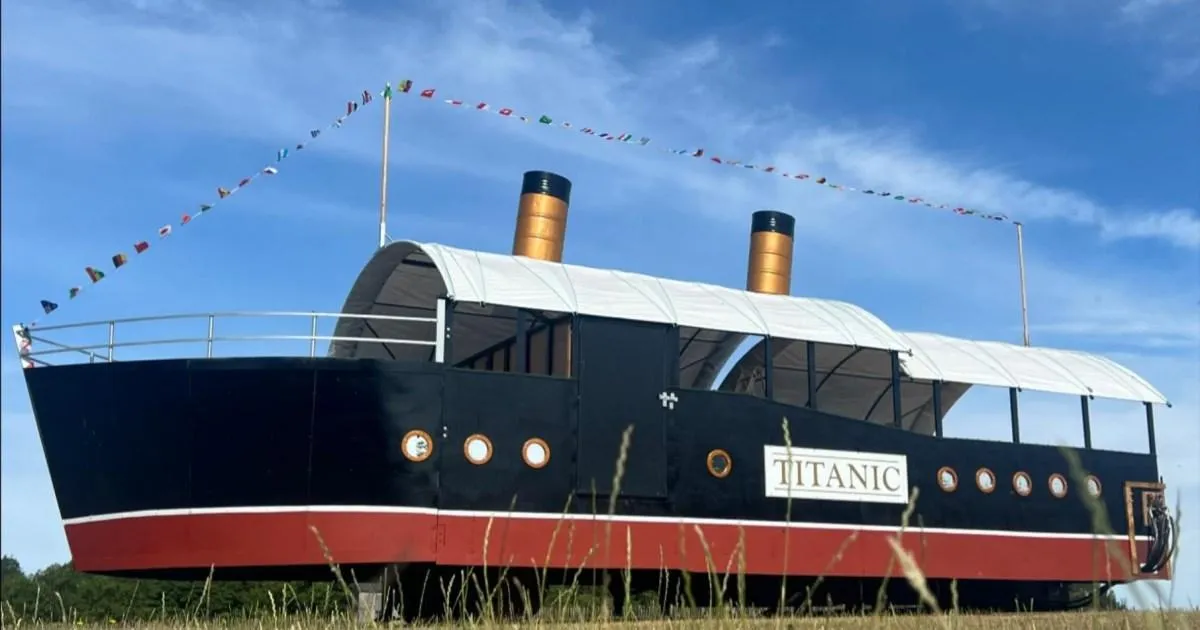
In the rolling countryside of Hertfordshire, nestled among strawberry fields and family-friendly attractions, a peculiar controversy has emerged that has divided a local community and sparked a national conversation about taste, memory, and the boundaries of entertainment. Graveley Fruit Farm, a beloved family destination that has been operating since 1981, found itself at the center of a heated debate this summer over its Titanic-themed children’s ride. The attraction, which costs just two pounds per ride, features a colorful replica of the ill-fated ocean liner complete with two of its iconic funnels. Children climb aboard, are tilted upward at a dramatic angle, and then released onto a soft crash mat below. For many families, this is simply a fun, quirky addition to a day of strawberry picking and mini-golf. But for others, the ride represents something deeply troubling: the transformation of one of history’s most devastating maritime disasters into a playground amusement.
The criticism began to mount on the farm’s Facebook page, where outraged commenters questioned the judgment behind creating a children’s game based on a tragedy that claimed nearly 1,500 lives. Andy Turner, one of the most vocal critics, drew sharp comparisons that resonated with many readers. He questioned whether the farm would create similar attractions based on other historical tragedies, asking pointedly about the Holocaust or the September 11 attacks. His comments struck a chord with others who felt that the ride trivialized the suffering of those who perished, including approximately 60 children who died when the ship sank on its maiden voyage in 1912. The visual imagery of children gleefully sliding down a replica of a sinking ship, even a colorful and cartoonish version, struck many as fundamentally inappropriate, a confusion of childhood innocence with historical horror that seemed to miss something essential about respect and remembrance.
The Human Cost Behind the Entertainment
To understand the depth of feeling this controversy has generated, one must appreciate the profound human tragedy that the Titanic represents. When the supposedly unsinkable ship struck an iceberg on the night of April 15, 1912, it wasn’t just a maritime accident—it was a cataclysmic event that shattered the confidence of an era and left an indelible mark on human consciousness. The ship carried over 2,200 passengers and crew members, each with their own dreams, families, and aspirations. In the freezing waters of the North Atlantic, over 1,500 people perished, many of them dying from hypothermia in the icy sea while waiting for rescue that would come too late for most. The sinking claimed lives across every social class, from the wealthiest industrialists to impoverished immigrants seeking new lives in America. The particular horror of the event lay in its avoidability, its shocking swiftness, and the way it exposed the hubris of technological progress. For families who lost loved ones, the tragedy was not abstract history but visceral personal loss, grief that was passed down through generations.
The children who died on the Titanic are perhaps the most heart-wrenching aspect of the disaster. Approximately 60 children perished, many of them in steerage class where the chaos of the sinking and the difficulty of reaching the lifeboats proved particularly deadly. These weren’t just statistics; they were real children with names and faces, children who had excitedly boarded a grand ship anticipating adventure and arrived instead at an icy grave. The stories of these young victims have been told and retold over the decades, part of the rich tapestry of Titanic lore that continues to fascinate and horrify us more than a century later. For critics of the ride, the specter of these children makes the amusement particularly difficult to stomach. They argue that turning the vessel that killed these children into a fun playground attraction demonstrates a callousness and historical amnesia that should be concerning to anyone who values empathy and moral awareness. The question they pose is uncomfortable but unavoidable: by making a game of tragedy, do we teach children to be callous about suffering, or do we somehow process and cope with historical horror by domesticating it?
The Farm’s Defense and Community Support
Despite the backlash, Graveley Fruit Farm has responded to the criticism with a mixture of defiance, historical perspective, and a notably edgy sense of humor. When initial complaints prompted the farm to announce it would change the ride’s name, the decision was quickly reversed following what the owners described as overwhelming support from regular visitors and local families. The farm’s defense rests on several arguments that have proven persuasive to many people. First, they point to the distance of time since the disaster, noting that more than a century has passed and that no survivors, or even children of survivors, remain alive today to be offended. Second, they argue that the Titanic has transcended its historical reality to become something else entirely—a cultural touchstone, a part of our shared vocabulary that appears in movies, songs, jokes, and countless works of art and literature. In a particularly poetic response to Metro, the farm suggested that the ghosts of those who perished might well smile at knowing that a children’s slide made in their memory brings joy to so many people, rather than sorrow.
This perspective has found resonance among many visitors and commenters who argue that the outrage is misplaced, perhaps even performative. They point out that the ride is clearly designed to be whimsical and fun, painted in cheerful colors and designed for young children who likely have little understanding of the historical event it references. Some supporters have noted that the ride’s design—tilting upward to simulate the ship’s sinking bow before a soft landing—bears comparison to amusement park attractions based on other disasters, natural or manmade, that rarely provoke similar outrage. Others have taken a more philosophical stance, suggesting that the human capacity to laugh at and play with our greatest tragedies is not callousness but resilience, a way of processing and domesticating our fears. The debate has become, in many ways, a microcosm of larger conversations about cultural memory and the boundaries of taste, with people on both sides genuinely believing they occupy the moral high ground.
The Broader Context of Tragedy-Based Entertainment
The Titanic ride controversy raises profound questions about where we draw the line between remembering and exploiting tragedy. History is filled with examples of disasters being transformed into entertainment, from ghost tours through former concentration camps to planes flown into buildings on film screens. We seem to have an almost primal need to revisit and re-enact our greatest catastrophes, perhaps as a way of asserting control over forces that once overwhelmed us. Museums devoted to tragedies like Pompeii or the World Trade Center site walk a careful line between education, commemoration, and tourism, constantly negotiating the tension between profitability and respect. Amusement park rides based on disasters are perhaps more common than we might think, from attractions themed around earthquakes and volcanic eruptions to the many roller coasters that promise to simulate plane crashes or other terrifying scenarios. The question is not really whether we engage with tragedy for entertainment—clearly we do—but rather what context and degree of sensitivity we bring to that engagement.
The specific objections to the Titanic ride seem to center on several factors that distinguish it from other disaster-themed entertainment. The first is the involvement of children as participants, not just observers. There is something uniquely uncomfortable about making a game for young people based on an event that killed many young people. Another factor is the specificity of the reference; this is not a generic disaster ride but one explicitly tied to a real event whose victims can be named and whose stories have been told. Finally, there is the sheer scale of cultural awareness around the Titanic, a tragedy that has been memorialized in countless books, films, and exhibitions, making it feel more present in our collective consciousness than many other historical disasters. Perhaps we have reached a point where the Titanic has become so thoroughly mythologized that we’ve lost sight of the real human suffering it represented, reducing it to a romantic drama of star-crossed lovers and class struggles rather than the horrifying mass death event it actually was.
The Question of Historical Sensitivity
Underlying the controversy is a fundamental question about how we balance historical sensitivity with creative expression and simple enjoyment. The critics’ argument, most memorably articulated by those who compared the ride to hypothetical Auschwitz or September 11 attractions, rests on the assumption that some tragedies are simply too sacred to be exploited for amusement. They argue that the suffering of the victims creates a moral obligation to treat their memory with respect, particularly when that memory is being used to generate profit. The farm’s owners might counter that no hierarchy of tragedy exists, and that singling out the Titanic for special treatment while tolerating other disaster-themed entertainment reflects a somewhat arbitrary and potentially classist perspective. After all, the Titanic was disproportionately a disaster of the wealthy and famous, whose stories have been told extensively, while many maritime disasters with even higher death tolls have faded into obscurity because their victims were less prominent.
There is also a question of intent to consider. Was the farm deliberately trying to provoke outrage, or did they simply see an opportunity to create a fun, memorable attraction without deeply considering the historical implications? Most likely, the latter is true, and the owners were genuinely surprised by the intensity of the backlash. In their defense, it’s worth noting that the ride has been operating for several years with little controversy, suggesting that public reaction is not monolithic and may vary based on broader cultural moods and sensitivities. The outrage seems to have been sparked by a few vocal critics and amplified through social media, perhaps not reflecting the actual views of most visitors. In their defense of the ride, the farm noted that it received far more support than criticism, and that the decision to initially cave to complaints was quickly reversed after receiving significant backlash from supporters who found the outrage absurd and overblown.
Finding Meaning in the Debate
Ultimately, the Titanic slide controversy may tell us less about the specific ride itself than about our broader relationship with history, tragedy, and the moral codes we construct around collective memory. Every society develops its own rules about what can be joked about, what can be made entertaining, and what must be treated with solemnity and respect. These rules are not fixed; they shift and evolve with time, generational change, and cultural perspective. A century and more after the Titanic disaster, we still haven’t fully settled on the appropriate tone for engaging with it. We can watch dramatic films about the disaster, read scholarly accounts, and visit memorial exhibitions, yet we recoil when its imagery is used in a children’s playground.