

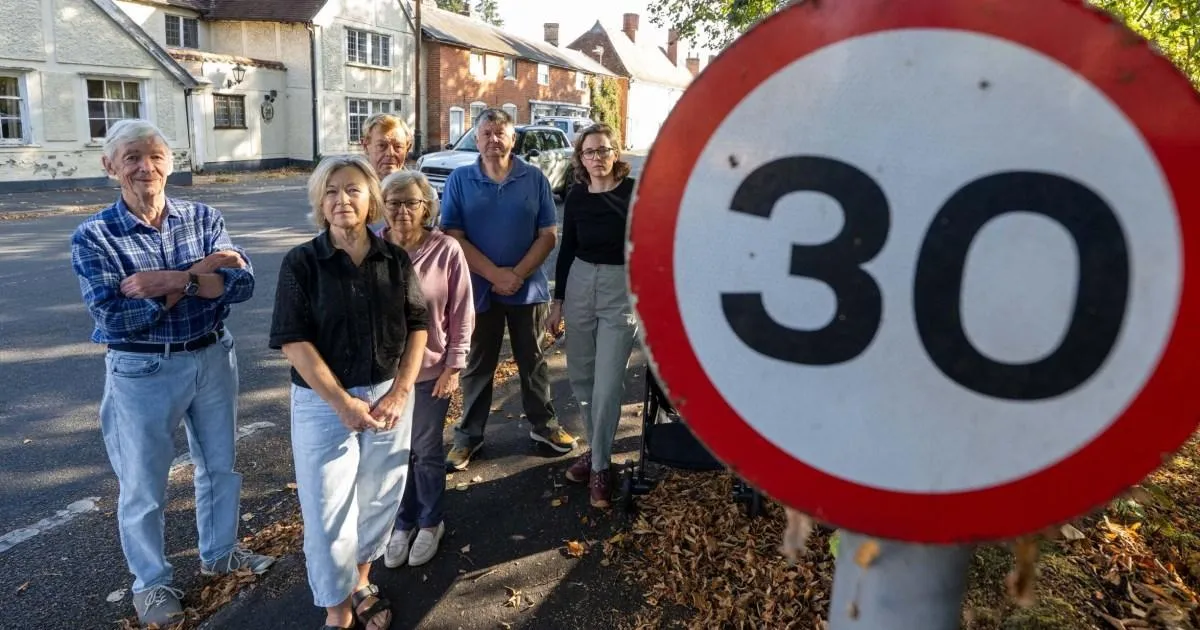
Tucked away in the Suffolk countryside, Walsham le Willows looks like the kind of place where nothing ever goes wrong. Its thatched cottages, timber-framed houses and ancient church bells seem to belong to a gentler, slower world. But beneath that postcard surface, a quiet but determined campaign has been growing. The village of around 1,400 people is demanding something that should not be controversial: safer roads. Residents want 20mph speed limits extended to the roads around their homes, schools and community spaces. They have watched the national speed limit turn their narrow lanes into racetracks, with blind bends, high hedges and no pavements to protect pedestrians. And they have a very real, very human fear that if nothing changes, someone will die. That fear is not abstract. In 2023, villagers were asked whether they wanted a 20mph limit on a road passing the village school, playground and residential areas. The result was emphatic: 90 percent said yes. The limit was introduced, but only on that one road. When residents asked for the same protection to be extended to other roads in the village, where 60mph limits still apply, Suffolk County Council said no. The council claimed that surveys and previous information did not provide enough evidence to justify extending the existing 30mph and 40mph zones. For the people who live there, this reasoning is at best baffling, at worst callous. They are not asking for a traffic-free idyll. They are asking for the chance to cross the street without fear.
Nick Tuck coordinates the village’s Speed Watch group, a team of volunteers who have reluctantly become the first line of defence against dangerous driving. They stand at the roadside with speed guns, logging every vehicle that exceeds the limit, and their records paint an alarming picture. The speed limit on many of these roads may be 60mph, but that does not mean it is safe to drive at 60. The roads are narrow, the bends are blind, and there are no pavements. In the rain, a patch of mud or a fallen branch can turn a normal journey into a skid. Tuck has lived in the village long enough to remember when traffic was light enough to walk in the road. Those days are gone. Now, he says, the situation is “unacceptable.” But his frustration is not just about the vehicles that speed through. It is about the refusal of those in power to act until it is too late. “Do we need to wait for a child on the way to the Sports Club to be killed before anything is done?” he asks. It is a stark question, and one that no official has been able to answer. He is not calling for a total ban on cars. He simply wants infrastructure that matches reality: chicanes, refuge crossings, width restrictions, reduced speed limits. “Ideally, we should be able to put the infrastructure in place to slow traffic,” he says. “Sadly, these all come at a cost, be it to the Parish or the County Councils, they also come with regulations and permissions. Road safety and traffic management are not top of the pile until something goes horribly wrong.” That last phrase is telling. In a rational world, you would think the job of a council was to prevent tragedies, not to wait for them. But Tuck knows the system doesn’t work that way. He has seen it too many times. So he keeps standing at the roadside, keeps recording the speeds, keeps hoping that the next person to be killed will not be a child on the way to football.
Parish councillor Janette Winch is another voice in the campaign, and she speaks with the weariness of someone who has been asking for change for years. She has watched the village’s narrow roads become busier and busier, not just with local traffic but with commuters and commercial vehicles looking for a shortcut through the countryside. The reason, she believes, is simple: housing. Across the region, new homes have been built to meet demand, but those homes come with cars, vans and lorries. The result is that a village built for a different age is now being asked to cope with an endless stream of vehicles. “We, as residents, feel there’s inconsiderate driving especially with those who don’t live here and are trying to get from A to B,” she says. “Those drivers are under a time pressure but slower speeds don’t massively impact an increase in their journey time.” Her point is one that transport planners often overlook: slowing down through a village adds seconds to a journey, not minutes. But those seconds can save a life. “If everybody drove the way some do, we would have accidents all the time. Within the village and the approaching roads, they are all at a national speed limit and it is not appropriate with the volume of traffic coming through.” Winch is not against drivers. She knows that most people are just trying to get on with their lives. But she also knows that the margin between a safe road and a deadly one is thinner than it looks. A child who steps out from behind a parked car, an elderly person who misjudges a gap, a cyclist who swerves to avoid a pothole: none of them stand a chance at 60mph. And yet the council’s response, she says, has been to ask for more evidence. More surveys. More reports. More time. Time that the village may not have.
Ian Hartley has his own story to tell, and it is one that will sound familiar to anyone who has ever tried to convince a council that a road is dangerous. When he moved into West Street in 2001, it was a quiet lane. He could stand in the middle of the road without hearing a car coming. But as the village grew, so did the traffic. He applied for a reduced speed limit and was told that there was not enough housing density to justify it. Yet half a mile away, he points out, there is a tiny hamlet with 30mph signs and almost no traffic at all. “The council couldn’t explain that,” he says. It is the kind of inconsistency that breeds cynicism. Why should one village be protected and another ignored? Hartley’s street, like many in Walsham le Willows, has no pavements. The houses open directly onto the road, and the bends are so sharp that drivers cannot see what is coming until they are almost upon it. “These are dangerous, blind bends and for most of us on our street, our access is on the front of the house,” he explains. Every time he reverses out of his driveway, he is taking his life in his hands. Every time his children play in the front garden, he is holding his breath. He describes the traffic increase as “exponential,” a word that has become all too familiar to rural communities across Britain. And yet the national speed limit remains in place, as if the village were still a green lane in the middle of nowhere. “Since then, with village expansion, the traffic has increased exponentially to dangerous levels with only the national speed limit in place,” he says. It is not just the speed that bothers him. It is the way some drivers treat the road as a racetrack, using the bends to overtake, accelerating out of corners, paying no attention to the houses and people on either side. He has seen the damage done by careless driving. He does not want to see it again.
Suffolk County Council, meanwhile, has not budged. In a statement, a spokesperson said: “We carried out a survey of the roads and also looked at previous information about the area. Based on what we found, there wasn’t enough evidence to support extending the existing 30mph and 40mph speed limits. We only reduce speed limits where there is clear evidence that a lower limit is needed to help keep people safe.” For residents, this is a classic catch-22. The council says it needs evidence, but the only evidence it accepts is a serious injury or a death. It is a grim accounting that makes a mockery of the phrase “prevention is better than cure.” And it is not as if the village is asking for something radical. Across the United Kingdom, the tide is turning against the idea that a national speed limit is always appropriate. In Wales, a default 20mph limit on most restricted roads was introduced in September 2023, despite accusations of a “war on cars.” In England, more and more local authorities are introducing 20mph zones in residential areas. Birmingham has announced plans to introduce 20mph limits on all non-A roads. Even individual citizens are taking action: in Stanford Rivers, Essex, a resident built a homemade speed camera that uses artificial intelligence to detect speeding vehicles and posts images of the worst offenders on social media. The anonymous creator said the project was motivated by “a healthy grudge against bad driving.” These examples show that the demand for safer streets is not a fringe cause or a campaign by a handful of NIMBYs. It is a national movement, driven by ordinary people who are tired of being treated as collateral damage in the name of keeping traffic moving. The council may not see the evidence, but residents see it every day: in the tyre marks on the verge, the dents in the hedgerows, the near misses that never make it onto any official form. They see it in the faces of children waiting at the school gate, and in their own hearts every time a car roars past.
Ultimately, the campaign in Walsham le Willows is about something deeper than speed limits. It is about the kind of communities we want to live in. Do we want places where people know their neighbours, where children can walk to school without an escort, where the sound of birdsong is not drowned out by engines? Or do we want places that exist only as corridors for commuters, where the local population is a nuisance to be negotiated, and where safety is a luxury that can only be afforded after a tragedy? The residents have made their choice. They are not anti-car; most of them drive. They are not asking for road closures or a ban on through-traffic. They are asking for the same simple thing that communities all over the country are asking for: the right to live without fearing for their lives every time they step outside. They have organized, campaigned, written letters, gathered data and made their voices heard. They have been polite, patient and persistent. But their patience has run out. Nick Tuck’s question — “Do we need to wait for a child on the way to the Sports Club to be killed before anything is done?” — is not a rhetorical flourish. It is a direct challenge to everyone in a position of power. And it deserves an answer. The residents of Walsham le Willows will keep counting speeders, keep attending council meetings, keep telling their story to anyone who will listen. But they should not have to. The evidence they have provided should be enough. The fact that it is not says more about the system than about them. In the end, the only acceptable speed through a village is one that lets everyone get home safely. Until that is understood, the campaign will continue. And the next time a council official asks for “evidence,” they should remember what that evidence will look like: a flower-wrapped lamppost, a pile of soft toys, and a community asking, with the unbearable clarity of hindsight, why nobody acted in time.