

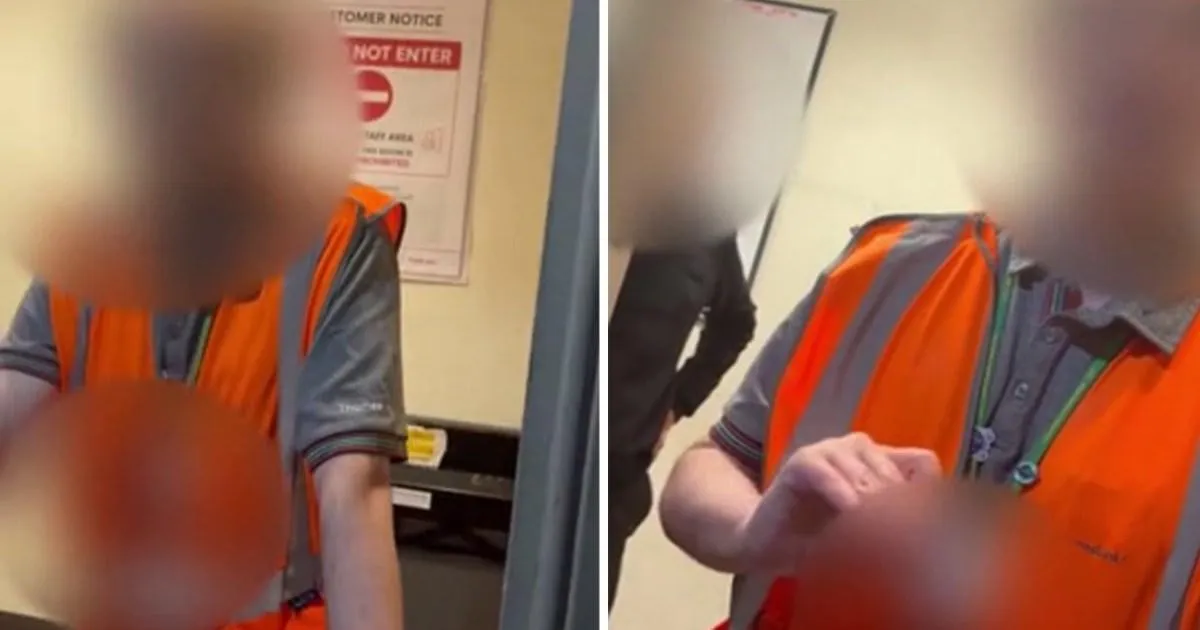
It was an ordinary Friday evening at Farringdon station, one of London’s busiest rail hubs, where thousands of commuters hurry through the ticket gates and down the escalators, each absorbed in their own thoughts, their own worries, their own small routines. For one Jewish passenger, though, the journey home was suddenly no longer ordinary. He noticed a Thameslink staff member wearing a badge that read “Palestine Solidarity” alongside the initials of the RMT rail union. It was a small piece of fabric, perhaps a few centimeters wide, but it carried a world of meaning. With tensions already running high after the third anniversary of the October 7 attacks, the passenger decided he could not let it pass in silence. He approached the supervisor and complained, hoping for a simple acknowledgment, perhaps an explanation, or even an apology. Instead, he says, he was met with a defensive response that quickly spiraled into something far more disturbing. A video shared with Metro appears to show the supervisor not only defending the badge as a “human rights badge,” but also making claims that the Israeli military, rather than Hamas, was responsible for most of the deaths on October 7. The passenger, shocked and angered, challenged the statement. The confrontation that followed would eventually lead to the supervisor allegedly trying to eject the Jewish man from the station, leaving him feeling unsafe, unheard, and humiliated in a public space where he had every right to be.
The video, which has now been handed to Thameslink investigators, captures the supervisor’s words with unsettling clarity. When the passenger raises the massacre of Israelis on October 7, the railway employee responds with a reference to the “Hannibal Directive,” an alleged Israeli military tactic that reportedly involves using overwhelming firepower to prevent the kidnapping of soldiers, even at the risk of harming or killing the hostages themselves. The implication was that Israeli forces, not Hamas, caused the deaths of many Israelis that day. The passenger calls the claim “absolute nonsense,” and in that moment the mood shifts. The supervisor tells him, “It is time you leave the station,” and moves toward him. There is something deeply unsettling about watching a person in authority use that authority not to de-escalate, but to silence. The passenger refuses to leave, insisting he has done nothing wrong. The supervisor then accuses him of harassing him and his colleagues. The passenger denies this, standing his ground on the platform, surrounded by the noise of trains and the flow of commuters who have no idea that a small but profound human drama is unfolding before them. For the Jewish passenger, the exchange was not just an argument about politics or history; it was a moment in which he felt his identity, his community, and his grief were being dismissed and distorted by someone who was supposed to be there to help him travel safely.
The allegations do not stop there. In the footage, the supervisor goes on to claim that Israel’s Prime Minister had been warned about the October 7 attacks a month beforehand but had deliberately failed to act. When the passenger asks directly whether the supervisor believes most of the Israeli casualties on that day were killed by Israelis, the supervisor replies simply, “yes.” He then offers a peculiar piece of reasoning, asking how all those cars and vans could have been blown up if Hamas had only small arms. The passenger, clearly frustrated, corrects him: “Hamas had RPGs.” The exchange is a dizzying mixture of conspiracy theory, geopolitical argument, and personal confrontation. It is the kind of conversation that might happen in a heated debate among friends, but here it is happening between a railway supervisor and a passenger in a busy London station. The supervisor appears to be using his position to lecture and intimidate rather than to protect and serve. Eventually, a senior staff member steps in and ends the dispute. The manager tells the passenger that he agrees railway staff should not display political badges, but that they should not have to “take abuse” either. The passenger denies giving any abuse, and the encounter ends not with resolution, but with an unresolved, simmering tension that leaves a bitter taste.
To understand why this incident has struck such a nerve, one must remember the devastating reality of October 7. On that day, Hamas militants crossed into Israel, killing around 1,200 people and taking more than 250 hostages. Many of the victims were civilians, young people at a music festival, families in their homes, soldiers defending their posts. The attack was the deadliest single day in Israel’s history and it triggered a war that has reshaped the entire Middle East, causing immense suffering in Gaza and leaving deep wounds on both sides. For Jewish people in Britain, the anniversary is not an abstract political event; it is a personal and communal memory of grief, fear, and solidarity. To hear a railway supervisor, a figure of authority, suggest that Israel itself was responsible for the deaths of its own citizens is, for many, not just offensive but deeply threatening. It feeds into a narrative that has been used to justify hostility toward Jewish people for centuries. It also raises serious concerns about whether Jewish passengers can feel safe in public spaces when such views are expressed by staff who hold power over them. The badge itself, while perhaps intended as a gesture of solidarity with Palestinians, becomes a flashpoint in a broader conflict that has no place on a station platform.
UK Lawyers for Israel, a legal group that monitors antisemitism and discrimination, has now written to Thameslink’s chief executive, John Whitehurst, demanding an investigation into both employees involved. The group is also asking whether political badges are permitted under the company’s uniform rules, and whether the staff member who wore the badge should have been allowed to do so. In their letter, UKLFI warns that the alleged behavior could amount to harassment under the Equality Act 2010, which protects passengers from discrimination and harassment based on race, religion, or other protected characteristics. A spokesperson for the group made their position clear, saying: “Jewish passengers should be able to travel on Britain’s railways without being subjected to offensive conspiracy theories about the massacre of Israelis on 7 October, or threatened with expulsion from a station for questioning a political badge. Railway staff are there to serve passengers, not to promote political causes or subject customers to hostile political lectures. It is particularly alarming that the employee who allegedly behaved in this way claimed to be a supervisor. Thameslink must investigate this incident urgently, make clear that such behaviour is unacceptable and ensure that Jewish and Israeli passengers can use its services without fear of harassment or discrimination.” The statement captures the sense of urgency and moral clarity that many feel about the incident, and it places the burden firmly on Thameslink to respond not just with words, but with meaningful action.
Thameslink, for its part, has acknowledged the video and said it is investigating. A spokesperson said: “We are aware of the allegations and investigating. We are committed to providing a safe and welcoming environment for everyone travelling on our network, and we take any allegations of this nature extremely seriously.” That commitment will now be tested. The investigation will need to determine exactly what was said, whether the supervisor overstepped the boundaries of his role, whether the badge violated uniform policy, and whether the passenger was treated unfairly because of his identity. But beyond the legal and procedural questions, there is a deeper human issue here. Public spaces like railway stations are shared by people of every background, faith, and political belief. They are places where strangers brush past one another, each carrying their own history, their own fears, their own hopes. When a person in uniform uses their position to lecture a passenger on a controversial and painful topic, or to threaten them with expulsion for asking a question, it breaks an unspoken social contract. It turns a neutral space into a battleground. It makes people feel unwelcome in their own city. The Jewish passenger who stood on the platform that Friday did not ask to be drawn into a debate about the Middle East. He simply wanted to go home. Instead, he found himself caught in a storm of accusations, conspiracy theories, and hostility, all because he dared to challenge a badge. As the investigation unfolds, one hopes that Thameslink will not only discipline those responsible, but also reflect on the broader culture that allowed such an incident to happen. For now, the video stands as a reminder that words matter, that authority carries responsibility, and that every passenger, regardless of who they are, deserves to travel without fear.