
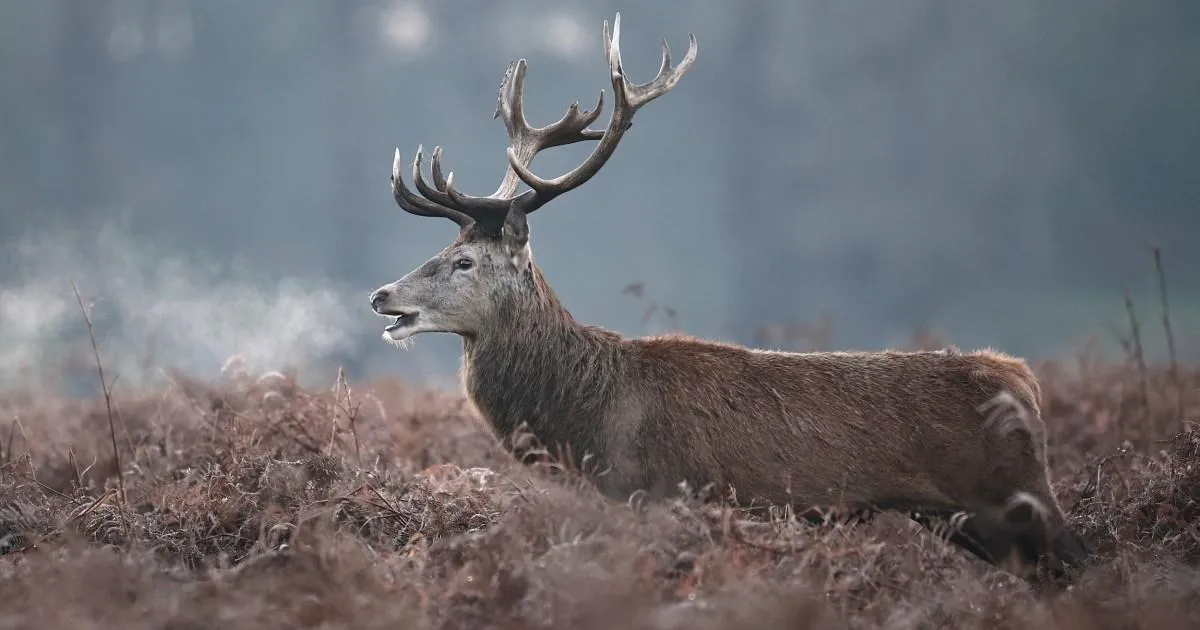
The sun had settled into a warm, honeyed glow over Richmond Park on that fateful Saturday afternoon, casting long, gentle shadows across the meadows. For a group of friends and family, it was the perfect setting for a lazy picnic—a moment of tranquility in the heart of London, where the city’s frantic pulse fades into the rustling of ancient oaks and the distant call of birds. Laughter and the clinking of glasses filled the air as they laid out their blankets and baskets just a stone’s throw from the bustling Roehampton Gate Cafe, a popular rendezvous for day-trippers. The scene was one of pastoral bliss, entirely unremarkable in its serene domesticity. But nature, in its most untamed and raw form, was about to shatter that peace. A magnificent stag, its antlers branching like a skeletal crown against the green, emerged from the treeline, drawn not by aggression but by a scent it had learned to follow—the unmistakable aroma of human food. Moving with a heavy, purposeful gait, it approached the group, its eyes fixed on the picnic spread. The initial curiosity of the visitors quickly turned to alarm as the animal ignored their nervous gestures and vocal shooing recalls. In a sudden, violent blur of muscle and bone, the stag charged, its antlers catching the man in his sixties, driving him to the ground with a sickening force that left him with serious, albeit non-life-threatening, chest injuries. The pastoral idyll had been shattered in a heartbeat, replaced by chaos, screams, and a frantic call for emergency services.
As the ambulance sirens faded into the distance, carrying the injured man to a nearby hospital, a quieter but equally profound tragedy was unfolding within the park’s administrative fabric. The victim, thankfully, was stable; his injuries, while painful and shocking, would not prove fatal. Yet for the stag, the outcome was absolute and irreversible. In the somber deliberation that followed, the Royal Parks wildlife officers made a grim assessment. The animal, emboldened by its success in obtaining human food, had crossed a dangerous threshold. It had lost its natural caution, transforming from a wild creature into a potential projectile of antlers and hooves. The decision was made with heavy hearts but unwavering logic: the stag had to be destroyed. It was a lethal injection of pragmatism into a tragic situation. A wildlife officer, tasked with preserving the park’s natural life, was forced to become its executionerate, firing a single, fatal shot to put the animal down. This wasn’t malice; it was a calculated risk assessment. The stag, in its unthinking quest for an easy meal, had become a liability too significant to manage. The shuddering reality of that moment—the crack of the rifle echoing through the peaceful park—stands as a brutal testament to the conflict that arises when human recreation and wild instinct collide.
The tragedy of this event is not that a wild animal acted on its primal instincts, but that those instincts were actively corrupted by human behavior over time. The majestic stag, which had roamed the park with a natural wariness of the two-legged creatures that flocked there, had somehow learned that humans were not predators to flee from, but providers of easy sustenance. Royal Parks officials suspect that this particular stag had, through repeated and likely well-intentioned but misguided human actions, developed a powerful association: people mean food. This is a deeply human-caused tragedy. It began not with the picnic itself, but with countless small, seemingly harmless moments of charity throughout the years. A child tossing a crust of bread, a tourist offering a biscuit, a well-meaning jogger leaving an apple core—each of these gestures, repeated relentlessly, chipped away at the deer’s innate caution. The animal’s brain rewired itself, prioritizing the reliable convenience of human generosity over the arduous foraging nature intended. The man in his sixties, now recovering in a hospital bed with chest injuries, was simply in the wrong place at the wrong time, the target of a set of learned behaviors that turned curiosity into a dangerous desperation. While the authorities have confirmed his injuries are not life-threatening, the psychological shock of being violently, unexpectedly charged by a 200-kilogram wild animal is a trauma that will linger far longer than the physical wounds. He became the unintended victim of a systemic failure, a cautionary tale etched into the very flesh of our collective carelessness. The gender of the animal, its majesty, and the tragic waste of its life, are all collateral damage of a societal habit of viewing public parks as zoos rather than the shared wild territories they truly are.
The proximity of the picnic to the picturesque Roehampton Gate Cafe is a glaring detail that underscores the root cause of this incident. This is not a wilderness far from civilization; it is a vast, protected wilderness sliced through by paths, roads, and excursion spots where thousands of people converge daily. The cafe acts as a magnet, drawing crowds who often treat the surrounding landscape as an extension of the dining room. For the deer, these areas become veritable buffets—places where dropped sandwiches, empty wrappers, and discarded fruit accumulate with predictable frequency. When humans feed the deer, even unintentionally, we strip them of their natural social structures and foraging skills. We turn these magnificent, untamed creatures into beggars. The Royal Parks spokesperson’s remarks are painfully clear: the stag had to be put down because it became a danger to visitors, but it only became a danger because visitors made it one. It is a deeply ironic and sorrowful loop. We conditioned the animal to abandon its survival instincts, and then we punished it fatally for following the commands we inadvertently taught it. The deer did not choose to become a threat; it simply trusted us, and that trust was repaid with a bullet. The echo of that gunshot should serve as a deafening indictment of our collective failure to respect the boundaries that separate human spaces from the wild.
Beyond the specific tragedy of Richmond Park, this incident has exposed a far more pervasive and dangerous pattern of behavior spreading across London’s royal parks. The Royal Parks charity expressed their shock at videos circulating online of visitors in nearby Bushy Park, not just casually observing deer, but actively approaching them, reaching out to touch them, and offering them food. The footage reveals a disturbing culture of entitlement and ignorance, where people treat these magnificent, antlered creatures as if they were oversized petting-zoo goats. The videos show individuals getting dangerously close, snapping selfies, and coaxing the deer with handfuls of snacks, completely oblivious to the raw, unpredictable power contained within those elegant frames. This behavior is not just reckless; it is a profound misunderstanding of animal psychology. When a deer is repeatedly fed, it undergoes a process of habituation. Its natural flight response, hardwired over millennia to ensure survival, erodes and is replaced by a territorial confidence. The animal begins to see humans as walking dispensers of treats, and when the dispenser fails to deliver, or when the human’s movements are perceived as a threat to the food source, the animal’s frustration can boil over into aggression. Royal Parks officials have expressed being “shocked and alarmed” at the recent viral videos of visitors in the neighboring Bushy Park, where people are seen getting dangerously close to deer to feed them by hand and take selfiesches. These seemingly innocent interactions are laying the groundwork for future tragedies, creating a generation of deer that sees humans not as formidable giants but as vending machines.
The fundamental issue at play here is a profound and dangerous disconnect between the modern human’s perception of wildlife and the reality of it. We have become so accustomed to the sanitized, curated versions of nature found in documentaries and city zoos that we forget that a deer in a public park is still a wild animal, complete with sharp hooves, heavy antlers, and the unpredictable fight-or-flight responses of its ancestors. The Royal Parks charity, responsible for managing these vast green spaces, has been vocally frustrated by the sheer volume of footage emerging showing visitors interacting with deer at dangerously close quarters, particularly in the neighboring Bushy Park. The spokesperson articulated this grave concern with a note of exasperation, highlighting videos circulating online of people feeding the deer, approaching them for selfies, and generally treating them as oversized pets. This behavior, seemingly innocent and affectionate, is a ticking time bomb. The parks are home to hundreds of red and fallow deer, wild animals with complex social hierarchies, powerful bodies, and a deeply ingrained fight-or-flight response. When they are fed repeatedly, they lose their wariness; they begin to see humans as gumball machines. The line between a docile, begging deer and a startled, defensive one is razor-thinMt. A sudden movement, a child’s shriek, a hand reaching out for a dropped apple—any of these could trigger a defensive strike. The video footage emerging from nearby Bushy Park, showing deer rifling through discarded trash and accepting food from outstretched hands, paints a chilling picture of a reality where parks have become drive-thrus for wildlife, and visitors are ignoring every piece of safety advice with arrogant bliss.
The response from Royal Parks was unequivocal and laced with a weary frustration that speaks to the constant battle they wage against public ignorance. Their advice is stark, simple, and tragically easy to ignore: keep at least fifty meters away from these wild animalsais do not feed them, and never, under any circumstances, try to touch them. If a deer approaches, drop all food and packaging immediately retreat slowly and calmly. This counsel, repeated ad nauseam across signage, social media, and park announcements, is a direct plea to preserve the delicate boundary between human enjoyment and animal survival. The authorities emphasized that they were “shocked and alarmed” by the viral videos depicting close encounters, a testament to the fact that for every visitor who respects the rules, there are many more who treat the deer as a petting zoo attraction. The core problem is not the deer; it is the ceaseless, relentless, unthinking kindness of the public that manifests as a dangerous feeding frenzy. Every time someone offers a piece of bread to a majestic stag or a baguette to a curious doe, they are not performing a kindnessav they are signing its potential death warrant. They are teaching the animal that human proximity equals reward, stripping it of the fear that keeps it alive and safe. This learned behavior is a one-way street. Once a deer loses its flight response and adopts an approach response, its temperament becomes unpredictable, and its fate is often sealed. The painful reality is that the most humane outcome for a deer that has become a public hazard is euthanisia. The very people who claim to love wildlife the most, the ones snapping photos and tossing snacks, are inadvertently sentencing these animals to death by making them dangerous.
In the grander scheme, this killing is not just a localized tragedy but a profound allegory for the Anthropocene—the age where human activity is the dominant influence on climate and the environment. We carve out these green sanctuaries in the middle of our gray urban sprawl, expecting them to be pristine versions of a pre-human world, yet we cannot resist the urge to invade them with our presence, our litter, and our constant need for interaction. We demand that nature be wild, but only in a curated, safe, and Instagram-friendly way. The deer in Richmond Park are not zoo animals; they are wild, free-roaming herbivores with sharp hooves and formidable antlers. They are governed by instincts honed over millennia of evolutionary survival, instincts that tell them to flee from predators and fight when cornered. By feeding them, we recalibrate those instincts, converting a majestic, cautious animal into a short-tempered beggar with a hair-trigger stress response. The stag’s death, therefore, is not just the loss of one animal; it is a symbolic indictment of our collective failure to understand that true appreciation of wildlife requires distance, respect, and a willingness to accept that we are merely visitors in their home, not masters of their domain who can bend their behavior to our whims.
The legacy of this tragic event must extend beyond a viral news cycle. It forces a sober reflection on what we owe to the creatures that share our green spaces. Richmond Park, with its six hundred strong herd of red and fallow deer, is a testament to the successful co-existence of a major metropolis and wild fauna. But that co-existence is predicated on a fragile contract: we provide the sanctuary, and they provide the wildness. When we violate that contract by feeding them, we place both them and ourselves in peril. The decision to shoot the stag was a clinical, necessary measure to protect the public, but it was also a profound loss. It erased a life that was simply trying to survive in the best way its evolved brain knew how, a brain that was taught those survival strategies by careless human hands. As the man in his sixties recovers in a hospital bed, and as the park rangers conduct their duties, the ghosts of that afternoon linger. The solution to this recurring problem lies not in more fences or harsher penalties, but in a fundamental shift in human empathy. We must learn to view these animals not as photo opportunities or interactive exhibits, but as sovereign beings with their own complex emotional lives. We must allow them to keep their wildness, for in stealing that wildness, we are also stealing their safety and, potentially, their lives.
Ultimately, the story of the Richmond Park stag is a somber parable for the Anthropocene, a stark reminder that the greatest threat to wildlife is often our well-intentioned interference. We wander into their habitats, bring our processed foods canvases, and then are shocked when they exhibit natural behaviors driven by an unnatural dependency. The deer didn’t attack out of malice; it attacked out of a learned expectation, a desperation born from a thousand prior acts of thoughtless generosity. As the park returns to its tranquil state, with the sun once again setting over the oaks, the void left by the fallen stag serves as an eerie monument to this lesson. The incident has reignited a crucial dialogue about wildlife management in urban green spaces, forcing both authorities and the public to confront the uncomfortable consequences of our actions. We are left to grapple with the profound irony that in our quest to get closer to nature, we often end up destroying the very essence of it. The memory of that majestic animal, felled by the consequence of our own carelessness, should serve as a rallying cry for a more respectful, distant, and ultimately safer coexistence. It is a stark reminder that to truly appreciate the wild, we must sometimes have the discipline to stand back and let it be wild.