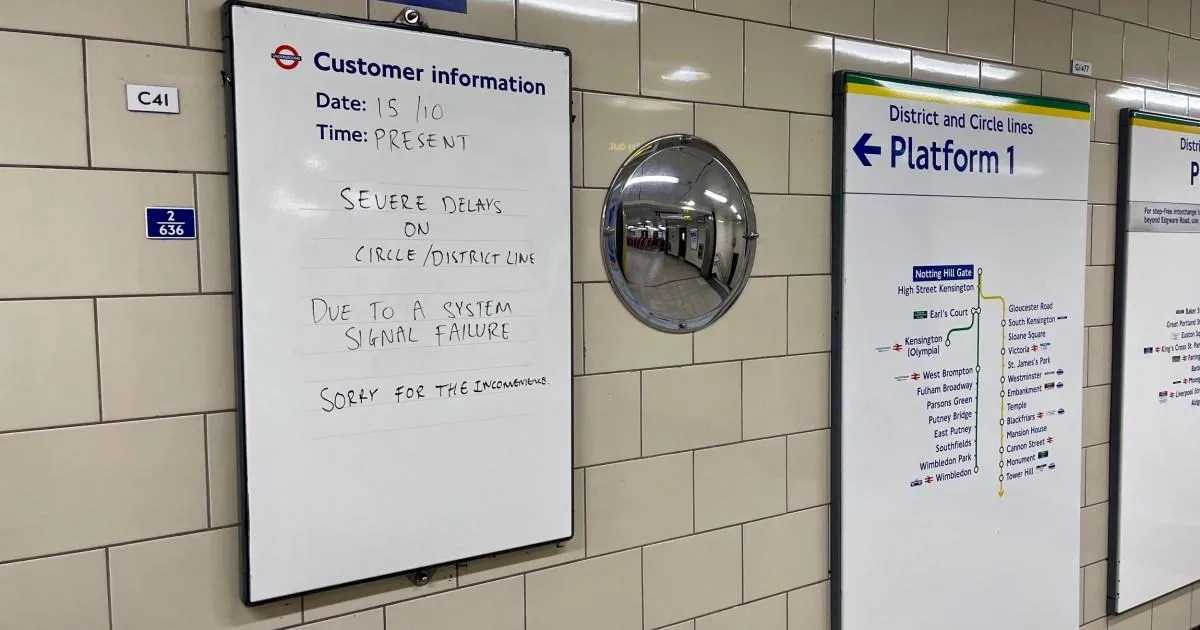
If you stepped out the door this morning expecting a quiet, orderly commute, London’s transport network had a different idea. It was one of those classic London mornings: grey, damp, full of people trying to get somewhere in a hurry, and the last thing anyone needed was a message saying “severe delays.” But that is exactly what greeted passengers across the city, as a messy combination of signal failures, faulty trains and an operational incident on the railway brought widespread disruption to the Underground, the Overground and mainline services. The advice was simple but maddening: check before you travel, allow extra time, and expect the worst. For many, that advice came too late. By the time the first wave of commuters reached their stations, the damage was already done. Departure boards flickered with a mixture of warnings and cancellations, platforms filled with anxious travellers staring at their phones for updates, and the usual morning rhythm was replaced by a chaotic shuffle of diversions, delays and desperate rerouting. It was the kind of morning that makes you want to crawl back into bed, reschedule every meeting, or simply stand on the platform with a resigned sigh, watching the minutes tick by. And the frustration was not confined to one corner of the capital. From the heart of the West End to the northern suburbs, from the City to the airport, the transport network was struggling under the weight of several simultaneous problems, leaving passengers to wonder whether they would ever reach their desks at all.
The most painful disruption on the Underground was reserved for those relying on the District line, a line already known for its slow, stop-start journeys during peak hours. Transport for London confirmed that a signal system failure was to blame for a series of severe delays stretching across some of the busiest sections of the line. If you were travelling between Earl’s Court and Ealing Broadway, Richmond and Tower Hill, or Edgware Road and Earl’s Court, you were likely facing severe delays, which in practical terms means trains moving at a crawl, long pauses between stations, and platforms so packed that finding a spot near the doors felt like a small victory. The misery did not stop there. The stretch between Upminster and Tower Hill, as well as the branch down to Wimbledon, was also plagued by minor delays, which for commuters means just enough time lost to make you late, but not enough to justify a dramatic excuse. At Notting Hill Gate, where the District and Circle lines share platforms and passengers often switch between them in search of a faster route, the warnings were especially disheartening. Everyone seemed to be checking their maps, trying to calculate whether it was quicker to walk, take a bus, or simply wait for the next train and hope for the best. Signal failures are particularly cruel because they affect everything at once, and there is no quick fix. One minute you are moving, the next you are stopped in a tunnel, listening to an announcement that repeats the same words: “We apologise for the delay to your journey.” The cause may have been technical, but the impact was deeply human, and you could see it in the tired faces of passengers who had left home early precisely to avoid this kind of chaos.
If the District line was bad, the Northern line was not much better. Passengers were hit by severe delays between High Barnet and Camden Town, one of the busiest commuter arteries in north London, after a faulty train at Nine Elms brought disruption to the entire branch. The Northern line is one of the few lines that can carry you from the very northern edge of the city down to the South Bank and beyond, so when it breaks down, the ripple effects are felt by thousands of people. Those travelling on the Kennington and Battersea stretch also experienced minor delays, meaning the trouble was not just limited to one end of the line but was creeping through the network like a bad cold. The faulty train at Nine Elms was likely a single carriage with a technical problem, but on a system as interconnected and finely balanced as the London Underground, one faulty train can cause a cascade of knock-on delays. Trains bunch up, platforms become overcrowded, station staff have to manage crowds, and passengers who planned their journeys down to the minute suddenly find themselves standing in the cold, watching the board tick upward from two minutes to five, then to ten, then to “severe delays.” The Northern line has always had a reputation for being busy, especially during rush hour, but mornings like this test the patience of even the most seasoned commuter. There is no enemy to point at, no one to blame except a piece of faulty machinery, and that somehow makes it even more frustrating. You cannot complain to a train; you can only wait, refresh your phone, and hope that the next train will arrive before your patience runs out.
If the Tube was not stressful enough, rail passengers heading to or through London Liverpool Street faced an even more chaotic scene. Liverpool Street is the UK’s busiest railway station, and on this particular morning, three of its platforms were closed after what was described only as an operational incident between the station and Hackney Downs and Chingford. National Rail warned that trains running between these stations may be cancelled or revised, and the disruption was expected to last throughout the day. That is the phrase every commuter dreads: “disruption expected until the end of the day.” It means the rest of your schedule is essentially a guessing game. Platforms 1, 2 and 3 were shut, which may not sound like much in a station with many platforms, but when it happens at a major terminal, it has a devastating effect on capacity. Greater Anglia services to and from Stansted Airport were affected in both directions, which is particularly brutal for anyone with a flight to catch, and trains to and from Cambridge and Cambridge North were also caught up in the chaos. The London Overground’s Weaver line, which serves a growing number of commuters in east London, was also disrupted, meaning that people who had planned to switch from Tube to Overground or from rail to Tube were left scrambling for alternatives. There were cancellations, last-minute changes, and no shortage of confusion. Some trains were diverted, others were simply removed from the schedule, and passengers were left to decipher the announcements, squinting at screens and trying to figure out whether their service was still running. It was a collective headache, made worse by the fact that the precise nature of the operational incident remained vague. Network Rail had not yet commented, and in that vacuum of information, rumours and frustration multiplied. For those caught in the middle, the only certainty was uncertainty, and that is never a good feeling when you are trying to get to work, to a meeting, or to an airport gate before it closes.
For commuters caught in this storm, the practical advice was the same as always, but no less important: check before you travel, allow extra time, and if possible, consider alternative routes or working from home. Transport for London’s status page was updated regularly, and National Rail asked passengers to keep an eye on their journey planner, but when you are already on a packed platform, that kind of advice can feel a little hollow. Still, there were ways to soften the blow. Some passengers chose to walk to neighbouring stations, hoping to find a less crowded line. Others turned to buses, bicycles, or ride-hailing apps, desperately trying to piece together a journey that would get them where they needed to go. The people most affected were probably those with strict start times, like hospital workers, teachers, and retail staff, for whom “severe delays” is not just an inconvenience but a genuine threat to their livelihood. There is something uniquely exhausting about transport disruption in a city like London, because so many people depend on the network not just for work, but for their entire lives. They need to pick up children, attend appointments, care for relatives, and run errands, and every delay has a knock-on effect that can last for hours. It is easy to lose sight of that when you are staring at a departure board, but mornings like this are a reminder that public transport is not a luxury; it is a vital connection between people and the lives they have built. The best thing anyone could do on a day like this was be kind to station staff, who were almost certainly dealing with far more hostility than they deserved, and to fellow passengers, who were all in the same frustrating boat.
As the day wore on, the immediate chaos would eventually subside, but the long-term question remains. Londoners are used to travel disruption, but that does not make it any easier to accept. There is a reason why the phrase “leave earlier” makes people roll their eyes: you can leave earlier and still be late, because the network sometimes fails in ways that no amount of planning can overcome. The signal failure on the District line, the faulty train at Nine Elms, and the operational incident near Liverpool Street were three separate problems landing on the same morning, and they served as a sharp reminder of how fragile the city’s infrastructure can be. For years, Londoners have been told that upgrades are coming, that new trains are on the way, that the network will become more reliable, but on days like this, all those promises feel very far away. And yet, there is something remarkable about the way people cope. They adjust, they improvise, they laugh about it with colleagues, they text their friends: “Guess what happened this morning?” They tap their Oyster cards, descend into the dark, and carry on. By the evening, the trains would be running again, the platforms would be less crowded, and the whole ordeal would become nothing more than a story to tell. But for one morning, London’s commuters were reminded that the city runs on a huge, complicated, sometimes infuriating network of tracks and tunnels, and that despite all the advances in technology and engineering, a single faulty train or a broken signal can still bring thousands of journeys to a halt. The best anyone can do is take a deep breath, plan for the worst, and hope that tomorrow will be a little less eventful. After all, this is London: the show must go on, even if it starts a little later than expected.